Author Archives: Maria Gillen

Festivals on Achill


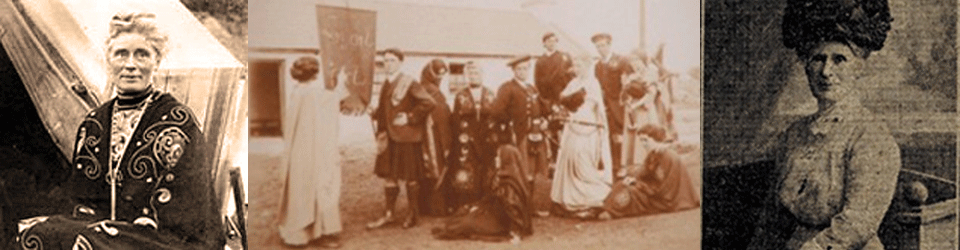
The first time St. Patrick’s Day was introduced as a national holiday was in 1903. When Emily arrived back in Ireland in 1906, the holiday was in its infancy. There were no parades as such, pubs were closed as it was a holy day, and people celebrated mostly by attending church. But in Achill that was not the case. It might have been a sober day but it did not prevent the festival atmosphere. An article that appeared in the Mayo News on March 30th 1907:

La Fheile Padraig in Dooagh!
Concert and Play a Magnificent Success!
St. Patrick’s Day was fittingly celebrated in Dooagh. In the early morning a large procession headed by the village band and waving some beautiful banners marched to the chapel playing national airs all along the route. Mass was celebrated by Rev. D. Greeney CC, who preached an eloquent sermon on the life and mission of our National apostle. The Acts as well as the Rosary were recited in Irish. In the evening the venue was Dooagh National school where an Irish Ireland concert and play was met with almost unbounded success notwithstanding the inclemency of the weather.!

The unprecedented success of the entertainment was chiefly if not wholly, due to the energy activity and perseverance of Mrs. Weddall, Miss McWilliams, Miss Grey, Miss McCabe, the Misses Callaghans and a host of other ladies, upon who it reflected great credit. To them and to their lieutenant all the Irish Irelanders of the parish extended the most heartfelt thanks and trust their net endeavor in that direction will be more successful still. The committee in charge of the arrangements are deeply indebted to Mr McGreevey, Balla and Mr Fitzhenry, League organiser for their kindness in lending scenery and other decorations.!

The success of St. Patrick’s day led on to other Irish cultural festivals on the Island, especially “Under the auspices of the Gaelic League”. Emily and/or other members of the local branch of the League did the fundraising and organised them at various locations and times of the year. It was also the early days of tourism and such events attracted the people who attended cultural events.

A Gaelic League event advertised in the Cliadheamh Soulis in 1907

A Gaelic League event advertised in the Cliadheamh Soulis in 1907

Sources
Mayo News, March 30 1907. Page 4
http://www.nli.ie/1916/pdf/3.4.2.pdf
http://www.irishcentral.com/roots/history/All-the-pubs-in-Ireland-used-to-be-closed-on-St-Patricks-Day.html
Cliadheamh Soulis 7 June 1907. P 7


Achill; the Early Years

Rockfield House, Keel, where Emily set up home with her husband

Rockfield House, Keel, where Emily set up home with her husband

Emily Weddall moved to Achill Island  in 1906 with her husband retired sea captain, Edward Weddall, whose compromised health, due to a tropical disease benefited from the fresh sea air.  Emily acquired Rockfield house, which once was a mission school in the 1840’s/50’s through connections established by her late father William John Burke who spent some time on Achill in the 1840’s.

Emily who was concerned mostly with the care of her husband, made time to indulge her passion and love of the Irish language and culture. A woman of means she had the resources and the drive to get involved in the beginning of the cultural revival on Achill. She naturally gravitated towards people who shared her interest and they to her. She joined forces with the local Parish Priest, Fr J Connolly and Seaghan Mac Enrigh, who had previously campaigned for the reintroduction of Irish in the schools and classes for children and adults alike.

Emily was already a member of the Gaelic League, which she joined when she returned to Ireland in 1906. and teamed up with Fr Connolly to form a local branch Grainne Mhoal (named after the pirate queen Grace O’Malley) in 1907/08. Over the next few years the people that would be pivotal to the revival would converge to make Achill, making it a hub for the Irish language and cultural revival.

The magazine produced by the Gaelic League, which Emily was a frequent correspondent

The magazine produced by the Gaelic League, to which Emily was a frequent correspondent


The Second Mrs Burke

No 40/41 Leinster Road, Rathmines, where Emily McArthur lived before she married,

The house on Leinster Road, Rathmines, where Emily McArthur lived before she married.

Emily McArthur became the second Mrs William John Burke on October 2nd 1861. The couple married in  St. Peter’s Church, Dublin, by witnessed by Henry Ashe and John Galbraith. The  marriage was solemnized by Rev Burke’s old friend Rev Hyacinth D’Arcy.

All that remains of St. Peter's Church, Dublin.

All that remains of St. Peter’s Church, Dublin. (Photo by Ciarán Parkes

Emily McArthur was living at an address on Leinster Road, Rathmines, possibly the one that the family lived in before her father’s death in 1829. Her new husband Rev Burke stayed in a rectory on Harrington Street, though it stated on their marriage certificate that his home address was still in his native Galway. It appeared that Rev Burke and his new wife did not return there but stayed on in Dublin, where their first child was born a year later.

The house on Harrington Road, where Rev Burke stayed before her married Emily's mother

The house on Harrington Road, where Rev Burke stayed before her married Emily’s mother

Rev Burke’s previous life in the West of Ireland was far from ideal. He had a long and controversial history there, and perhaps did not want to subject his new wife to it. Shortly after their marriage and birth of their child the couple moved on to Edenderry, Co. Offaly, where they had a better chance of living a peaceful existence. Their tranquility was lived, as it did not take long for the Rev Burke’s past to catch up with him…

 Thanks
Thanks to Ciarán Parkes for photo of stained glass window from St. Peter’s Church Aungier Street, Dublin.
Sources
http://churchrecords.irishgenealogy.ie/churchrecords/details/991b890574938

Nuptials

Emily McArthur was a wealthy woman when she became her mother and brother’s sole beneficiary in 1859. With no immediate family left she was very much alone? In Victorian times was not usual then for women to own property or make their own financial decisions. Ironically this rule can be disproved by both her mother and grandmother. They were in the slightly better position of knowing their late husbands trade well enough to continue in their footsteps. When Emily lost her family, they had long left the printing business and lived off a trust fund.

Emily may have been content to her life out independently in a comfortable position but, given the times  it may have been difficult socially. In 1862 at the age of 35 she walked up the isle with the widowed Rev William John Burke, twenty two years her senior. The marriage was the result of a match.

image: psi@nationalarchives.gsi.gov.uk

With her fortune alone Emily McArthur would have been a good catch for anyone. For Rev William John Burke, she would have been heaven sent. Rev Burke, who was widowed with a growing son and was bankrupt.

Emily’s trustees, Charles Knox, Rev McIntire and Michael Kennedy saw to it that Emily’s interests were safeguarded,  and a marriage settlement was drawn up to insure that she did not loose her fortune to a man in a dire financial state. Her trustees need not have worried, as Rev Burke and Emily McArthur’s marriage lasted for over twenty years until they died, within a few months of one another.

 Sources

D366/822 psi@nationalarchives.gsi.gov.uk

Emily Alone

Emily McArthur lived alone in quite a sizable house in Clonskeagh Dublin, when she lost her mother and only brother in quick succession. She inherited both their estates which amounted to substantial fortune  of £1,500, (1859) or just short of €250,000 in today’s currency. She also inherited her brother’s house in Canada. This sudden acquisition of wealth was probably a cold comfort for Emily, now alone without any immediate family.

College Green, where Emily McArthur's father Richard had a bookshop

College Green, where Emily McArthur’s father Richard had a bookshop

She had at least two aunts living in Dublin, at the time, Charlotte who, like her mother married  a bookseller, Joshua Porter. Her other aunt Abigale was married to the Rev Henry Revell, and lived Dublin county.

It was perhaps Rev Revell that introduced Emily to her future Husband Rev William John Burke.

Sources

https://familysearch.org

http://www.willcalendars.nationalarchives.ie/