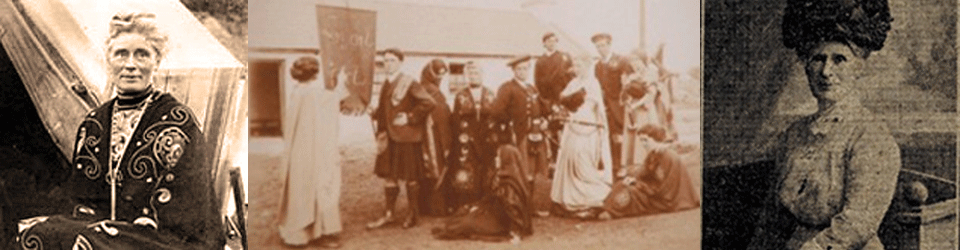
As the National Army was the official army sanctioned by the Irish government, it was provided with superior weapons. They were also provided for by the state. The IRA was outlawed and relied on Cumann na mBan (including Emily) and the few remaining sympathetic members of the public to provide food and shelter for them. Many gave up and went home; the remainder took to the safer haven of the hills, where they were less likely to run into the well-armed National Army.
In September 1922, the government passed the Public Safety Bill, emergency legislation permitting the National Army the authority to issue punishment, which included the death penalty for anyone found with weapons on their person. Because of this, as well as a lack of weapons, the anti-Treatites (IRA) resorted to guerrilla tactics such as sabotage and destruction of public infrastructure such as roads and railways.
“Back to Blighty,” stated one headline in the Freeman’s Journal of December 23, 1922. The action that got under way on December 14 marked the beginning of the end of the British military forces’ evacuation of the Irish Free State.
“The first sign of the change from the old order to the new was the taking over of the sentry duty at the gate. Green-clad and khaki-clad the new sentry and the old stood side by side. a sharp word of command- “Sentries Pass” – and the first Irish soldier to mount gaurd at the headquarters stepped smartly to his post. Old sentry—dismiss.” and the British soldier marched away to join his waiting comrades, proud of the honour, no doubt. of being the last British soldier to pace the sentry’s beat at British headquarters.”
The Irish Civil War cast a shadow over Christmas in 1922. The mood was gloomy, much as it had been throughout the war, and violence hung over everything. However, there were occasional sanctuaries of calm, like the crib in Inchicore.
On this day 100 years ago, Erskine Childers faced the firing squad. Like Emily Childers was vehemently opposed to the Anglo-Irish Treaty and was quite vocal about it. In a dawn raid at his cousin Robert Barton’s home in County Wicklow by the National troops, a revolver was found. He and another man, David Robinson, were duly arrested.
Wicklow Gaol
Born in London in 1870, Erskine Childers was the second of five children. His father was Robert Childers, and his mother was Anna Childers (née Barton). Robert Childers (1838–1866), who was appointed to the Ceylon Civil Service in 1860, became the private secretary to Governor Sir Charles McCarthy. In his time there, he studied Sinhala (and possibly Pali) and became a student of Buddhism. After returning to the UK, he kept up his studies and, in 1872, published the first volume of the Pali dictionary. Unfortunately, his life was cut short when he died at the age of 38, leaving behind a young family. After his death his family moved to Co. Wicklow the ancestral home of his mother.
Mount Lavinia Hotel, formerly the Governor’s Palace, Sri Lanka
Young Erskine received a good education, taking classics and law at Trinity College and then Cambridge, where he studied law in which he came out with a first in the subject in June 1893. He also showed great literary promise and was editor of Cambridge Review. Childers took the civil service entrance exams and excelled, earning the position of joint assistant clerk at the House of Commons. When the Boer War broke out in 1898, he enlisted and volunteered as an artillery driver.
After he returned, his novel, Riddle of the Sands, was published. The novel, which he began in 1901, was loosely based on his own experiences. The book, often cited as one of the great works of espionage, is about the main character, who is invited by his friend to go on a yachting expedition, and their subsequent adventures. Childers, a keen sailor, was one of the crew of the Asgard. In May of that year, he traveled to Hamburg with Darrell Figgis to broker an arms deal there. They successfully sourced 1,500 Mauser Model 1871 rifles with 49,000 rounds of ammunition at a good price. In August, Childers and his wife, Molly Spring Rice, along with Gordon Shephard and two fishermen from Donegal, arrived at Howth with an arsenal of weapons.
Childers returned to London, where he served in the Royal Naval Volunteers for most of the Great War. In 1917, he was assigned as assistant secretary to the Irish convention, where he began to gravitate toward the Irish cause. In 1919, he relocated to Dublin and was elected to the Dáil in 1921. The same year, he was appointed Minister for Propaganda as well as Secretary to the Irish contingent of the treaty negotiating team. Childers, like Emily, was vehemently anti-Treaty and was quite vocal about it too. He was not fully trusted by either side and was suspected by the British and Irish provisional governments alike; it was only a matter of time until he was captured in November 1922. He was sentenced to death and executed at Beggars Bush Barracks. A true gentleman to the end, it was said that he shook hands with each member of the firing squad before he faced his death.
Thirty years later to the exact day Emily died in St. Mary’s Nursing Home. She too was buried near the Republician plot in Glasnevin Cemetery.
WHAT IS A CONSTITUTION? During the early days of the second French Republic a customer entered a bookseller’s and asked: “Have you a copy of the French Constitution?” “We do not,” the bookseller politely replied, “deal in periodical literature.”
THE IRISH CONSTITUTION EXPLAINED BY DARRELL FIGGIS
In March 1922, Michael Collins charged Darrell Figgis with writing the Constitution of the Free State. Although Collins never fully trusted him, he did recognize Figgis’ superior writing skills, appointing him vice-chairman of the committee assembled to draft the constitution. Figgis inadvertently ended up chairing many of the meetings as Michael Collins, occupied with other business, missed many of them. Figgis proved to be very effective at the helm, completing the constitution in a record quick time in September 1922. The sad irony was that Michael Collins did not live to see the work completed. He had died the previous month.
Darrell Figgis published, the Irish Constitution Explained, later in 1922 to Arthur Griffith, who died a week before Michael Collins.