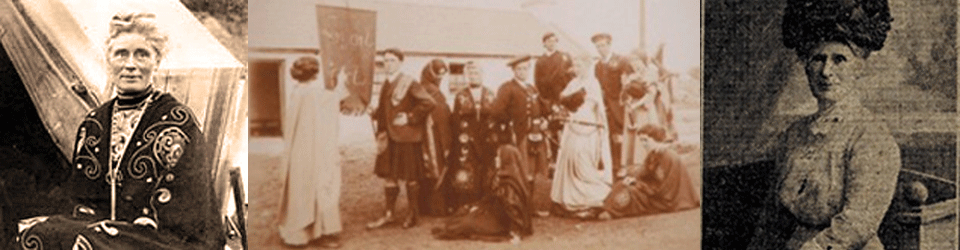
As did Emily’s fortunes rise and fall during her life, so did her ancestors. In fact is was a way of life for them most of the time. Sometimes they were rich and other times they were plunged into financial ruin.
When Emily’s grandfather Richard M’Arthur died in 1829 leaving a wife and two small children under three, at least they were left as “fund holders”, as documented in a later census. However, as few years later Mary M’Arthur was back at ‘work’ in the old family business of selling books and stationary. Mary may not have had the same business sense as her mother, the resourceful Ruth Graisberry, who ran the family print business, for twenty years after her husband died.
In March 1854, the notice below appeared in Halifax Courier:
Halifax Courier 18 March 1854
It appeared that Mary M’Arthur was bankrupt. Somehow she paid her creditors. She did not live long enough to regain her ‘fortune’. She died exactly one year later.
Sources
https://www.findmypast.ie/transcript?id=GBC/1851/0013988887;1851 England, Wales & Scotland Census
Northumberland, Durham & Yorkshire, Slater’s Royal National Commercial Directory, Vol 1, 1854-1855
Halifax Courier 18 March 1854
28 July 1855 – Worcester Journal – Worcester, Worcestershire, England
Emily’s half brother, Dr. William Burke, was a member of the fraternity, the Odd Fellows. When he attended the Loyal Midland Lodge’s anniversary in 1883 he was admitted as an honorary member. He cited the same in the medical directories, perhaps to add prestige to his profile.
The Odd Fellows are, like the Freemasons and Foresters a friendly society that permits only male membership. When Emily’s brother was accepted into the fraternity in 1883, many of the medical profession were members. Reflected in the medical journals at the time, articles with titles such as “Friendly Societies And TheMedical Profession. Statements Of The Friendly Societies, And The Facts As Ascertained”. There was also a air of distrust around such societies due to their secretive nature.
Provoked by the French Revolution, societies such as the Odd Fellows were classed as illegal. Informers sent in by the government were paid to infiltrate Lodges (branches). Secret signs and passwords were introduced to sort the real brothers from the imposters, as a matter of security. This tradition, which origin is not widely known is still used today, more as a tradition than necessity.
Late 18th century Government suspicions of societies that ‘administer oaths and correspond by signs and passwords’ reached fever pitch, triggered by the French Revolution. So much so, organisations such as ours were deemed illegal and driven underground – exacerbating connotations of ‘secret societies’.
https://www.oddfellows.co.uk/about/history/
Image courtesy of Library and Museum Charitable Trust of the United Grand Lodge of England
How the Odd Fellows Became the Odd Fellows
There are several different reasons given for our strange name. One old and apparently authoritative history of Odd Fellowship gives the explanation, “That common laboring men should associate themselves together and form a fraternity for social unity and fellowship and for mutual help was such a marked violation of the trends of the times (England in the 1700’s) that they became known as ‘peculiar’ or ‘odd,’ and hence they were derided as ‘Odd Fellows.’ Because of the appropriateness of the name, those engaged in forming these unions accepted it. When legally incorporated the title ‘Odd Fellows’ was adopted.”
“Friendly Societies And The Medical Profession. Statements Of The Friendly Societies, And The Facts As Ascertained.” The British Medical Journal, vol. 1, no. 1956, 1898, pp. 1661–1662. JSTOR, www.jstor.org/stable/20255058.
When Emily’s maternal grandfather, Richard M’Arthur entered partnership with Robert Hodges, the establishment was five decades in existence. It was then Gilbert and Hodges.
The Long Room in the Library at Trinity College
In its first incarnation the business, the bookshop opened for business in 1768, on Skinner’s Row. The original proprietor was John Milliken. It appears that the shop remained in his family for at least one more generation. Over the years the shop changed locations, and merged with other bookshops owners forming partnerships.
One time partner was William Gilbert who founded a bookshop on South Great George’s Street in 1776. In 1802 he teamed up with Robert Hodges, and opened a store on Dame Street. In 1817, Gilbert retired, he was well over 80 years.
It was then that Hodges teamed up with Emily’s grandfather Richard M’Arthur. The shop relocated the short distance to 21 College Green, adjacent to Trinity College. The duo did a good trade with the college, selling academic books to students of medicine, science and law. But students were not the only customers. Many private collectors did business with the shop, too. One such person was Lord Bellew, of Mountbellew, County Galway. Richard M’Arthur sources books for the Lord from London and Paris. Their relationship ending when the lord died in 1827.
Letter from Richard McArthur to Lord Mountbellew about a book buying trip to London and Paris. Courtesy of National Library of Ireland.
It was the same year, 1827 that Richard M’Arthur left the partnership, returning to Co. Down with his family, he returned briefly to Rathmines in Dublin, in the hopes that his failing health might improve, but that was not meant to be. He died in 1829.
The gap he left was was filled by Smith. The Hodges and Smith partnership, presumably later generations, lasted until 1877, when it became Hodges, Foster and Figgis, in 1884, Foster left and the shop, which was by then on Grafton Street became as it is known today – Hodges and Figgis.
Based on Irish Times article of 19 December 1961 for An Irishman’s Diary (Quidnunc)
Sources
Irish Times 19 December 1961
A Dictionary of Members of the Dublin Book Trade 1550-1800; Mary Pollard, Guild of St. Luke the Evangelist (Dublin, Ireland), Bibliographical Society (Great Britain)
Hodges and McArthur (booksellers), and Christopher Dillon Bellew. Receipts Etc From Hodges and McArthur, Booksellers of Dublin to Christopher Dillon Bellew.
In April 1829 Emily’s grandfather traveled with his wife and young family traveled from Co. down to Dublin in hopes that relocating to Rathmines would cure his illness. But that was not to be. It is lost in time what his ailment was. Perhaps his hopes lay in the fact that the best doctors In Ireland were in Dublin.
He was a bookseller by trade and one half or the Hodges and M’Arthur partnership, whose shop on College Green opened its doors to the Physicians of the day to hold meetings before the Royal College of Physicians in 1865. He and his partner allowed them to hold meetings in a tiny “reading room” over their shop. Perhaps they wanted to return the favor and treat him with the most up to date medicine for his ailment.
Hodges And M’Arthur 1818 Merchants And Traders Dublin The Treble Almanac 1818
Richard M’Arthur did not get better. He lost his battle with disease in April 1829.
Death Notice of Richard M’ArthurThe Will of Richard M’Arthur
Sources
Hodges And McArthur 1818 Merchants And Traders Dublin The Treble Almanac 1818
19 December 1866 – Dublin Medical Press – Dublin, Dublin, Republic of Ireland
Sligo Journal 03 April 1829
Prerogative and diocesan copies of some wills and indexes to others, 1596 – 1858
One hundred and ten year ago John Millington Synge died. He was only a week or so shy of his thirty eight birthday. Having only enjoyed a short period of fame, little more than half a decade, illness and eventual death cutting it short.
BIOGRAPHICALLY the most remarkable feature of Synge’s career was its brevity. In the six years which elapsed between 1903, when In the Shadow of the Glen was produced, to 1909, when he died, he rose from absolute obscurity to world fame, and provided us with six plays on which his reputation must rest” Read more:
Originally published in Minute History of the Drama. Alice B. Fort & Herbert S. Kates. New York: Grosset & Dunlap, 1935. p. 118
Emily and Synge were friends from Gaelic League and literary circles but may have known one another from their earlier years. Both came from clerical families and were similar ages, she slightly older. There is a possibility that they met in their youth. Emily’s father and Synge’s uncle were both evangelical missionaries in the 1850’s. Synge’s uncle went to the Aran Islands, with the view to converting, the islanders, Emily’s father, Mayo and Connemara. Both men were run out of town. There was a good chance they were close enough friends as Emily was one of a relatively small group that attended his funeral, traveling cross country all the way from Achill to Dublin.