Category Archives: Friends

Emily and the Countess; Part 2

A week or so after the event, Emily went to England to marry Captain Weddall in London. One year later she was living on Achill. She quickly joined the local Gaelic League and became part of the fabric of the Island. Two years later her husband died, leaving her alone in the world but independently wealthy.

As she had no children or had to work for her living, Emily used her time and resources to augment the Gaelic League on Achill.  Her enthusiasm and generosity made her popular with the locals and new arrivals to the island, who were more than happy to help with her ventures. By 1910 the idea for an Irish language and culture summer school was realised and by the following year it was a reality.

Countess Markieviez had also returned to Island as a married woman and set up home in Dublin. She also became involved Gaelic revival. She was in good company as her childhood friend, W. B. Yates was already established in Dublin and had just set up the Abbey Theatre  with Lady Gregory, where she acted. Both she and her husband were artists exhibiting frequently. One such exhibition in 1913 was attended by Emily, their paths crossing again. In the same year the Countess lent support financially and physically to the families of the workers during the lockout.

“Madame Markievicz in a big overall, with sleeves rolled up, presiding over a cauldron of stew, surrounded by a crowd of gaunt women and children carrying bowls and cans”.

Over the winter of 1912/13 Emily was involved in another socially unjust situation- the Land Wars. Emily along with her friend, Anita McMahon sat through the court case that finally ended in victory for the tenants. Read more: https://www.duchas.ie/en/cbes/4497767/4344557/4497807?ChapterID=4497767

the-aristocrat-who-became-an-irish-revo
Connaught Telegraph 1830-current, 19.05.1956, page 4https://www.abbeytheatre.ie/about/history/
https://www.irishtimes.com/culture/heritage/striking-bravery-1.1522156
The Schools’ Collection, Volume 0086, Page 318 Tonatanvally, Co. Mayo
The Mayo News, April 12 1913
Illustrated Sporting and Dramatic News 15 April 1916

Emily and the Countess; Part 1

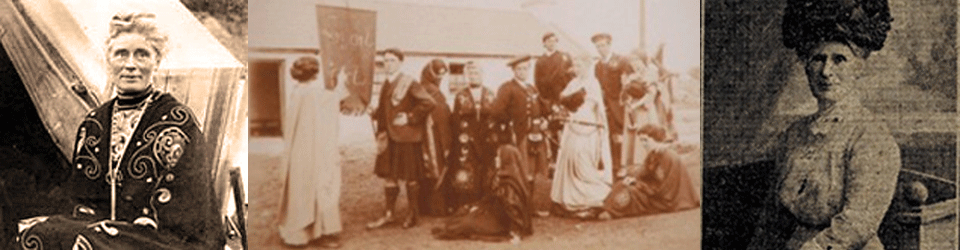
Emily Weddall and Constance Markieviez were born six months apart. Emily in September 1867 and Constance the following February. In early life their paths were unlikely to cross, as one was born into the aristocracy the other a clergyman’s daughter. One lead a comfortable existence in a grand house in Co. Sligo the other moved around frequently depending on the fortunes of her father. Constance Gore Booth was presented at court, Emily trained as a nurse.

Emily went on to enjoy an adventurous life when she qualified as a nurse, traveling to France, Germany and on to Russia. It was in the latter that she developed a strong social conscience, when she witness a group of prisoners, shackled together one night as they were being transported to Siberia, for minor crimes. Constance Gore Booth had that innately, taking side with the tenants on her father’s estate and organising sufferage meetings with her sister at Lissadell when she was quite young. Read more: https://www.irishtimes.com/culture/heritage/the-aristocrat-who-became-an-irish-revolutionary-1.3451474

After coming out the Countess traveled to Paris to study art. Emily found herself in France too, possibly employed as a nurse, but it was a lucky trip for her as she first met the man who would become her husband. Incidentally, Constance Gore Booth met hers in France too. Emily married a retired sea captain Constance a count.

Their paths may have crossed earlier but in 1905 they were documented at the Seachtaine na Ghaelige parade in March 1905, part of the same Gaelic League branch, Craogh na Gluig Gluigi.

https://www.irishtimes.com/culture/heritage/the-aristocrat-who-became-an-irish-revo

The Rosary in Irish.

Sources
Ní Dheirg, Íosold. Emily M. Weddall: Bunaitheoir Scoil Acla. Baile Atha Cliath: Coisceim, 1995
23 July 1927 – Ballymena Weekly Telegraph – Ballymena, Antrim, Northern Ireland
Irish Independent 13 March 1905
https://www.irishtimes.com/culture/heritage/the-aristocrat-who-became-an-irish-revolutionary-1.3451474

Countess Markievicz

Countess

On this day in 1927 Countess Markievicz died. She breathed her last in a public ward in Sir Patrick Dunn’s Hospital, Dublin, not the usual setting for a Countess. She had reneged upon a pampered life for a one of service to the poor of her country and then on to fight for that same country.

To read more about her remarkable life:

Countess Markievicz

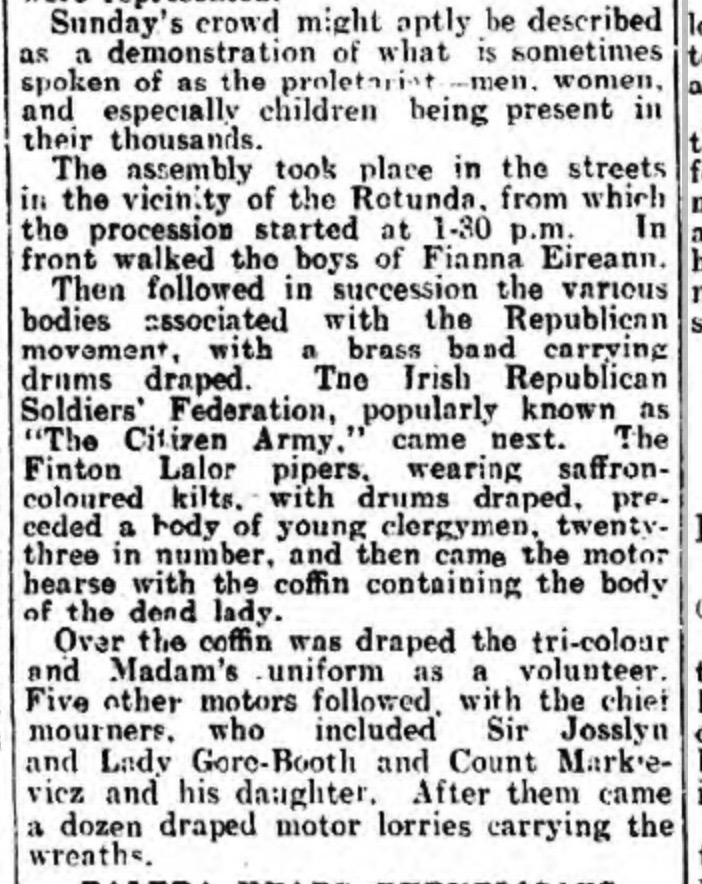
Her funeral attended by thousands, was held over three days. Her body lay in repose at the Rotunda, on Parnell Square. From there crowded lined to route to Glasnevin Cemetery, to be interned alongside her friends and fellow Republicans, who had gone before her.  

It is impossible to say if Emily Weddall attended the funeral, chances were she was there in the crowd or marching with fellow members of Cumman Na mBan.

The funeral procession took place on Sunday but the burial was not until the following day, Monday as the gravediggers union forbade them to work on Sunday. The Countess’ coffin was held in a vault in the O’Connell Circle, where the founder of the cemetery, and Irish Liberator was originally buried (he was reinterred in a crypt beneath the Irish round tower) in 1869. If she were alive she may have been pleased as;

“DANIEL O’CONNELL (1775-1847) –Daniel O’Connell was a politician, Lord Mayor and human rights activist. He achieved Catholic emancipation and fought for the repeal of the Act of Union between Great Britain and Ireland.” (Glasnevin Trust)

Last Post.

The Countess was buried with almost full military honors, the only exclusion was the firing of shots over her grave. At the time such was band by the state, but she did get the all other honors due to her. As a personal touch her uniform, worn during the Rising of 1916 was buried with her.

Over the years she was joined by her friends and fellow Republicans, one by one until that generation came to an end. Emily rests nearby next to Cathal Bruagh and across from Maude Gonne. The Republican Plot is part of the Glasnevin tours, and the graveyard is one of the top Dublin tourist attractions and well worth a visit: https://www.glasnevinmuseum.ie/daily_tours/

Filmed and edited by Marcus Howard. On the 90th anniversary of Countess Constance Markievicz’s death, The 1916 Relatives Association held a special commemorative event in Glasnevin Cemetery. To watch the video;

https://youtu.be/TnaY5mT-SGI

Sources
23 July 1927 – Ballymena Weekly Telegraph – Ballymena, Antrim, Northern Ireland
http://lissadellhouse.com/countess-markievicz/
02 October 1917 – Daily Mirror – London, London, England
https://www.youtube.com/channel/UClH7iRo8l6OmCYSZBzwrVbw
https://www.glasnevintrust.ie/visit-glasnevin/interactive-map/daniel-oconnell/

Captain Weddall’s Bicycle: part 3

Chain smoking the night away Sean O’Longain could not rest that night. When he eventually fell asleep his dreams were haunted by sea captains and bicycles. About 7.30 the following morning he was woken from his restless slumber by a rap on the door. Thinking that somehow the captain had found out about the mangled bicycle and had come to reprimand the hapless school teacher about it.

It was not the enraged captain Weddal, it was his landlady. What she had to tell him was the last thing he expected.

“Shaun, Shaun,” said my landlady (in an unusual tone of voice), “are you awake?” said she,

“Indeed I am mam,” said I, in  a voice that was not very normal either.

“Isn’t it awful! Isn’t it awful!” said she.

“What’s wrong mam, what’s wrong?” asked I.

“Ochon ochon go deo, poor Captain Weddall was found dead in bed this morning.”

The young teacher could not believe the timing of Captain Weddall’s death.

“Neighbours passing were bewailing the captain’s sudden demise. I joined in their lamentations as best I could under the circumstances. “May God be good to him.” Says I “the poor poor captain was a kind old neigbour.”

“Isn’t he as well off” says old Mrs. O’Toole, “his troubles are over.”

“True for ye,” says I -“and the troubles of other people too.”

Just as he was breathing a sigh of relief, his landlady back back from visiting the new widow, advised that he should go to see Mrs. Weddall, as she would like to see him. He did reluctantly.

“I did so and offered my sincere sympathy to Mrs. Weddall, after which she invited me into the room to see the captain laid out. That was my hardest ordeal. Even though I knew him to be dead I still had a sort of feeling that he might make some move at my presence. I gave the corpse a side glance, made some excuse and took my leave from the room as soon as the opportunity offered. “Guilty conscience makes cowards of us.””

Emily being Emily, a generous soul told the young teacher and Gaelic Leaguer, that he could keep the bike. I would have been more use to him as he needed one to travel around the island. He thanked her accordingly. He had it repaired and kept if for a long time. No doubt he treasured the bike that in its way was hard bought. Emily as well as her husband went to their graves without knowing of the accident. If they did know they probably would have laughed.

Sources
Connaught Telegraph 1830-current, 19.05.1956, page 4

Captain Weddall’s Bicycle: part 2

Off went Sean O’Longain down the road, with Captain Weddall looking after him, as if making sure that he was fit to cycle such fine bike. The wind was in his favour, blowing him all the way to Achill Sound, 10 Km away to catch the train, except when he got there the train had already gone.

Fazed less than he should have been, perhaps because of the captain’s shiny bicycle, at the prospect of cycling the 40 or so kilometres to Westport, where he reached before nightfall. He was greeted by his friend who told him that he was invited to give a talk at a branch of the Gaelic League at Irishtown, a further 50 km from Westport. They left the next morning arriving in time for the Gaelic League concert, which lasted into the early hours. Sean O’Longain bit farewell to his friends and set off the long and arduous journey home.

He had the company of one of his friends to Westport, which he welcomed as the night was dark and misty. All went well until a turn in the road where the two bicycles collided and the young teacher hit the stone wall. Luckily he was not injured but the captain’s bike was buckled and a peddle missing.

What a sudden change of scene and mind came upon me would be better imagined than described, I thought of the beautiful silvery, neat and glittering bike which I got from the Russian [he was English] captain two days previous and the strict obligations and conditions which he imposed upon me regarding its care and use. What a contrast! It was a different article, bent, broken and covered by the slush of the road.

He didn’t know what he was going to tell the captain. He and his companion managed to transport the wreck of a bike between somehow dragging and pulling the it along the road until they reached the train station at Claremorris. At Westport he bid farewell to his friend and made the rest of the journey to Achill alone with his thoughts. When he reached Achill Sound the last stop on the line:

On arriving at Achill Sound I took the disabled bike off the train and waited in the little village until nightfall, as I didn’t wish that anybody would notice the state of my machine. I had over ten miles to wald to my destination. I trudged along in downcast depression that weary journey, deeply absorbed in gloomy thoughts of foreboding trouble.

When he eventually arrived at his lodgings well after midnight, he slowly slunk into bed. He fell into a dreamless sleep meditating on how he would face the formidable captain having to explain the bike wreckage the next day…

Sources
Connaught Telegraph 1830-current, 19.05.1956, page 4