Paul Henry lived on Achill from 1910 to 1919. He had intended only to stay as long as his return ticket permitted but:
“The currents of life had carried me to this remote spot, and there seemed no current strong enough to carry me away…I made another of my quick decisions, which I never regretted and taking my return ticket to London out of my pocket tore it into small pieces and scattered the fragments into the sea which foamed round the rocks of Gubalennaun.”
The West of Ireland, Achill and Connemara inspired him like no other place and became subject of a great body of his work, perhaps his most most iconic paintings are of both places. Below is curious article from 1921, in which he exhibited with a youngish Picasso.
In June 1919, writer, Darrell Figgis as editor began a new newspaper called ‘The Republic’, for an independent Ireland that was yet to emerge.
The publication had a short lifespan. It appeared to end a year into independence the paper’s print run came to an end. On October 7th 1922 copies of the publication were “seized and destroyed”. The reason given, that in a recent issue Civic Guard, Sergeant Fox, who was at the time subject to an inquest was slandered by the paper. Darrell Figgis, on the side of the ordinary man put it to the head of Government if it was their intention to compensate the newspaper vendors and paperboys. No reply was reported.
In 1919, one hundred years ago, the artist, Paul Henry left Achill for pastures new, after making the Island his home for near a decade. He had intended to stay for a short time only but could not drag himself away, being captivated by the island’s otherworldly beauty. In his own words:
“The currents of life had carried me to this remote spot, and there seemed no current strong enough to carry me away…I made another of my quick decisions, which I never regretted and taking my return ticket to London out of my pocket tore it into small pieces and scattered the fragments into the sea which foamed round the rocks of Gubalennaun.”
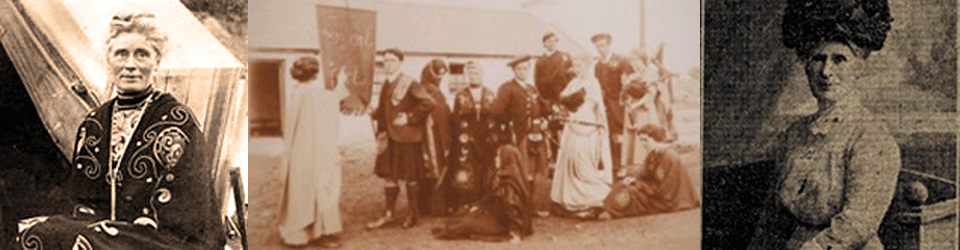
He and his wife, Grace, also a painter, settled into the island life helped by Emily, who Henry, described as, “a woman who bubbled over with enthusiasm”. She was was the person who introduced him to the locals as he recalled many years later;
“I had made the acquaintance of Mrs. Weddall, the widow of a sea captain. She introduced me to the people and initiated me into many of the ways peculiar to the island”
As a token of his appreciation, he gave her some of his artwork, one was a painting called “Twilight Houses”. Emily being Emily gave more than she took and lent the painting to Darrell Figgis. Inscribed on the reverse: “Lent to D. Figgis by E. M. Weddall 15 . (?) 4 . 1918”. Knowing Emily she may never have reclaimed the picture. Many years later the painting resurfaced from the hidden world of private collections, when it went up for auction by Whites of Dublin in 2006.
In the following years Paul Henry, got reabsorbed into city life , and was involved in the founding of the Society of Dublin Painters. He did return to Achill towards the end of his life, perhaps retracing his owns steps, before he penned his autobiography, An Irish Portrait. By then many of his friends there, including Emily were no more.
Claud Chevasse first came under the radar as a person of interest to the authorities, after being arrested in Cork for refusing to speak English to the arresting policeman. He was summoned to court andwas fined £5 or spend a month in Jail. Claud Chevasse would not pay the fine on principle, citing that Ballingeary was in an Irish speaking area and the sergeant could have easily have found a translator.
Like Emily and Darrell Figgis he became a person of interest to the authorities, perhaps attracting their attention after the above incident. He was arrested during the Rising and taken to Richmond Barracks, but was released a few days later as there was no substantial against him. But as a ‘rebel’ he felt that he and his fellow prisoners should have had a fair trial, but it was denied due to the chaos after the insurrection.
To make things worse his bicycle, his main method of transport was ‘mislaid’ along with it his broach, possibly the one in the picture below that he wore with pride on his brat (sash). It was a gift from Scoil Acla.
Claud Chevasse
Sources:
Freeman’s Journal 04 April 1916Weekly Freeman’s Journal 13 June 1914
26 February 1916 – Wigan Observer and District Advertiser – Wigan, Lancashire, https://search.findmypast.ie/record?id=ire%2fpettys%2f005174188%2f00427&