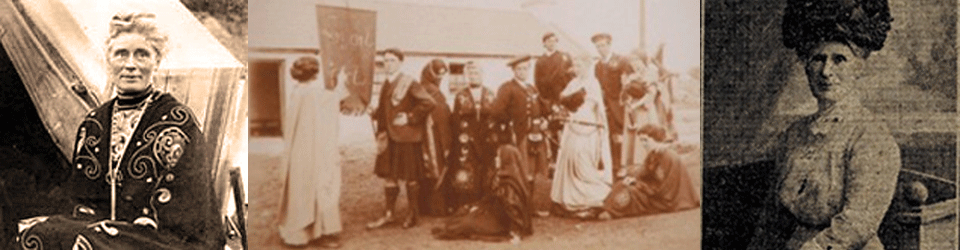
Category Archives: History

Homeless

In 1870 Emily’s family left their house in Edenderry, to move in to the tiny vestry ’10f 6 inches long by 9 feet broad’ in Castlejordan Church, where her father was incumbent. Why is not stated in the letter, but chances are the family had leave town quickly, as they did before fleeing from persecution for changing religion. A fund had been set up by the outraged well wishers of Rev. Burke and his family.

The letter below to the Waterford Standard of October 15th 1870 by someone who singed off as GD tells of their plight.

If Rev. Burke had his enemies he had well wishers too. One sent a total of £10, which was quite a sum in the 1870’s. From another source, possibly the more wealthy Thomas Scott, who appears to have been a councilor sent almost £50 with a promise of £50 more at a later date, which will go quite far towards the fund for a parsonage. The poetically put accompanying letter supporting Rev. Burke and advising him to remain in “David’s Den of Lions” until” the porch of Solomon’s Temple”. Comforting advice!

It is not clear if the Burkes got to live in the proposed parsonage or indeed if one was built. The family moved to Dunloe Hill in Ballinasloe, Co. Galway soon afterwards, where Rev. and Mrs Burke ended their days.

The ruin of Castlejordan Church, where Emily ‘lived’ with her family during the winter of 1870/71

Sources
Waterford Standard 15 October 1870

Canada

Canada is currently celebrating it’s 150th anniversary in 2017. Coincidentally Emily Weddall was born 150 years ago too. Read more:

Emily’s ancestors, the Graisberrys, emigrated to Canada, where their descendants still live today.  One such relative was her uncle Richard Lyons McArthur. Born in 1826 he was her mother Emily’s only brother. Emily McArthur was born a year after, and appeared to be very close to her older brother, that may have come to pass because of the early loss of their father who died in 1829.

Both sibling lived together with their mother for most of their lives, the greater part in Dublin while Richard completed his education at Trinity College. He was ordained a Deacon in 1849 and a Priest a year later. His first parish it appears was in Copgrove, a small parish near Ripon in Yorkshire, where his mother and sister moved along with him. His mother Mary died in 1855 and sometime after that he emigrated to Canada to take up a position in the church at St. Catharines, Ontario, Canada. His sister Emily followed some time later and stayed on as his housekeeper. They bought a house on Duke St. St Catharines, but only lived there less than a year. Richard contracted Scarlett Fever and died within days. The grave of Rev. Richard Lyons McAthur

For the short time he spent in his Canadian parish Richard Lyons McArthur was well liked and sadly missed. His kindness was noted by the parishioners and his memory lasted for decades as expressed in his obituary from a unknown local paper:

“On Saturday morning last the Rev. Richard Lyons McArthur, Curate of the English Church in this town, aged 30 years.

The deceased had not been among us quite a year, and yet had made himself beloved and respected by all who were honored with his acquiescence. In addition to Mr. McArthur’s clerical duties he added many others calculated to to endear him to the inhabitants of this town – such for instance as visiting the poor and needy, the sick and infirm. To those who required help his hand was open in offering charity to those who required instruction, he was “apt to touch.”

We have suffered a loss not seen to be supplied in the death of this gentleman. Mr. McArthur was quite a young man but has been cut down by two days sickness. Scarlet fever took hold of him and not withstanding the able medical attendance of Dr. Mack, such was the virulence of the disease, that he lasted but from Tuesday till Saturday. The deceased was a young Englishman, who had chosen Canada as his home, and the sphere of his spiritual labours. He was rich, and had invested largely in our Provincial institutions. How mysterious appear the ways of Providence to us in the removal of much usefulness and the means and dispositions to do such good. The poor blessed him, the children loved him, and the close observer of, character respected him. Unobtrusive and deeply pious he “did good by stealth, and blushed to find it fame.” Mr. McArthur’s remains were followed to the grave by a large and respectable portion of our inhabitants.”

Emily must have been heartbroken and at a loss to what to do now that her only brother had passed and her service to him was over. She rented their house and returned home to Ireland.

With her own fund to live on and investments in Canada and a house there too she was for all intents and purposes an independent woman. It was still Victorian times and independence was not the order of the day for young ladies from Emily McArthur’s background. She may have enjoyed her freedom while it lasted but a few years later she was matched up with Rev. William John Burke, more than twenty years her senior. In October 1861 she became the second Mrs. Burke.


Sources
Dublin Evening Mail 28 December 1849

“A Plucky Hull Captain”

Edward Weddall was a true master of his trade. The master mariner, on at least two occasions saved his crew and ship from wreckage. Once in Captain Weddall saves the day and Lloyd’s some money – again.

The following article appeared in the – Hull Daily Mail on 21 November 1895;

A PLUCKY HULL CAPTAIN

“The Hull steamer Fairy, on a recent voyage from Konigsberg to London, had the misfortune to break her crank shaft. at the time of the accident she was 300 miles from Hull, to which port the master decided to take the steamer. Very stormy weather was experienced, the steamer having to ride at both anchors during the worst of the gale. The pluck and perseverance of the master, Captain Weddall, had its reward, the vessel reaching Hull in safety without any assistance and Lloyd’s underwriters in London have recognised these services by a handsome presentation to the master.”

Emily, who had not as yet met her future husband when the incident occurred. She would have been proud of Edward Weddall’s bravery and perseverance, traits she possessed herself.

Lloyd’s of London today

Sources
21 November 1895 – Hull Daily Mail – Hull, East Riding of Yorkshire, England

Saving the Cargo

“From those beginnings in a coffee house in 1688, Lloyd’s has been a pioneer in insurance and has grown over 325 years to become the world’s leading market for specialist insurance. On the following pages you can learn about Lloyd’s unique and colourful past, from its early days in Edward Lloyd’s coffee house, to the historical events that changed the face of Lloyd’s forever.” Lloyd’s of London

Lloyd’s of London today

Lloyd’s the insurance company originated in a 17th Century London coffee shop, run by Edward Lloyd trading where the merchant navy traded. The demand for insuring expensive cargo increasingly became a necessity. In Victorian times the business transporting goods around the world grew and practically every ship in the British Isles was insured with them. Edward Weddall as a captain in the merchant navy was covered by the company.

One incident in 1881 when he was at the hull of Cohanim, under his command spared the company a big insurance payout on the cargo worth 250,000 dollars (5.5 million in today’s currency). His quick thinking and ability to influence his crew to follow through to the bitter end paid off. The article taken from The Shipping News; “The crew repairing a broken crank shaft in the Atlantic.”

His crew worked for four days and nights to repair the crank shaft, which got broken in a storm, which they did against pretty much all odds. The brave bunch saved the cargo and were rewarded 200 dollars (almost 5,000 today) by the insurance company.

The Shipping News

THE CREW REPAIRING A BROKEN CRANK SHAFT IN THE ATLANTIC

We see it is stated in a New York contemporary that the New York Board of Trade of Underwriters have awarded the officers of the Cohanim 200 dollars in testimony of their courage and skill during a recent storm. Late in October last the screw-steamer Cohanim belonging to Newcastle, sailed from Gibraltar for New York with a cargo of dried fruits and almonds form the Mediterranean valued at about 250,000 dollars. When she was seven days at sea a severe hurricane broke the crank shaft and left her the mercy the waves about miles west of Madeira, the nearest port. Captain Weddall ordered the crew to set all sail and keep the vessel hauled to the wind. So furious was the tempest that the vessel must have foundered but for the captain’s skill in managing her. The engineers had no tools with which to repair the broken shaft, but the were ordered to get to and make them. by working hared a large drill was finished in a few hours, but it was found to be needless without a large brace and the only one on board was a small one, the sailors made a new socket for the brace. Then with the ship tossing about like a cork, the seamen began to bore a hole 3 1/2 in diameter through 28 inches of solid iron. For four days and nights they stuck to their task, each man working as long as he could, and then being relieved by another until the core of the shaft was neatly drilled out. then an iron stanchion was cut away from the hold and rude bolt was made out of it. The bolt was driven through the shaft and clenched on both ends, thus securing the fractured part sufficiently to carry the steamship to Madeira in six days by running slowly and keeping the ship under full canvas. from Madeira world of the accident was sent to England, and after a few days Captain Wendall received a new shaft from Hull. Then the vessel proceeded on her way to New York in safety. the owners of the cargo testified their admiration of the feat by making every man a handsome present.

Sources
https://www.lloyds.com/lloyds/about-us/history
26 January 1881 – Shields Daily Gazette – South Shields, Tyne and Wear, England
http://www.in2013dollars.com


Typhus

Typhus fever (Epidemic louse-borne typhus)

Cause

Rickettsia prowazekii.

Transmission

The disease is transmitted by the human body louse, which becomes infected by feeding on the blood of patients with acute typhus fever. Infected lice excrete rickettsia onto the skin while feeding on a second host, who becomes infected by rubbing louse faecal matter or crushed lice into the bite wound. There is no animal reservoir.

Nature of the disease

The onset is variable but often sudden, with headache, chills, high fever, prostration, coughing and severe muscular pain. After 5–6 days, a macular skin eruption (dark spots) develops first on the upper trunk and spreads to the rest of the body but usually not to the face, palms of the hands or soles of the feet. The case–fatality rate is up to 40% in the absence of specific treatment. Louse-borne typhus fever is the only rickettsial disease that can cause explosive epidemics. (World Health Organisation)

One hundred and four years ago there was an outbreak of typhus in Connemara. The poverty in the area at the time was rife, people were malnourished, making them more susceptible to disease. The occasion was reported on in several newspapers including the Irish Independent.

Mrs. Emily M. Weddall,Widow of the late Captain Weddall of Burnby,Yorkshire, and Rockfield House, Keel, Achill, who has hastened to Connemara to nurse the fever-stricken victims there. Founder of the Achill Irish Summer School, who is best known in Gaelic circles as Bean Ui Uadal, and it is for the sake of this last remnant of the Irish-speaking nation she is making such a heroic sacrifice.

The site where the fever hospital in Oughterard one stood

Emily however did not revel in the publicity generated by her kind gesture, but used it to highlight the poverty in that part of the county. She put pen to paper and composed the following letter to the Cliadheamh Soulis telling of the dire conditions in which the patients were living in, and the lack of basic facilities such as decent health care. She praised the Gaelic League for being the first to step up to help the poor of Connemara.

I came away last week to help look after the poor typhus patients here. I found all the typhus cases in Oughterard Fever Hospital, and only a few typhoid patients (who can’t be moved) in their own homes. I was going to write to you to ask you to insist on the establishment of a temporary hospital into which fresh cases (which are sure to occur) could be moved, but today the government representatives have at last arrived on the scene, Mr Birrrell, Sir Acheson McCullagh (Local Government Board), John Fitzgibbon, M.P., C.D.B., and Mr. O’Malley M.P. for the district. The doctor tells me that they have provided the hospital, and it is about time! The people have been treated worse than beasts should be treated, and they are almost all that remains to us of the unsullied ancient Irish race. I am glad the Gaelic League was first on the scene, but we ought to do something efficient to preserve these people and to enable them to find a livelihood in their own country…

Emily joined Rodger Casement, Augustine Birrell, Chief Secretary for Ireland and Jane Tubridy,  who was the schoolmistress at Carraroe, who saw the poverty firsthand on a daily basis, made a big campaign to attract aid to Connemara. Their combined efforts drew it the needed publicity to help remedy the poverty in the area. Under the influence of Rodger Casement a fund was set up. One contributor was William Cadbury a philanthropist and a member of the chocolate making family Cadbury’s. The campaign paid off and by Christmas of that year all children in the area were given a hot meal a day.

This is a good  example of Emily’s generosity and better example of how she used her con

connections to influence.

Connemara 1913 An Claidheamh Soluis


Sources
http://www.rte.ie/centuryireland/index.php/articles/typhus-outbreak-in-connemara
Irish Independent 1905-2011 Date:May 21, 1913;Section:None;Page Number:3
An Claidheamh Soluis May 1913. p 8
http://www.irishtimes.com/opinion/an-irishman-s-diary-1.477184