Category Archives: History

Generosity and History Repeats Itself

In April 1917 there was a gift sale held at the Mansion House in Dublin in aid of the Irish National Aid and Volunteer Dependents. Emily, out of generosity and always ready to make a contribution to a cause close to her heart, donated a motor coat, which fetched £20.

“Relics As Bargains

The desk on which Gerald Griffin wrote “The Collegtans” was bought for 22s 6d and two L’enian pikes got £1. A case of butterflies collected in India by the Late Michael Mallin, one of the executed leaders, together with two books of music containing his autograph, presented by his widow bought £1 10s. Twenty pounds were paid for a motor coat presented by Mrs. Weddall and a motor coated lined musquash, given by Mme O’Reilly, reached £10. forty pounds were given for a pan of 6in antique silver candle sticks, Dublin hallmark 1725. Robert Emmet’s Wallet fetched £10 and the block on which he was beheaded was sold for £5 10s. Ten pounds were paid for a silver dish 1774.”

History Repeats Itself

The mentioned block that Robert Emmet was beheaded on is still doing the rounds to this day. It was on display in the entrance hall in the Pearse Museum, St. Enda’s Park associated with Emmet and for a time at Kilmainham Gaol, where he was held before his execution in 1803, completing the full circle. Read more on Robert Emmet:

The donation of the motor coat by Emily was most generous, as at the time the cold reality of her dire financial state was beginning to dawn on her. She was on the eve of becoming penniless. Up until early 1917 Emily was reliant on her income from her stock and shares and any other investments she had in Russia. In March of 1917 the Revolution began to unfold and any finance from there was under threat. Emily was not the most financially astute person and overlooked the bills and notices from the bank stacking up.


Sources
Freeman’s Journal 21 April 1917
Staffordshire Advertiser 31 May 1919
http://pearsemuseum.ie/online-tour/tour-of-the-house/
http://kilmainhamgaolmuseum.ie/
http://www.history.com/topics/russian-revolution
Ní Dheirg, Íosold. Emily M. Weddall: Bunaitheoir Scoil Acla. Baile Atha Cliath: Coisceim, 1995.  

St Patrick’s Day 1917

St Patrick’s Day 1917 was more of a bleak affair than previous years. The country was still under the dark cloud of the uprising of the previous year. In Achill it was no different but with the added extra of the deportation of Darrell Figgis, a prominent member of the Gaelic League in Achiil and indeed Mayo.

The celebrations went on in spite of all and a Ceili was held in the hall Emily had commissioned a few years earlier in Dooagh on the night of the 17th of March. The event proved lucrative and £5 was raised for the Gaelic League.

Sources
Claidheamh Soluis; April 7th 1917. p5

The Sea

The village of Pocklington lies in close proximity to Hull, a major port especially in Victorian times. I was not unusual for local young Yorkshire men to go embark on a life at sea. By no means an easy life and in in some ways harder than the agricultural alternative. In Edward Weddall’s case he grew up in an agricultural setting, however the sea must have called to him. At the age of “sixteen” he left the land behind and headed off to to sail the seven seas.

In 1859 young Edward Weddall may have taken the 90 minute train journey from Pocklington Station to Hull to begin his life at sea.

Pocklington Station. Photo courtesy ofpocklingtonhistory.com

Hull’s Maritime History

During the late 12th century when the monks of Meaux needed a port to export wool from their estates they chose a spot at the junction of the rivers Hull and Humber to build a quay and named it Wyke on Hull. In the late 13th century when Edward I looked for a port in the north east of England he acquired Hull which then became known as Kingston (King’s Town) on Hull. The king set about enlarging Hull and built an exchange where merchants could buy and sell goods. Read More:

Sources
http://pocklingtonhistory.com/
http://www.hullhistorycentre.org.uk/discover/hull_history_centre/our_collections/maritime_sources/ships_and_shipping.aspx
Special thanks;
Andy Sefton of Pocklington Historical Society


Edward, the early years

Edward Weddall was born in March 1844, about the forth child of Eliza and Charles. Before he was born Eliza and Charles welcomed John Robert, Eliza Ann and Everilda, according to the 1841 census. It is possible that there was another child or indeed two before he arrived, but they could have died in infancy, not uncommon at the time.

Photo of Burnby Church. Courtesy of http://www.pocklingtonhistory.com

Edward, like his siblings christened at the local church in Burnby depicted above.  The same church the saw the Weddall family  baptised, married and buried for many generations.

School


Edward and his siblings attended the nearby school in Pocklington. Edward most likely continued his education to at least twelve (the age the average child left school in Yorkshire at the time), before setting off to sea at sixteen. Compared to many, his family enjoyed a more comfortable existence than most in Victorian times. Charles Weddall could afford to allow his children to attend school rather than sending them to work. They may have helped on the family farm but were spared having to toil in industry such as in the mills at the age of eight.

A Yorkshire primary school in the time of Edward Weddall. Picture courtesy of http://www.maggieblanck.com


Pocklington’s first National School was built in 1819 on West Green. The National Society, founded in 1812, had as its aim  ”to communicate to the poor generally, by means of a summary mode of education lately brought into practice, such knowledge and habits as are sufficient to guide them through life in their proper stations, especially to teach them the doctrine of Religion, according to the principles of the Established Church. Read more:


Farm Life

Charles Weddall had a sizable farm, employing labourers. He owned the land rather than rented it. He also owned property in the village of Pocklington and was also listed in the 1844 Williams & Co. Directory of York as a coal merchant at Canal Head. Most improtantly he appeared on the 1842 voting list. Only land owners or people of importance had the right to vote then.  According to http://www.maggieblanck.com “Very few people in England had the right to vote until the Reform A of 1884, which extended the franchise to two thirds of adult males. Females could not vote until 1918.”

The Weddall’s apparent wealth suggested that they were not fully reliant on the land for an income, but they lived on the farm at Burnby rather than in Pocklington, showing that the family was more accustomed to a rural setting than the slightly more industrial life in the village. Fairs were commonplace to the country lifestyle. Pocklington was no stranger to the village fair, they were taking place there since Medieval times. The infamous Dick Turpin showed up for several of them in the 18th Centenary, before he met his demise at York.

Fairs took place in Pocklington from early medieval times. The earliest recorded being a grant made for a four day fair to be held annually for the feast of St. Margaret (July 19-22) in 1245. More fairs were added until by the 17th century there were seven fairs held annually in the town. The infamous highwayman Dick Turpin was known to have attended Pocklington Fair, as it was mentioned in his trial evidence. His real name was John Palmer, a horse dealer who turned to horse stealing and highway robbery. He was hung in York on 7th April 1739.

Edward Weddall must have enjoyed an easy if not happy childhood in rural Yorkshire, for Victorian times. His future wife Emily was not quite as fortunate, but they both had a rural background in common. Maybe it was one of the reasons that they chose Achill, not dissimilar to the wild Yorkshire countryside to make their home.

Sources
Special thanks to Andrew Sefton, Archivist
Image of Pocklington Church 1844 courtesy of http://www.pocklingtonhistory.com
http://www.maggieblanck.com/Land/Children.html
Weddall’s Farm

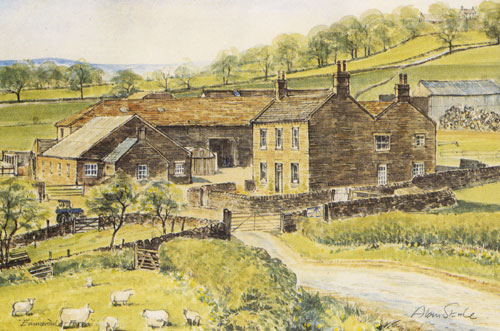
Charles Weddall was listed as a yeoman farmer, which meant that he owned his own land rather than renting it. According to the 1871 census Charles Weddall even though he was 67 years of age was listed as a farmer owning 250 acres of land, employing three laborers and four boys, who could have been between the age of ten and fourteen, not uncommon for the time. These boys were sometimes the sons of other farmers, who hired them out.

Around the time of Edward’s birth the agricultural industry in the area was thriving:

The Pocklington Agricultural Society started in 1847. An Agricultural show was followed by a public dinner with an an impressive number of toasts! Read more from and Extract from the Hull Packet and East Riding Times for July 30, 1847.

Charles Weddall was also a coal merchant, in1844, the same year his son Edward was born he was listed as such in the 1844 Williams & Co. Directory of York. The address of his business is given as Canal-head, Pocklington. It was not unusual for merchants to have their business’ close to canals to transport heavy goods before railways and motorways. However Charles Weddall’s business may not have been as lucrative as it could have as described below by the Pocklington Canal Amenity Society;

The canal was mainly used to carry coal and agricultural produce. It was never a great financial success, partly because goods had to be transferred to horse-drawn carts at the terminus of the canal, adjacent to the Hull-York turnpike road, to continue their journey.

COAL MERCHANTS.

Hodgson, Rt., Canal-head
Peart, James and Josh., Canal and West-green
Weddall, Chas., Canal-head

Pocklington Canal today, near where the Weddall’s had their coal business. Photo courtesy of PocklingtonHistory.com

In spite of their less than thriving coal business the Weddall’s were comparatively well off the standards of the time. Young Edward, unlike his future second wife Emily, would have grown up wanting for nothing. Somehow the agricultural lifestyle did not appeal to Edward Weddall and at the tender age of sixteen he left home and headed to the nearest port, Hull and embarked on a life at sea.


Sources
http://www.history.com/topics/child-labor
http://www.pocklingtonhistory.com/archives/people/directories/1844_williams/index.php
http://www.pocklingtoncanalsociety.org/history.html


Special thanks to Andrew Sefton, Archivist
Image of Pocklington Church 1844 courtesy of http://www.pocklingtonhistory.com