Category Archives: History

Philanthropy and an encounter with her future husband

On Saturday, April 18, 1896, the following headline appeared in the letters page of the Irish Times

Modern day ‘Kingstown’

The letter was from a Miss Emily Burke and with it was a sum of money collected from her fellow residents of Hotel Splendid in Meneton, France in aid of the families of the men who lost their lives in the Kingstown Lifeboat Disaster of 24th December 1895.

    December 1895 had begun with south-westerly gales which continued to blow without moderating as the wind direction backed around to southeast. This brought a trail of devastation in its wake on land and sea. The River Lee overflowed its banks in Cork and the towns of Skibbereen and Bandon were flooded. Clonmel in Tipperary suffered the same fate. The Blessington steam tram found the road impassable at Tallaght and a local man, Mr. Nicholson, was drowned in a flood in the same locality. Pedestrians had difficulty walking due to high winds and there was great damage to windows from flying slates. Rainstorms swept Dublin city for days… Read more:http://www.dunlaoghaire-lifeboat.ie/index.php/Latest-News/detailed-historical-account-of-the-dublin-bay-lifeboat-disaster.html

RNLI Fundraiser, October 2016

It was from this address that the first hint of Emily’s meeting with her future husband, Edward Weddall was recorded. He made an ostentatious contribution to the fund. Young Emily must have been impressed with his generosity, and he with her concern for others. When their relationship is hard to pin down, but in 1896 his first wife also Emily was still alive so it was probably not then.

Sources
The Irish Times – Page 5 Saturday 18 April 1896
http://www.dunlaoghaire-lifeboat.ie/index.php/Latest-News/detailed-historical-account-of-the-dublin-bay-lifeboat-disaster.html

Emily Visits the Riviera

In 1879 William Miller published his book Wintering in the Riviera, a travel book, containing his travel notes of Italy and France, to advise travellers. Did Emily read the book? – Unlikely but it was a good history of the early days of destination Riviera.

The Rivera, particularity Mentone was becoming famous as a health spa in the wake of Queen Victoria visiting the location in the 1880’s. Although the climate was known for health benefits long before particularly for people recovering from TB. In his article for The Telegraph, travel expert Anthony Peregrine humorously describes health tourist in the Menton of Emily’s era;

The belief spread quickly through the consumptive classes. It was encouraged by doctors, not least the Manchester-born James Henry Bennett who’d had TB himself and apparently been cured by travelling to Menton. His resultant bestseller, Winter and Spring on the Shores of the Mediterranean, channelled the well-heeled and coughing to the Riviera in general, Menton in particular.

Emily’s services as a nurse would have been in high demand in the days before there was any known cure for TB.

http://gutenberg.polytechnic.edu.na/4/7/4/6/47463/47463-h/47463-h.htm#front

Sources
http://www.telegraph.co.uk/travel/destinations/europe/france/cote-d-azur/articles/Britains-150-year-love-affair-with-the-Cote-dAzur/
http://gutenberg.polytechnic.edu.na/4/7/4/6/47463/47463-h/47463-h.htm#front

France

According to her biographer Iosold Ni Dheirg, Emily worked for a family as a private nursemaid and traveled with them to France and Germany. It is not clear how long she stayed in France as a nursemaid with that particular family. She certainly stayed long enough in the country to become a fluent French speaker

With French and a good command of German she had certainly had the option to travel as a nurse. Iosold Ni Dheirg, who knew Emily personally mentioned that she had a great sense of adventure, another reason behind her visit. The third possible reason could possibly have been that she was on a tour of Europe, not an uncommon for young ladies at her time. Having lost her parents and all but one of her siblings, her other relations may have taken her to the Continent as part of her education.

Either one of the ways described or another way completely young Emily found herself in the South of France in the Spring of 1896, having  brush with destiny too.


http://gutenberg.polytechnic.edu.na/4/7/4/6/47463/47463-h/47463-h.htm

Sources
Ní Dheirg, Íosold. Emily M. Weddall: Bunaitheoir Scoil Acla. Baile Atha Cliath: Coisceim, 1995
http://gutenberg.polytechnic.edu.na/4/7/4/6/47463/47463-h/47463-h.htm


Language

Emily was a fluent French speaker. She also had a good command of German, and lastly she spoke Irish too, perhaps not as well as the first two. She may have grown up listening to her father speak in his native tongue but she would not have been taught it at school, given the time it was not encouraged. When the Gaelic League was set up in the 1890’s it became ‘fashionable’ to speak Irish.

The Gaelic League, or Conradh na Gaeilge, was founded in Dublin on July 31, 1893 by Douglas Hyde (Dubhghlas de hÍde in Irish), a Protestant from Frenchpark, County Roscommon with the aid of Eugene O’Growney, Eoin MacNeill, Luke K. Walsh and others. The league developed from Ulick Bourke’s earlier Gaelic Union and became the leading institution promoting the Gaelic Revival…

Read more:https://www.cnag.ie/en/info/the-irish-language/a-brief-history-of-conradh-na-gaeilge.html

As a Nationalist Emily promoted the Irish language, speaking it when and where possible. The purpose of Scoil Acla was to promote the speaking of Irish. She was also masterful at writing it too, as a regular correspondent with the Gaelic League’s weekly, An Claidheamh Soluis.

Achill Summer School
The Achill Summer School has been closed for this year. It was small but in every way a remarkable success. Its promoters claim that it has accomplished all that they had hoped from its institution. it has turned the tide of Anglicisation. it has been a pure well of Gaelic spirit and enthusiasm in an arid and neglected district. It has refreshed and renewed all who have had the happiness to visit it. Its good work has made itself felt all over the country side. Next year it will open with a reputation already made.

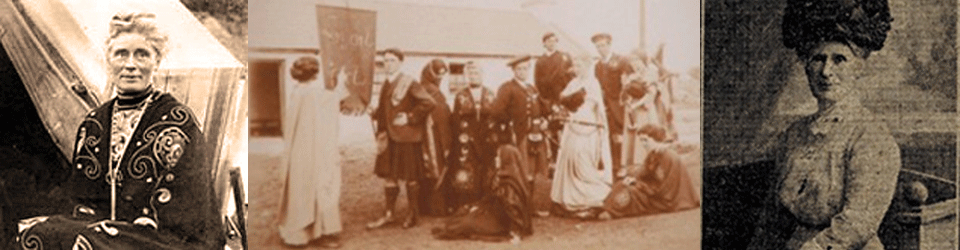
Emily Weddall  


Sources
https://www.cnag.ie/en/info/the-irish-language/a-brief-history-of-conradh-na-gaeilge.html
An Claidheamh Soluis September 16th 1911  P. 8

Superstition

The superstition around Fr. Manus Sweeney is what myths are made of. There is superstition around his life and death that even reach beyond the grave.  Bridie Mulloy recorded much of it in her folklore collection. Most of the informants stories matched with of course slight variations but the general consensus was that the was certainly something myth-like about the patriot priest.

The most mysterious occurrence which is sadly fading from living memory has to be when Emily, Anita, Eva and the committee for the erection of a monument dedicated to Fr. Sweeney back in 1944. Theresa McDonald recorded the folklore of the event in her book Achill Island;

The people of Achill decided to build a monument to commemorate his death, but could not agree on a suitable location. One evening, two men saw a bright light down on the shore beside Fr. Manus’s old home in Dookinella and, needless to say the monument was erected there, where it stands to the present day.

1798 Monument in Castlebar

1798 Monument in Castlebar

A myth that lives on but is all but forgotten is the one that since Fr. Sweeney was hanged it always rains on market day in Newport!

Market Day in Newport in the Rain

Market Day in Newport in the Rain


Sources
McDonald, Theresa. Achill Island. Tullamore: I.A.S, 1997. p341
Mayo News 1893-2004*, 26.08.1944, page 3