Category Archives: History

May 1922

By May 1922 the tension between the pro and anti- Treaty sides was heating up to boiling point. The was a palpable sense, that those hostilities could erupt in to combat at any moment in the atmosphere. That did come to pass in Kilkenny City on May 2nd.

Kilkenny Moderator 06 May 1922

About 300 members of the IRA took the city centre, which included one of the cathedrals, the city hall and the Castle. In counteraction the The Free State Army on behest of The Provisional government took over the Barracks, Jail and the Bank of Ireland. The government sent in over 200 troops from Dublin to remove the irregulars by force if necessary. It was. Fighting broke out causing many to be injured and eighteen deaths. A ceasefire, followed by a truce was negotiated and the fighting drew to a halt.

Weekly Freeman’s Journal 06 May 1922

Kilkenny Castle; Weekly Freeman’s Journal 06 May 1922

Under the instruction of the provisional government 200 troops were dispatched by train to Kilkenny. It was not a peaceful operation as a shootout ensued with a total of 18 casualties. The following day civil war is just about prevented when the Anti-Treaty members of the Dail announce a truce.

At the other side of the country there after the IRA enter and rob a bank in Buncrana, Donegal. There was a shootout between them and the Free State Army, in which two members of the IRA and young female civilian are killed and numerous injured. Again troops are sent in from the Free State Army, but were ambushed at Newtowncunningham, and three are killed.

As May 1922 progressed there was a spate of bank raids by the IRA, around the country. In one such raid in Westport, the irregulars left a note stating that as the state refused to finance them, they were only taking the money to cover their expenses.

Weekly Freeman’s Journal 06 May 1922

As the violent flare ups around the country continued it was becoming increasingly clear that civil war could easily break out in an instant. A ‘pact’ was drawn up between Eamonn de Valera and Michael Collins, to establish the most peaceful way forward. The agreement resulted in the call for a general election, with view to forming a coalition party which would include both the pro and anti-Treatyites. The move allowed the public to have their say on the Treaty and the general politics of the new state. Polling day was set for June 16th. But as May drew to a close even Michael Collins had his doubts about a peaceful outcome. He told a reporter from the Chicago Tribune: “If this peace conference fails, then there will be no other, and we will have to take strong action to restore order in the country.”

Sources

Kilkenny Moderator 06 May 1922

Weekly Freeman’s Journal 06 May 1922

Weekly Freeman’s Journal 06 May 1922

Freeman’s Journal 19 May 1922

Weekly Irish Times 20 May 1922

Weekly Freeman’s Journal 20 May 1922

Today in Irish History, The Truce, 11 July 1921

Easter 1922

Six years after the Easter Rising a new organisation was formed to honour “Men of Easter Week”. Named the “1916 Club”, they held their first annual church parade. Before the procession that began at St. Mary of Angles on Church Street and continued to Glasnevin Cemetery, where some of the fallen of Easter Week were buried. At the time, the Republican Plot didn’t exist as such, as many of who are now buried there, were still alive at the time. None of the executed leaders of the Rising were buried their neither, their final resting place in Arbour Hill Cemetery.

In spite of the political tension between the pro and anti Treaty supporters, which could have erupted at any moment the commemorations continued. Large crowds lined the route from Church Street to the Parnell Monument, stopping all traffic on the route. When the parade reached O’Connell Bridge, they slowed down and the St. James Pipe Band began playing a lament, as the reached the GPO, still a burnt out hollow behind it’s facade at the time.

On the approach to Glasnevin Cemetery, the parade slowed down again to the solemn music of the “Dead March”. Again a crowd had formed to greet them at the cemetery gates. Inside wreaths were laid on the graves of the dead heroes of more recent times and of old in various locations throughout the cemetery. The Rosary was recited in Irish, which formed a Republican tradition, that still exists, regardless of the patriot’s religious faith.

The event concluded by the band playing “The Soldier’s song” and “Wrap the Green Flag Round Me.”

Weekly Freeman’s Journal 29 April 1922

Sources

Freeman’s Journal 25 April 1922 p 3

Weekly Freeman’s Journal 29 April 1922

Taking of the Four Courts

Weekly Irish Times 22 April 1922

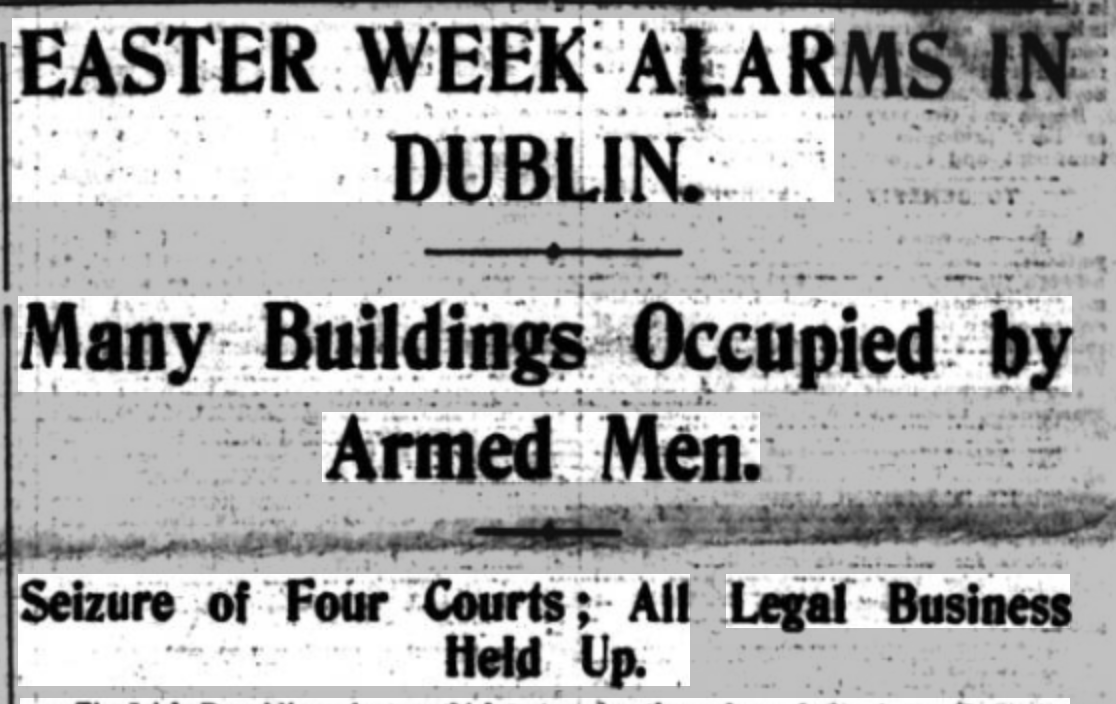
On this day one hundred years ago, on Good Friday the Anti-Treaty IRA occupied the Four Courts. Led by Rory O’Connor, and about two hundred men took possession of the building. He issued a statement to make it clear that the action was no coup d’etat, that he required a building to house his men and no more.

Sources

Weekly Irish Times 22 April 1922

Freeman’s Journal 26 April 1922

#OTD in 1922 – Led by Rory O’Connor, forces against the Anglo-Irish Treaty seized the Four Courts in Dublin.

https://www.rte.ie/history/ira-convention/2022/0208/1278631-britain-and-the-irish-civil-war/

The Irish Constitution February 1922

From February to May 1922, The Shelbourne played host to its most historic meetings: the drafting of Ireland’s first Constitution. Under the chairmanship of Michael Collins, the committee met in room 112, to write the Constitution of the Irish Free State. This room is now The Constitution Suite, and contains the original table and chairs.

https://www.theshelbourne.com/history
Courtesy of the Shelbourne Hotel

In February 1922, when the Irish Free State was about a month old, the provisional government held a special meeting to set the Constitution.

Courtesy of Shelbourne Hotel

“The team: Mr. Michael Collins, Chairman; Mr. Darrell Figgis, Acting Chairman: Mr Hugh Kennedy, Mr. James Murnaghan, Mr James MacNeill, Professor Alfred O’Rahilly, Mr. Kevin O’Neill, Mr. John Byrne. Assistance is being given by persons who are acting in specialized capacities.”

Munster News 01 February 1922
Courtesy of The Shelbourne Hotel

The Constitution took about six months to complete was ratified by the Dail in October 1922. Darrell Figgis, vice-chairman, did the lions share of work on it as chief, Michael Collins was frequently absent from the committee, due to his other political commitments. Having spent so much time working on it, later that year he published a book entitled; The Irish constitution explained.

Sources

https://www.theshelbourne.com/history

Munster News 01 February 1922

https://www.gutenberg.org/files/32612/32612-h/32612-h.htm

https://www.dib.ie/biography/figgis-darrell-a3078

Playboy

On this day 115 years ago Playboy of the Western World premiered at the Abbey Theatre. Instead of being applauded at by an appreciative audience, it was met by a booing hissing and stamping of feet, in what became known as the “Playboy Riots”. The play caused much consternation among Nationalists who were affronted by Synge’s depiction of Irish peasantry. The moralistic members of society were scandalised by the mention of the word ”shifts” (lady’s undergarments).

Playboy of the Western World, main character Christy Mahon was based upon the life of notorious Achill man, James Lynchehaun. Although when asked if Lynchehaun was his muse, Synge did not confirm nor did he deny leaving critics of the time guessing. “Well, all I can say is, that it if he based it on the true facts of Lynchehaun’s escape he could have made a play that would at least be good melodrama” one proclaimed.

Synge, who was too ill to attended the opening night was eventually forced to write to the press to defend his work:

Synge’s letter to the press

Abbey Theatre manager, W.B. Yeats, who was also absent on the opening night due to a commitment in Scotland, invited a live audience to an open discussion on “The Freedom of the Theatre and Mr. Synge’s Play”.

It is difficult to say how Emily, who was a good friend of J M Synge felt about the controversy surrounding his latest work. She was a dyed in the wool Nationalist, suggesting that she might have disapproved of his portrayal of the Irish peasantry. Emily, always loyal where her friends were concerned may very well have been happy for his unconventional success.

Sources

Dundee Courier 31 August 1903 p 3

Search terms Download PagePrint Page Back to Search Results Image (purchased)

Irish News and Belfast Morning News 31 January 1907

https://discover.hubpages.com/education/The-Playboy-and-the-Yellow-Lady

Dublin Evening Telegraph 31 January 1907

http://www.achill247.com/writers/jmsynge5.html