Category Archives: History

Achill; the Early Years

Rockfield House, Keel, where Emily set up home with her husband

Rockfield House, Keel, where Emily set up home with her husband

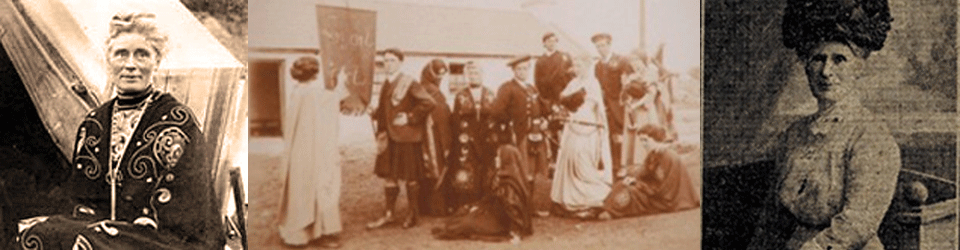
Emily Weddall moved to Achill Island  in 1906 with her husband retired sea captain, Edward Weddall, whose compromised health, due to a tropical disease benefited from the fresh sea air.  Emily acquired Rockfield house, which once was a mission school in the 1840’s/50’s through connections established by her late father William John Burke who spent some time on Achill in the 1840’s.

Emily who was concerned mostly with the care of her husband, made time to indulge her passion and love of the Irish language and culture. A woman of means she had the resources and the drive to get involved in the beginning of the cultural revival on Achill. She naturally gravitated towards people who shared her interest and they to her. She joined forces with the local Parish Priest, Fr J Connolly and Seaghan Mac Enrigh, who had previously campaigned for the reintroduction of Irish in the schools and classes for children and adults alike.

Emily was already a member of the Gaelic League, which she joined when she returned to Ireland in 1906. and teamed up with Fr Connolly to form a local branch Grainne Mhoal (named after the pirate queen Grace O’Malley) in 1907/08. Over the next few years the people that would be pivotal to the revival would converge to make Achill, making it a hub for the Irish language and cultural revival.

The magazine produced by the Gaelic League, which Emily was a frequent correspondent

The magazine produced by the Gaelic League, to which Emily was a frequent correspondent


Richard McArthur (Grandfather) 2

Emily's grandfather's business Card of. Courtesy of the National Library of Ireland

Emily’s grandfather’s business Card of. Courtesy of the National Library of Ireland

In 1817, Gilbert was now an elderly man and the partnership between Gilbert & Hodges was dissolved. Emily’s grandfather Richard a loyal employee entered the partnership in place of Gilbert and the business became Hodges & McArthur. By now Richard McArthur had began traveling afar sourcing books for a faithful client, Lord Mountbellew, whose large estate was in  Co Galway. From their correspondence, it is plain to see that they had good business relationship, which seemed to stem from their mutual love and appreciation of books. So much so that on his “honeymoon” in Paris and London of 1825, Richard McArthur still had time to source and send on a shipment of books to the Lord.

At the time Richard McArthur traveled between Dublin and France it was easy to buy entire libraries once owned by the fallen French aristocracy quite cheaply, and he may have made a good living by doing so.

Letter from Richard McArthur to Lord Mountbellew about a book buying trip to London and Paris. Courtesy of National Library of Ireland.

Letter from Richard McArthur to Lord Mountbellew about a book buying trip to London and Paris. Courtesy of National Library of Ireland.

Sources
Hodges and McArthur (booksellers), and Christopher Dillon Bellew. Receipts Etc From Hodges and McArthur, Booksellers of Dublin to Christopher Dillon Bellew.
 A Dictionary of Members of the Dublin Book Trade 1550-1800 By Mary Pollard, Bibliographical Society (Great Britain, p 248-50

Richard McArthur (Grandfather)

Richard McArthur was originally from Ardglass Co Down. Little can be told of his early life and background only that he was well educated and a gentleman. A bookseller by trade, he arrived in Dublin in the beginning of the 1800’s. He worked with Gilbert & Hodges, booksellers and stationers of College Green as early as 1812, a loose receipt signed by him confirms the date. It appears from the few remaining documents from the business that his role was, locating and distributing books to clients.


Receipt for books sold by Richard McArthur to Lord Moutbellew. Courtesy of National Library of Ireland

Receipt for books sold by Richard McArthur to Lord Moutbellew. Courtesy of National Library of Ireland

He may have relocated to Dublin, because at that time it was a hub for printing and publishing, providing better opportunities than nearby Belfast. The move proved a good decision for Richard for in 1817 he was made a partner in the business, when Gilbert left, and it was probably in the same bookshop he first set eyes on his future wife Mary. There are records to confirm that Mary Graisberry’s family printed medical books sold by Gilbert & Hodges over the years.

Sources
The Oxford History of the Irish Book, Volume IV: The Irish Book in English By James H. Murphy. P 578
 Hodges and McArthur (booksellers), and Christopher Dillon Bellew. Receipts Etc From Hodges and McArthur, Booksellers of Dublin to Christopher Dillon Bellew.  

The Graisberry Girls: Mary II

Emily’s grandmother Mary was born about 1797/8 in Dublin. She was most likely, the eldest child of Ruth and Daniel Graisberry. Mary grew up in the printing industry where it was not uncommon for the whole family to be involved in the running of their business. Each generation of the Graisberry women either by design on necessity ended up working as printers.

The oldest building and trees in TCD. They were there when the Graisberry's were the official printers to the college

The oldest building and trees in TCD. They were there when the Graisberry’s were the official printers to the college

When her father died in 1822 Mary and her sisters probably helped their mother keep the business going. It was not uncommon back then for women to take over the busines, when their male relatives died. In the Graisberrys time a high percentage of women were registered in the print industry trade journals. 66.6 per cent of these were widows of printer/bookbinder/bookseller husbands. The main reason for this was  financial, as was in the case of Ruth Graisberry who pleaded poverty in her petition to Trinity College. Her daughters  may have been well skilled in the folding and sewing of pages, but Ruth was as good as anyone in the industry.

Despite her protestations of poverty Ruth Graisberry was, in fact, together with Harriet Colbert and Anne Watson, among the biggest master printers and booksellers in early nineteenth-century Dublin.

As is was common for widows to take over from their husbands so was it for the girls of the industry to marry the apprentices of the print, binding and publishing trades.

From the 1800’s into the mid-20th century, a set number of apprenticeships were always reserved for printer’s sons. Many of them married female workers and this led to the growth of print families or dynasties within the print, publishing and bindery trades.

It was through the book industry that Emily’s grandmother Mary Graisberry met and/or was matched with Richard McArthur, bookseller from Ardglass Co. Down.

Take a tour of Trinity College Dublin, where the Graisberry’s were the official printiers:
https://www.tcd.ie/Library/bookofkells/trinity-tours/
Thanks to:
Irish Print Museum
Sources
Irish Booklore: A Galley of Pie: Women in the Irish Book Trades Author(s): Vincent Kinane Source: The Linen Hall Review, Vol. 8, No. 4 (Winter, 1991), pp. 10-13 Published by: Linen Hall Library. Stable URL: http://www.jstor.org/stable/20534214
Dictionary of Irish Biography 9 Volume Set: From the Earliest Times to the Year 2002. Cambridge University Press 2009,James McGuire and James Quinn. Turlough O’Riordan. Vol 3 P 192

The Graisberry Girls: Ruth (2)

When her husband Daniel Died Ruth Graisberry found herself alone with five daughters and a deaf blind mother to support. As her son Daniel was not of full age (21) at the time she was the heir to her late husband’s assets. Nowadays she could have just stepped into her de

ceased husband’s shoes and took up where he let off but it was not as simple back in 1822. Ruth had to make her case to Trinity College to be allowed to continue on as their official printer.

A printing press from the early 1800's, the kind the Graisberrys would have used. Curtesy of the National Print Museum, Dublin.

A printing press from the early 1800’s, the kind the Graisberrys would have used. Courtesy of the National Print Museum, Dublin.

A resourceful woman, she used her wiles to make she self indispensable to the college. In 1823 she made the following petition:

“Being possessed of the Presses, Types, and materials for Printing and having proper and respectable Work people in her employ, she feels herself fully capable with the aid and assistance of several of the most respectable Master Printers in Dublin, who have kindly and voluntarily come forward and signed a paper undertaking to aid and assist your Memorialist if necessary to carry on the business…”


Ruth Graisberry was not above mentioning her dependents (five daughters and her invalided mother), and the fate that would befall them if she were denied the position of college printer. Her pleading worked she given the contract. It was not wasted on her she she held on to the position until 1837, when an ongoing health complaint forced her to sell her part of the business to her once apprentice and eventual business partner Michael Gill.


Drawers of print typefaces used in the print trade. Curtesy of The National Print Museum

Drawers of print typefaces used in the print trade. Courtesy of The National Print Museum

Family Connections

Ruth was no stranger to the printing industry when she took over from her husband. She may have worked in the industry before she married. It was not uncommon for young female employees of print works to marry the apprentices and sons, like Ruth to Daniel Graisberry II.  Keeping it in the industry was common of the Graisberry family. Ruth’s sister in law Elizabeth, married the apprentice Richard Campbell, who later became a partner. Her daughter Emily, Emily’s mother married Richard McArthur a bookseller.

Ruth was a member of the McCormick family, who were stationers and paper sellers. There is an entry in the dictionary of members of the Dublin book trade 1550-1800, of a John McCormick who was a blind news hawker (early newspaper street vendors). He and a Patrick Smith murdered his wife and was sentenced to hanged and quartered, Smith was acquitted, but McCormick met his demise at Newgate Prison on December 16 1754. He may or may not have been related.


To find out more about the printing and book trade in Ireland visit the National Print Museum’s website. If you are in Dublin pay them a visit.

http://www.nationalprintmuseum.ie/

All photos courtesy of the National Print Museum


Sources
Irish Booklore: A Galley of Pie: Women in the Irish Book Trades Author(s): Vincent Kinane
Source: The Linen Hall Review, Vol. 8, No. 4 (Winter, 1991), pp. 10-13 Published by: Linen Hall LibraryStable URL: http://www.jstor.org/stable/20534214 Accessed: 07-05-2015 14:24 UTC
A dictionary of members of the Dublin book trade 1550-1800 :
Author: Pollard, M. (Mary)
Dictionary of Irish Biography 9 Volume Set: From the Earliest Times to the Year 2002. Cambridge University Press 2009,James McGuire and James Quinn. Turlough O’Riordan. Vol 3 P 192
http://www.askaboutireland.ie/reading-room/history-heritage/pages-in-history/early-dublin-newspapers/news-gathering/11/06/2015