Category Archives: Places

The Trial of Dr. Burke at the Leeds Assizes (1)

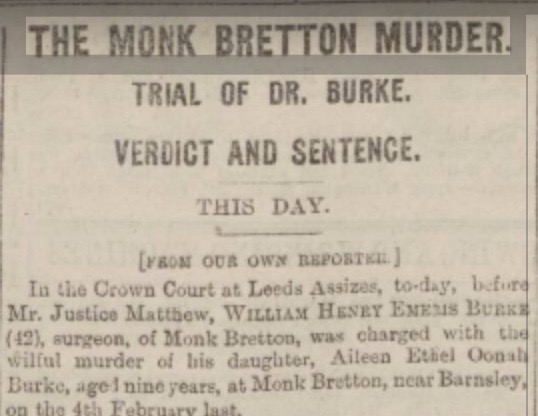
On this day 130 years ago Dr. Burke found himself in the dock again, this time at the Leeds Assizes. His previous hearing at Barnsley found him guilty of the willful murder of his nine year old daughter Aileen. He was granted a second hearing because of the delicate nature of the case. He was not granted any special clemency, for the loss of his daughter  and had the agony of waiting more than a month for what he probably knew delivered a guilty verdict.

In 1856, judges of the Central Criminal Court were also given the right to hear cases outside the court’s ordinary jurisdiction, to ensure a fair trial where local prejudice existed or when it could offer an early trial and so avoid the delay involved in waiting for the next assizes.

The second hearing didn’t attract as many of the public as the previous. It was held in a distance from Barnsley and too far for locals to travel in those days. It still attracted media attention, appearing in the local and national and some international newspapers. It was covered by some Irish newspapers but not in depth, sparing Emily and her siblings the anguish of being confronted by their half-brother’s misdemeanor daily.

Sources
Sheffield Evening Telegraph 05 May 1888
https://www.judiciary.gov.uk/about-the-judiciary/history-of-the-judiciary/

The Assizes at Leeds

Emily’s brother, Dr. William Burke was found guilty at the district court at Barnsley, Yorkshire. He was sent to be tried further at the Leeds Assizes. His was one of many cases that the assailants were accused of murder. Living in the Victorian Era the punishment by society was harsh and by the law, the death penalty.

In the case of Emily’s brother, who was a doctor and considered to hold a superior position, he was judged more harshly than those in with a lesser social standing. But his alcohol addiction did not obey the same rule.

His was one many murder cases of that particular year, in the local area of Barnsley, Yorkshire.

Sources
Sheffield Independent 02 May 1888

Conviction

There was no testimony to how the tragedy occurred, because there was no witnesses. The only certianty was that Dr. Burke pulled the trigger. He either did it on purpose or by accident, The only people that could say what exactly happened were either dead or on trial.

“He [the magistrate] was instructed that the revolver went off by pure accident. Seeing that the accident had resulted in the death of the child whom he loved, and horrified at the occurrence, Mr. Burke turned the revolver against himself `’

The above was probably what happened, but could not be proved. Nevertheless Dr. Burke was charged with the murder of his daughter and attempted suicide, a crime at the time. He pleaded not guilty, but was charged with the crime.

Sources
Leeds Mercury 27 March 1888

The Letter

The day his daughter died Dr. Burke spent the whole day drinking at his local pub, the Norman Inn. He consumed quite a lot of alcohol, by anyone’s standard. Over the course of the day as he grew more and more inebriated and wrote a letter to his wife, Katherine about the state of their marriage.

On the night of his daughter’s death it was retrieved from the floor in the room which she died. It was first taken by his wife and then given to the police as an afterthought. The letter could be and was used as evidence in the trial.

The letter was used to prove how competent Dr. Burke was competent when the shooting occurred. The letter although rambling and incoherent in a lot of respects was grammatically correct. This small detail was used against the doctor, suggesting that he had sufficient wits about him to knowingly shoot at his daughter. Nowadays that would not have been the case and advanced forensics could have told a different story. The truth was that nobody knew what happened in the room, because no one was in it except for the doctor and his daughter.

Sources
Sheffield Evening Telegraph 26 March 1888
Sheffield Daily Telegraph 27 March 1888

Personal Effects

After the death of his daughter and subsequent arrest, Dr. Burke’s wife and young son left their marital home. Who could blame them for leaving the memories the house must have held. Dr. Burke’s wife went to live with her family, the ones she fled to so often when their marital problems became unbearable.

An advert was placed in the local papers announcing the sale of contents of the house. For the time the items for sale would be a good bargain for anyone who could afford them. They bore testimony to a lifestyle that was out of range for most, seeming desirable but the grim reality was something else. The auction offered 45 framed photographs, along with ones of his wife and children, perhaps there was one of his half-brothers and sisters, Emily included. It is hard to imagine who would want such items after they knew the circumstances of why they went up for sale, but it was Victorian times, personal effects were lesser and life harder with little room for sentiment.

It appeared from the notice below that many if not all items were sold due to the great turnout for the sale. “There were many spectators”, stated the article, not at all surprising as people had a morbid fascination with such thing particularly in that era.

Sources
17 March 1888 – Sheffield Daily Telegraph – Sheffield, South Yorkshire, England
Sheffield Daily Telegraph 20 March 1888