
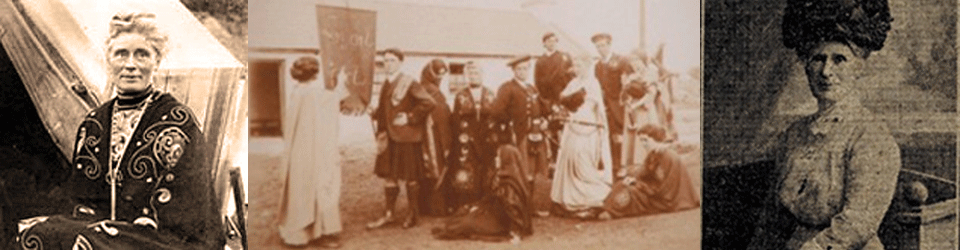
Easter week 1916 began as any other for the people of Achill, Emily and Darrell Figgis alike. Nothing out of the ordinary apart from the unseasonably good weather as Figgis described in in his book A chronicle of jails, more or less his prison diary of his time incarcerated during 1916-17. 
Tues, April 25th 1916 was filled with sunshine in token of the summer that was on the way while a keen wind from the north came in reminder of the winter that was passing.
No one would have been any the wiser that there was an uprising taking over the capital if on the island. Only a few would have noticed that there was something amiss, those waiting on the post, which Darrell Figgis was one.
It was not till some hours after noon that, looking along the road for the post that was so unaccountably late, I saw a friend making her way toward the house on her bicycle. As she came nearer and dismounted I could see the traces of tears on her cheeks, and wondered.
“The post is very late,” I said.
“There is no post,” she replied, “but there’s terrible news. There has been fighting in Dublin. they say Dawson Street is full of dead and wounded men. the Volunteers hold the General Post Office, the Bank of Ireland, and a number of buildings all over Dublin…”
It is impossible to say if the friend of Darrell Figgis was Emily, there is a high likelihood that it was, either way Emily got the news and headed to Dublin to play her role in the Rising, except she never got there. Two days later and half way there she was intercepted in Rochfordbridge, Co. Westmeath and brought to court there.

Tullamore Prison Gates
The record still exists and contains the following details:
Name of Justice: M. S. Moore R. M.
Defendant: Emily Weddall
Cause of Complaint: Defense of the Realm
That Defendant on the 28th of April 1916, at Mulling in the county of Westmeath was acting in such a manner as to vie reasonable ground for suspecting that she was about to act in a manner prejudicial to the Defense of the Realm and that she is thereby guilty of an offense against the Regulations made under the Defense of the Realm Act 1914 and was arrested by the Constable Thomas Forkin R. I. Constabulary in accordance of said regulations.Particulars of order of dismissal: Defendant remanded in Custody for seven days from this as for further examination.
The Complainant was listed as ‘The King’.
Emily was sent to Tullamore Gaol for the duration of the Rising. She was released without further ado. On May 3rd her niece, Enid made her way across the country from Achill to Tullamore to meet her aunt at the prison gates. Enid was only 17 and at the time on Easter holidays from school.
By the time Emily returned to Achill, the Rising was over, Dublin was in ruins, some of her friends including Darrell Figgis were imprisoned and some were no more, executed for their part.

An Cliadeamh Soluis 24/04/1916
 Edward Weddall joined the Navy at the age of fifteen pretending that he was sixteen. He gave his date of birth as 1843, when he was really born in 1844. That was not uncommon for youngsters to pretend they were older to join the services. It was harder to prove age as there few passports if any, were issued and authorities rarely questions anyone who looked of age. Edward Weddall was one of those who slipped through the cracks.
Edward’s parents may well have condoned his early joining the navy, he was one of many children and had older brothers to inherit his father’s farm. It was Victorian time and survival of the fittest was the order of the day.
Commissioned Officers
Emily’s financial trouble may have been building up for some time, even back as far as when she was widowed in 1908. Her husband Captain Weddall, died intestate, however Emily eventually claimed his estate of £276 9s 5d, roughly €18,000 in today’s money. In 1917 it was almost a decade since his death the cash was possibly well spent. One such occasion which easily have put a dent in her finances was the possible purchase of her house Rockfield from the Mission Estate in 1913. By the time revolution broke out in February/March of that year she may have been feeling the pinch. By November, when the second wave of the uprising took place, her income from her shares in Russian Industry were to be wiped out completely.
February Revolution: 1917
In 1917, two revolutions swept through Russia, ending centuries of imperial rule and setting in motion political and social changes that would lead to the formation of the Soviet Union. In March, growing civil unrest, coupled with chronic food shortages, erupted into open revolt, forcing the abdication of Nicholas II (1868-1918), the last Russian czar. Read more:

Emily possibly kept an eye on the news unfolding in Russia, not necessarily for financial reasons but for her great empathy with the Russian people. Her affinity with the country began years earlier when she visited or perhaps worked there as a nurse. It would have still hit hard the moment that she discovered the gravity of her financial future. Since the death of her husband she had led a pretty independent life, not afforded to many at the time, especially women. She had the financial freedom to do what she pleased and she did. But what she did could not have been considered self indulgent, as she gave her resources freely, including her time.
Emily was as generous with her time as she was with her money. She co-founded the Lower Achill branch of the Gaelic League, Scoil Acla and financed the Hall in Dooagh. She gave her time to the same causes and sat on many committees working tirelessly for all. But now that she had no resources left she would have to go back to work as a nurse. But all was not lost she still managed to help those that needed her assistance. Even in financial trouble herself she still scraped what she could together to help the widows and orphans of 1916.
Her good friend Mary O’Connor recounts the day that Emily asked her to her house. She knew there was something seriously wrong when a gloom looking Emily opened a cupboard, a pile of letters came tumbling out. The documents were notices from the bank, dating back quite a while. All were informing her of her worsening financial state. Emily may have sheepishly admitted to Mary that she had paid no attention to the letters until then.
As the two women went through the documents it was coming more apparent how much debt Emily was actually in. The bottom line was that Emily had no choice but to go back to work immediately and possibly sell her house. She did get work eventually. An unfortunate turn of events in 1918 secured her full employment. But the sale of her house would take nearly a full decade, and a long drawn out legal wrangle.

St Patrick’s Day 1917 was more of a bleak affair than previous years. The country was still under the dark cloud of the uprising of the previous year. In Achill it was no different but with the added extra of the deportation of Darrell Figgis, a prominent member of the Gaelic League in Achiil and indeed Mayo.
The celebrations went on in spite of all and a Ceili was held in the hall Emily had commissioned a few years earlier in Dooagh on the night of the 17th of March. The event proved lucrative and £5 was raised for the Gaelic League. 
