Category Archives: Places

The Advantage of a Foreign Language

Emily a fluent French speaker had an added advantage when seeking work abroad. She could translate freely between employer and the locals when required. The below taken from Wintering in the Riviera, by William Miller describes the advantage of speaking the local language had.

The first great stumbling-block in the way of going abroad is to many, especially elderly persons, the want of knowledge of the language of the country to which they wish to direct their steps, or the want of power to converse in it freely.

There can be no doubt that it is of great consequence to have an acquaintance with the language of the country in which one desires to travel or reside for a time. People are saved much inconvenience and often money when they can talk it with fluency, and can comprehend what the natives say—usually the more difficult operation. At the same time, in all frequented parts of France, Italy, and Switzerland, either English or French will carry any one through.

Although Emily had a command of the French language, she would have got by without it in the South of France. Most hotels had at least one English speaker, and some even to Emily’s delight had an Irish representative.

At the hotels, unless they be what I have called English hotels, one usually meets with people of all countries. In one hotel in France, I was informed we had representatives of eight different nations, counting English, Scotch, and Irish as one. It has struck me, however, that although the French language is so generally spoken, the French themselves, while found travelling in every part of their own land, are very seldom seen in other countries.

Lost in translation

In his book Wintering in the Riviera, William Miller explains the sometimes disadvantages of speaking the language of the visited country. In his and Emily’s time they did not have the advantages of television or the internet, although there were plenty travel guides, but few ways of experiencing another country before visiting it. It was common to experience some kind of culture shock. William Miller gave the following advice for those who might partied with the locals;

There is nothing so difficult as to get merry with those who speak another language, into which everything has mentally and slowly to be translated, and the flashes of merriment often will neither brook translation nor abide deliberative meditation.

How Emily fared in the situation is hard to say now but always sociable she seemed to have fitted in easily. During her stay at Hotel Splendid in Mentone she seemed to be on friendly enough terms with the other guests to ask them to contribute to Kingstown Lifeboat disaster fund of 1895.

Sources
http://gutenberg.polytechnic.edu.na/4/7/4/6/47463/47463-h/47463-h.htm
The Irish Times – Page 5 Saturday 18 April 1896

Hotel Splendid, Mentone

People in the present day travel sometimes for pleasure and to obtain acquaintance with what cannot be seen at home, and sometimes for the sake of health…

The above is taken from Wintering in the Riviera, with Notes of Travel in Italy and France, and Practical hints to Travelers, written by William Miller, S.S.C. in the age that travel to the South of France became fashionable. The quote could apply to Emily Weddall, as she had just qualified as a nurse and was also according to her biographer, Iosold ni Dheirg.

As a fluent French speaker the South of France was a perfect place for her to find employment as a private nurse. The Riviera became a new health spa, since Queen Victoria made the area popular a few years earlier. Qualified nurses would have been in high demand to provide round the clock care for health tourists.

As proximity to the sea air, or to be within hearing of the monotonous noise of the waves, does not suit some persons, while the proximity may benefit others, and as the temperature of the east and west bays differs considerably, it is not inadvisable for those in delicate health to consult a medical man, who should decide which part of Mentone is best suited to the particular case. There are about twenty doctors practising in Mentone. Of these, the English doctors are, I believe, the following:—In the west bay, Drs. Siordet, Marriott, Gent, and Sparks; and in the east bay, Dr. Bennett. It is also well to know that the fees of the resident English medical men are high, and are paid at each visit. If the visit be to two persons of the same party, two fees, I have been told, are charged or expected. The fees of the French medical men are greatly less. It would seem, on some points,[174] the doctors of the two countries differ,—as, for example, English doctors advocate sitting in the sun, and foreign doctors, sitting in the shade; and knowing how foreigners abhor their friend the sun, I can well believe they do.

PROMENADE DU MIDI, MENTONE at the time Emily visited

An advert for Splendide, at Menetone from the 1890’s


Sources
http://gutenberg.polytechnic.edu.na/4/7/4/6/47463/47463-h/47463-h.htm
Ní Dheirg, Íosold. Emily M. Weddall: Bunaitheoir Scoil Acla. Baile Atha Cliath: Coisceim, 1995

19/2016: A Year in Photographs

February

Edenderry

Edenderry

http://edenderryhistory.blogspot.ie/

 March

Easter Sunday/Monday

Achill Easter 2016

June

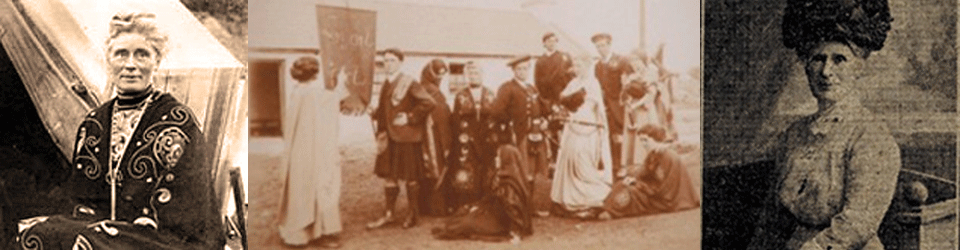
Reenactment of 1913 Oireachtas Photograph, depicting Emily Weddall

Original 1913 photo. Emily is 6th from left

2016 Reenactment. Photo by

July 2016

Scoil Acla 2016

November 2016

Night at the Pearse Museum

Pearse Museum at night

Pearse Museum at night

http://pearsemuseum.ie/

When: November 1, 2016 @ 7:00 pm – 8:00 pm

Where: Pearse Museum
Saint Enda’s Park
Grange Rd, Haroldsgrange, Dublin 16
Ireland
Cost: Free

Maria Gillen will be giving a lecture on the fascinating life of Emily Weddall in the Pearse Museum on Tuesday, 1 November at 7pm.

dscf2272_2

Emily Weddall, nee Burke 1867-1952 was born in Edenderry, Co. Offaly to a Church of Ireland Minister and his wife. She trained as a nurse in Sir Patrick Dun’s Hospital, on qualifying she traveled to France Germany and Russia with her career. In the early 1900’s she married retired sea captain Edward Weddall, the couple settled on Achill in 1906. Around that time she co-founded the Lower Achill Branch of the Gaelic League, and became a regular correspondent, with An Claidheamh Soluis, of which Patrick Pearse was editor. It is through these circles that Emily first met the Pearse family.

Strongly influenced by the cultural revolution of the time, of which Patrick Pearse played a pivotal role in, she co-founded Scoil Acla, an Irish language and cultural school in 1910. Their paths would cross on many occasions, socially, culturally and politically, frequently causing controversy! After 1916 she remained friends with the family and during the struggle for Ireland’s independence, living at their former home at Cullenswood. She took the side of Mrs Pearse, in rejecting the Treaty.

Emily remained a lifelong Republican, her final resting place is in Glasnevin Cemetery in close proximity to the Republican Plot.

Admission is free – no booking required.

Thanks to:

Edenderry Historical society

http://edenderryhistory.blogspot.ie/

Scoil Acla Committee;

www.scoilacla.ie

Pearse Museum

http://pearsemuseum.ie/

Photographs

Achill Easter 2016 by;

Minette Glynn

Town Hall Oireachtas 1913 by;

Aengus McMahon Photography

Creative. Results. Delivered.
Two time PPAI (Photojournalism) award winner
Scoil Acla 2016 by;
Minette Glynn

Travel in Victorian Times

Although there are no record of Emily traveling to France, in the passenger lists of the 1890’s she may have fallen below the radar or simply not have been recorded. Passports were not crucial as they are today, but helped to save time and inconvenience. As described below by William Miller in his travel guide Wintering in the Riviera, the reason why is was best to carry a passport.

Travel Check List

Passport:

…a passport is sometimes useful; it now costs little, and should always be taken. It is easily got under the directions contained in Bradshaw’s Continental Guide, and the visas of the foreign consuls seem now to be unnecessary, at least for the countries in which we were to travel. It is particularly important in some towns, to facilitate the obtaining of registered letters. Even ordinary letters occasionally, as I have found (1872) at Brussels on a former trip (having unfortunately lost my passport at Strasburg), will scarcely be delivered at the Poste Restante without production of the passport or other presumable evidence of identity; and it is said in guide-books, although we have never experienced the benefit of the information, that it operates as an admission to certain places of public resort.

Luggage

In Emily’s time, a century or more before air-travel and the cheap airfare, all Continental travel had to be done by sea and rail. Unlike today it was possible to take a whole trunk (the size of about ten on the standard ten kilo suitcases on a journey, although, like today there were restrictions on weight too, however, the allowance was quite a bit more than now!

Some ladies seem to travel with their whole wardrobe, or at all events with a useless number of changes of raiment. On one occasion we met a gentleman and lady, who had with them nine huge boxes, nearly filling up the top of a large omnibus, besides smaller articles, including their maid’s modest provision. This is a grievous mistake. Ladies ought to travel with the least possible quantity of changes. More than is fairly needful is inconvenient in many ways. Apart from causing detentions to others, it is a source of anxiety, and is most expensive in countries where the luggage is all weighed, and every pound or extra pound must be paid for.

Bradshaw’s Guide, the definitive travel book of the time


Sources
http://gutenberg.polytechnic.edu.na/4/7/4/6/47463/47463-h/47463-h.htm
http://bradshawsguide.org/

Philanthropy and an encounter with her future husband

On Saturday, April 18, 1896, the following headline appeared in the letters page of the Irish Times

Modern day ‘Kingstown’

The letter was from a Miss Emily Burke and with it was a sum of money collected from her fellow residents of Hotel Splendid in Meneton, France in aid of the families of the men who lost their lives in the Kingstown Lifeboat Disaster of 24th December 1895.

    December 1895 had begun with south-westerly gales which continued to blow without moderating as the wind direction backed around to southeast. This brought a trail of devastation in its wake on land and sea. The River Lee overflowed its banks in Cork and the towns of Skibbereen and Bandon were flooded. Clonmel in Tipperary suffered the same fate. The Blessington steam tram found the road impassable at Tallaght and a local man, Mr. Nicholson, was drowned in a flood in the same locality. Pedestrians had difficulty walking due to high winds and there was great damage to windows from flying slates. Rainstorms swept Dublin city for days… Read more:http://www.dunlaoghaire-lifeboat.ie/index.php/Latest-News/detailed-historical-account-of-the-dublin-bay-lifeboat-disaster.html

RNLI Fundraiser, October 2016

It was from this address that the first hint of Emily’s meeting with her future husband, Edward Weddall was recorded. He made an ostentatious contribution to the fund. Young Emily must have been impressed with his generosity, and he with her concern for others. When their relationship is hard to pin down, but in 1896 his first wife also Emily was still alive so it was probably not then.

Sources
The Irish Times – Page 5 Saturday 18 April 1896
http://www.dunlaoghaire-lifeboat.ie/index.php/Latest-News/detailed-historical-account-of-the-dublin-bay-lifeboat-disaster.html