Category Archives: Places

Bridie’s Collection

Co. Sligo

Co. Sligo

Bridie Mulloy began collecting folklore, as a school teacher but her love if it began long before, perhaps as a child. She grew up in rural Sligo. As she recalls later on in life in her  1991 book Itchy Feet & Thirsty Work: A Guide to the History & Folklore of Ballinrobe, her early images of the Seanachai James Flynn;

Everybody listened, captivated no matter how far-fetched the stories were indeed the more far-fetched the better they went down. He’d sit on his favorite kitchen chair, shoulders hunched gazing into the glowing coals as if her was drawing inspiration from them. Though he seldom raised his voice above conversation level, he spoke with the same conviction as if he was following his characters, enjoying their adventures, reveling in their feasting and fearful disasters. So night after night the stories rolled our of fairy hijacking to Greece and Turkey, changeling children and magical music which lured inspection mortals into all kinds of trouble.

These early memories perhaps left a lasting impression on Bridie Mulloy, inspiring her to search for stories herself. She not only listened to his tales but studied the storyteller himself.

He would sit at the butt of a cock of hay chewing a trawneen (piece of straw) and enjoying the heat of the sun. In this leisurely wait e studied the gap in the mountains over which the fairy horse would leap, that night in his story. The ring fort would inspire tales of abduction where mortals were forced to join the fairy revels. A stone field in the distance was the scene of mighty battles between long dead men and intruders who came to disturb their peace. He accepted help from neighbors if work got a bit behind hand, while he dreamed up his stories. He knew they liked to do so and that they’d be in at night to enjoy his flights of fancy and the currant bread and tea which his wife and family would provide.

This early brush with a man who not only spoke in narrative, but shaped his stories by the flora and fauna, the landscape and its moods, must have prompted her to search for the ‘magic’ essence that made the storyteller a master of his art. As a result Bridie made her way around the counties of  Sligo, Mayo and Waterford collecting local folklore during the thirties and forties. The fruits of her labour are contained in 21 manuscripts in the Irish Folklore Department in University College, Dublin. In her pursuit of the folktales and lore of days gone by she arrived on Achill in the forties when the last of the older generation were around to pass on their knowledge to the younger woman.

Destiny played her part too because Bridie Gunning would meet her future husband Tony Mulloy and her path would cross with that of the now elderly Emily Weddall.

Sources
Itchy Feet & Thirsty Work: A Guide to the History and Folklore of Ballinrobe. [Ballinrobe]: Lough Mask and Lough Carra Tourist Development Association, 1991.
http://www.mayonews.ie/obituaries/8008-bridie-mulloy

Bridie Arrives on Achill

In the early 1940’s Bridie Gunning arrived on Achill. Born in about 1919 in Ballindoon, Co. Sligo. As a pupil at Ballymote Vocational School, she first became interested in folklore. Her schoolgirl hobby became a career when she took it upon herself to collect the folklore of her home county Sligo, followed by Mayo and Waterford. As a result 21 of the manuscripts in the Irish Folklore Department in University College, Dublin, are the fruits of her labour.

In the 1930’s there was a national competition, inviting entrants (schoolteachers) to submit an example of their work to the National Folklore Commission, as a schoolteacher Bridie was perhaps one of the entrants, although there is no record of her entry. Nevertheless she was one of the biggest collectors of that era. To read more on the collection follow the link: http://www.ucd.ie/irishfolklore/en/schoolsfolklorescheme1937-38/

Bridie met and married Keel man, Tony Mulloy, whose family owned the Village Inn, in the village. Tony school teacher, was very knowledgeable in the folklore and stories of Achill. Perhaps it was where and how they met!

dscf2412

Sources
http://www.mayonews.ie/obituaries/8008-bridie-mulloy
Thanks
Special thanks to Croistoir at the  National Folklore Collection at University College Dublin


Night at the Pearse Museum

Pearse Museum at night

Pearse Museum at night

http://pearsemuseum.ie/

When: November 1, 2016 @ 7:00 pm – 8:00 pm

Where: Pearse Museum
Saint Enda’s Park
Grange Rd, Haroldsgrange, Dublin 16
Ireland
Cost: Free

Maria Gillen will be giving a lecture on the fascinating life of Emily Weddall in the Pearse Museum on Tuesday, 1 November at 7pm.

dscf2272_2

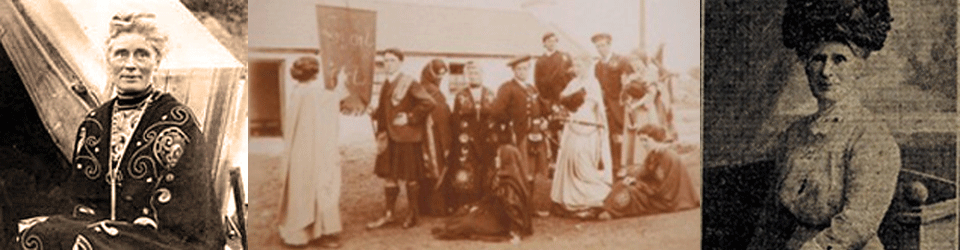
Emily Weddall, nee Burke 1867-1952 was born in Edenderry, Co. Offaly to a Church of Ireland Minister and his wife. She trained as a nurse in Sir Patrick Dun’s Hospital, on qualifying she traveled to France Germany and Russia with her career. In the early 1900’s she married retired sea captain Edward Weddall, the couple settled on Achill in 1906. Around that time she co-founded the Lower Achill Branch of the Gaelic League, and became a regular correspondent, with An Claidheamh Soluis, of which Patrick Pearse was editor. It is through these circles that Emily first met the Pearse family.

Strongly influenced by the cultural revolution of the time, of which Patrick Pearse played a pivotal role in, she co-founded Scoil Acla, an Irish language and cultural school in 1910. Their paths would cross on many occasions, socially, culturally and politically, frequently causing controversy! After 1916 she remained friends with the family and during the struggle for Ireland’s independence, living at their former home at Cullenswood. She took the side of Mrs Pearse, in rejecting the Treaty.

Emily remained a lifelong Republican, her final resting place is in Glasnevin Cemetery in close proximity to the Republican Plot.

Admission is free – no booking required.

http://pearsemuseum.ie/

Bridie Mulloy

Bridie Mulloy and Emily Weddall met when she arrived on Achill to collect the Island folklore, from the older generation before they were no more. Bridie stayed at Corrymore House, former residence of Captain Boycott, and that time was owned by Major Dermot Freyer.

Major Freyer was a friend of Emily’s,and possibly made the introduction between her and Bridie. The Major a former war veteran, bought Corrymore and turned the big house into a hotel. Well connected in artistic circles, he invited his friends to stay at his hotel and perform for the locals such as the Sadler’s Well Ballet Company and troups of Morris Dancer, he even hosted his own tea dances as Bridie mentions in the letter below.

The letter, less than 20 lines tells a lot about the life on Achill in that era. It also gives insight into the people, who lived there in a few words, the letter is a piece of folklore itself.

Croughan Mountain where Emily and friends may have had the idea for Scoil Acla

Corrymore House as it stands today

Corrymore House
Dooagh
Achill
Co Mayo

Oct 29 1948

Dear Sean

I expect by now you have given up all hope of ever hearing form me again. However, here I am still to the good. I hope you will like this note book, I feel in many ways that it contains more gossip than folklore, but perhaps, even that may be of some use. I have just started working on my Dungarvan notes, and hope to have at least, one notebook ready fro you within the next few weeks. Actually I would like if you could send me by return two notebooks instead of the usual one, as I do not think that I will be able to fit all the Dungarvan notes into one book, also what about that extra special ink for writing my folklore which some of you promised me? I am not sure as to how Pat McNulty’s “radiant blue” will stand the test of time! It is really wonderful to think that Achill is free of visitors again. We had a very busy season, but the weather was so miserable, that I cannot imagine that many people enjoyed their holidays. Our tea dances were very popular this year – I think that, it was due to the fact that there was nowhere else for people to on a Sunday. Can you imagine 150 people crammed into a lounge, some of the drinking tea and others dancing while the Major roared instructions at them, and two or three of us charged in and out among them with trays? That was our biggest crowd, but similar comedy happened ever Sunday from the beginning of July till the middle of September. So I can tell you that we thanked God when the whole business was over. Give my kind regards to Marie ni Neill and Seamus O’Dallaigh and Brid McMahon, and tell Marie that Mary Lavelle (Tony) keeps the word I should have some notes that would interest her in my next collection. The Major made a very neat job of sticking in those extra pages in the back of this notebook.

Sources
National Folklore Collection / Cnuasach Bhéaloideas Éireann NFC 1015: 54-9.

Fr Manus Sweeney

The monument below is dedicated to Fr. Manus Sweeney, who was exectued for taking part in the 1798 Rebellion.

Fr Manus Sweeney Monument, Achill

Fr Manus Sweeney Monument, Achill

The monument was erected in 1944, by a committee, that included Emily, Eva O’Flaherty and Anita McMahon. Other members of the committee were Fr. Godfrey, C.C., Brother Michael Darcy, Mrs. Barrett, Mr. Pat Mulloy, Pat Corrigan, Thady Gallagher, Michael Fadden,  Joseph Sweeney, John Barrett and Miss Malone.

In the Mayo News Article of 28th 1944, Anita relayed the following to the paper

Mrs. Weddall of Keel Sandy Banks, who, throughout, gave the same devoted service that she has given to so many other national projects during the last thirty years; Miss Eva O’Flaherty, of St. Colman’s Dooagh, who instructed by the committee with the task of find a suitable artist for the Memorial fulfilled this duty with the success shown in the present work of art, designed and with sculptured, insets by Peter Grant, A.N.C.A., who was assisted in the building up of the Monolith by Mr. John Kilbane, Achill Sound, and Mr. Pat Corrigan of Dukinella.

The unveiling proved a runaway success, with music, song and speeches, the event would stay in living memory up to this day. One of the people appointed to speak was Pat Mulloy, of Keel. He was supposed to give a talk of the local traditions associated with Fr. Sweeney, but time did not permit on that particular day. This invaluable folklore was not lost in time however, his wife Bridie was a well known folklore collector, whose work is an integral part of the National Folklore Collection at University College Dublin.


Sources
Mayo News 1893-2004*, 26.08.1944,page 3
Tuam Herald 1837-2000*; Date:Nov 28, 1942; Section:None; Page Number: 4