
Easter 2019
Claud Chevasse first came under the radar as a person of interest to the authorities, after being arrested in Cork for refusing to speak English to the arresting policeman. He was summoned to court andwas fined £5 or spend a month in Jail. Claud Chevasse would not pay the fine on principle, citing that Ballingeary was in an Irish speaking area and the sergeant could have easily have found a translator.


Like Emily and Darrell Figgis he became a person of interest to the authorities, perhaps attracting their attention after the above incident. He was arrested during the Rising and taken to Richmond Barracks, but was released a few days later as there was no substantial against him. But as a ‘rebel’ he felt that he and his fellow prisoners should have had a fair trial, but it was denied due to the chaos after the insurrection.
To make things worse his bicycle, his main method of transport was ‘mislaid’ along with it his broach, possibly the one in the picture below that he wore with pride on his brat (sash). It was a gift from Scoil Acla.


Sources:
Freeman’s Journal 04 April 1916Weekly Freeman’s Journal 13 June 1914
26 February 1916 – Wigan Observer and District Advertiser – Wigan, Lancashire, https://search.findmypast.ie/record?id=ire%2fpettys%2f005174188%2f00427&
In April 1829 Emily’s grandfather traveled with his wife and young family traveled from Co. down to Dublin in hopes that relocating to Rathmines would cure his illness. But that was not to be. It is lost in time what his ailment was. Perhaps his hopes lay in the fact that the best doctors In Ireland were in Dublin.
He was a bookseller by trade and one half or the Hodges and M’Arthur partnership, whose shop on College Green opened its doors to the Physicians of the day to hold meetings before the Royal College of Physicians in 1865. He and his partner allowed them to hold meetings in a tiny “reading room” over their shop. Perhaps they wanted to return the favor and treat him with the most up to date medicine for his ailment.

Richard M’Arthur did not get better. He lost his battle with disease in April 1829.


Sources
Hodges And McArthur 1818 Merchants And Traders Dublin The Treble Almanac 1818
19 December 1866 – Dublin Medical Press – Dublin, Dublin, Republic of Ireland
Sligo Journal 03 April 1829
Prerogative and diocesan copies of some wills and indexes to others, 1596 – 1858
| – | |
Today the Eiffel Tower turns 130. When unveiled first it was quite a marvel. “A Nineteenth Century wonder” it was called, but before Parisians saw it as a wonder to behold they were quite skeptical during construction. As one paper reported it was cited as a “Metallurgical Monstrosity.”


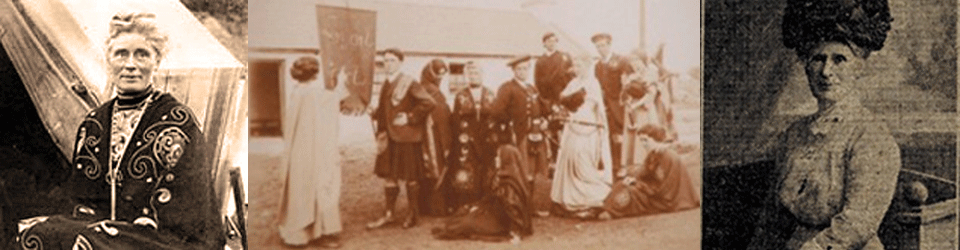
Emily visited France in the 1890’s she may have been to Paris taking in the spectacle of the newly constructed Eiffel Tower herself, or even may have a lift to highest point accessible to the public at at the time. It was in her character to do so as she was once described by a friend as “intrepid”. It is possible that she may have been to France at an earlier date as she spoke fluent French.
Sources
13 April 1889 – Fife Free Press, & Kirkcaldy Guardian – Kirkcaldy, Fife, Scotland Cambridge Daily News 03 April 1889
One hundred and ten year ago John Millington Synge died. He was only a week or so shy of his thirty eight birthday. Having only enjoyed a short period of fame, little more than half a decade, illness and eventual death cutting it short.

BIOGRAPHICALLY the most remarkable feature of Synge’s career was its brevity. In the six years which elapsed between 1903, when In the Shadow of the Glen was produced, to 1909, when he died, he rose from absolute obscurity to world fame, and provided us with six plays on which his reputation must rest” Read more:
Originally published in Minute History of the Drama. Alice B. Fort & Herbert S. Kates. New York: Grosset & Dunlap, 1935. p. 118
Emily and Synge were friends from Gaelic League and literary circles but may have known one another from their earlier years. Both came from clerical families and were similar ages, she slightly older. There is a possibility that they met in their youth. Emily’s father and Synge’s uncle were both evangelical missionaries in the 1850’s. Synge’s uncle went to the Aran Islands, with the view to converting, the islanders, Emily’s father, Mayo and Connemara. Both men were run out of town. There was a good chance they were close enough friends as Emily was one of a relatively small group that attended his funeral, traveling cross country all the way from Achill to Dublin.

Sources
http://www.theatrehistory.com/irish/synge001.html
http://www.achill247.com/writers/jmsynge.html