Typhus

Typhus fever (Epidemic louse-borne typhus)

Cause

Rickettsia prowazekii.

Transmission

The disease is transmitted by the human body louse, which becomes infected by feeding on the blood of patients with acute typhus fever. Infected lice excrete rickettsia onto the skin while feeding on a second host, who becomes infected by rubbing louse faecal matter or crushed lice into the bite wound. There is no animal reservoir.

Nature of the disease

The onset is variable but often sudden, with headache, chills, high fever, prostration, coughing and severe muscular pain. After 5–6 days, a macular skin eruption (dark spots) develops first on the upper trunk and spreads to the rest of the body but usually not to the face, palms of the hands or soles of the feet. The case–fatality rate is up to 40% in the absence of specific treatment. Louse-borne typhus fever is the only rickettsial disease that can cause explosive epidemics. (World Health Organisation)

One hundred and four years ago there was an outbreak of typhus in Connemara. The poverty in the area at the time was rife, people were malnourished, making them more susceptible to disease. The occasion was reported on in several newspapers including the Irish Independent.

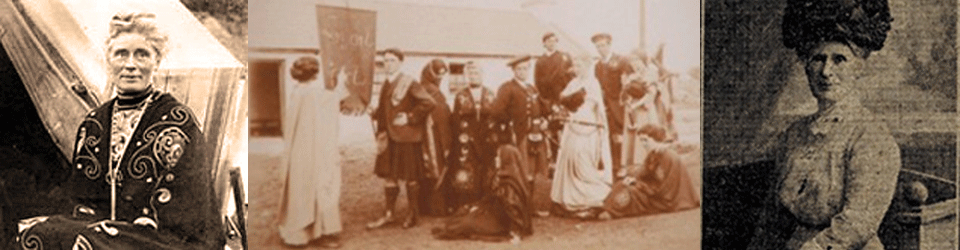
Mrs. Emily M. Weddall,Widow of the late Captain Weddall of Burnby,Yorkshire, and Rockfield House, Keel, Achill, who has hastened to Connemara to nurse the fever-stricken victims there. Founder of the Achill Irish Summer School, who is best known in Gaelic circles as Bean Ui Uadal, and it is for the sake of this last remnant of the Irish-speaking nation she is making such a heroic sacrifice.

The site where the fever hospital in Oughterard one stood

Emily however did not revel in the publicity generated by her kind gesture, but used it to highlight the poverty in that part of the county. She put pen to paper and composed the following letter to the Cliadheamh Soulis telling of the dire conditions in which the patients were living in, and the lack of basic facilities such as decent health care. She praised the Gaelic League for being the first to step up to help the poor of Connemara.

I came away last week to help look after the poor typhus patients here. I found all the typhus cases in Oughterard Fever Hospital, and only a few typhoid patients (who can’t be moved) in their own homes. I was going to write to you to ask you to insist on the establishment of a temporary hospital into which fresh cases (which are sure to occur) could be moved, but today the government representatives have at last arrived on the scene, Mr Birrrell, Sir Acheson McCullagh (Local Government Board), John Fitzgibbon, M.P., C.D.B., and Mr. O’Malley M.P. for the district. The doctor tells me that they have provided the hospital, and it is about time! The people have been treated worse than beasts should be treated, and they are almost all that remains to us of the unsullied ancient Irish race. I am glad the Gaelic League was first on the scene, but we ought to do something efficient to preserve these people and to enable them to find a livelihood in their own country…

Emily joined Rodger Casement, Augustine Birrell, Chief Secretary for Ireland and Jane Tubridy,  who was the schoolmistress at Carraroe, who saw the poverty firsthand on a daily basis, made a big campaign to attract aid to Connemara. Their combined efforts drew it the needed publicity to help remedy the poverty in the area. Under the influence of Rodger Casement a fund was set up. One contributor was William Cadbury a philanthropist and a member of the chocolate making family Cadbury’s. The campaign paid off and by Christmas of that year all children in the area were given a hot meal a day.

This is a good  example of Emily’s generosity and better example of how she used her con

connections to influence.

Connemara 1913 An Claidheamh Soluis


Sources
http://www.rte.ie/centuryireland/index.php/articles/typhus-outbreak-in-connemara
Irish Independent 1905-2011 Date:May 21, 1913;Section:None;Page Number:3
An Claidheamh Soluis May 1913. p 8
http://www.irishtimes.com/opinion/an-irishman-s-diary-1.477184

Cholera

“Every year 3-5 million people around the world are infected  with cholera and 100,000- 120,000 people die from the infectious disease, according to estimates by the World Health Organization (WHO).”

The above is from a 2016 report not that of more than a century ago, when an outbreak meant death for most that contracted the deadly disease. Nowadays a vaccine can be administrated in high risk and epidemic zones saving thousands of lives. Back in the nineteenth century there was no such vaccine as the disease was thought to have been transmitted by air. The disease is in fact  but we now know that the disease is caused by  bacteria. Cholera is spread through the ingestion of contaminated food and water. That is how it found its way on to the Bracadaile, the ship Edward Weddall was captain on in 1894/5.

The ship carrying mostly emigrant workers from Calcutta in India to St. Lucia in the West Indies, when cholera broke out. This particular stain of cholera originated on the banks of the Ganges making its way to the port of Calcutta and then on broad Captain Weddall’s ship in the water supply and in the food.

Edward Weddall, just like any other sea captain would have placed high importance on hygiene on board his vessel, as it was vital to the survival of all on board. The Health Authority of the United States, stated in regards to the cholera epidemic of 1894/5:

Sanitary service at sea. Second only in importance to securing at the foreign port a clean vessel and uninfected freight, with the crew and passengers in healthy condition, is a sanitary service at sea that shall preserve the cleanliness of the ship and the health of the crew.”

The above would have been implemented by the captain when leaving port, but as it has a twelve hour to five day incubation period symptoms may not have been recognized till the ship was far out at sea. By then the Blue Death because the victim turns a blue hue from dehydration, had well taken it’s grip, claiming the lives of 21 passengers and one crew member. Captain Weddall telegraphed the port authority with the grim news to prepare the for the arrival at  Saint Lucia, but the ship was quarantined until the disease had run it’s course.

REPORT OF THE NATIONAL BOARD OF HEALTH. WEST INDIES. BARBADOS.

[Report by Consul Holley. ]

‘ I have the honor to report the following Government telegrams from Saint Lucia, telegraphed as general news to the commercial body of this island, viz, August 3: *’ The ship Bracadaile, with immigrants from Calcutta for this island, arrived to- day. Reports having had 31 cases of cholera on board, 21 of whom, including one of the crew, succumbed. No fresh cases have occurred for twenty-nine days. Vessel quarantined.”

August 6. — The administrator officially announces that the  ship has been free from sickness since leaving the Cape on the 9th of July, and that all are well on board. No communication whatever has been or is allowed with the ship, which has been sent to ride out her quarantine of observation in a bay 5 miles from Castries Island perfectly healthy, and clean bills of health are being issued.

August 16. — It is officially announced that the ship Bracadaile left this morning for New York without having communicated with the mainland. The passengers were landed yesterday on the quarantine island, about a mile and a half from main- land. On landing all clothing was burnt ; the only articles of any kind which were’ landed from the vessel were jewelry and metal drinking vessels. The passengers are in , strict quarantine. The general health among them has been good, and there has been no cholera since 10th July.” In consequence of the telegram of the 16th August, I cabled the following to the Department of State, viz : ‘* Ship Bracadaile left Saint Lucia 16th — New York — had cholera.” I observe by New York Herald, August 11, that the steamship Bracadaile, with Saint Lucia advises, arrived, and was quarantined at Havana August 10. This is undoubtedly the ship referred to in the foregoing official telegrams.

ROBERT Y. HOLLEY.

Captain Weddall with the remainder of his crew arrived home at Tyne on February 18th 1895, having survived this infectious and deadly disease. It was not an unusual situation, life in general was precarious and life at sea more so. He survived this time but would contract a tropical disease later forcing him into early retirement.

Sources
http://www.who.int/wer/2016/wer9138/en/
Full text of “Annual report of the National Board of Health. 1885
http://www.choleraandthethames.co.uk/cholera-in-london/origins-of-cholera/
Image:
Sanatory Committee, under the sanction of the Medical Counsel, in New York City New York Historical Society Wilford, John Noble. “How Epidemics Helped Shape the Modern Metropolis.” The New York Times. April 15, 2008. – And “Plague in Gotham! Cholera in 19th-Century New York.” New York Historical Society. April 04, 2008 – August 31, 2008.

Shipwreck #1

Disasters at sea were all too commonplace when Edward Weddall was a mariner. Before modern technology it was more difficult to predict weather patterns and communications with shore were limited as Emily’s husband Edward Weddall recounts in his letter to a newspaper below. The event of the night of 12th December 1869 resulted in the loss of  The Lady Flora, on which Edward Weddall first mate off the Island of Heligoland, in the North Sea. This may have been his first brush with death in his ten years at sea. He survived to tell the tale and to express his gratitude  for the kind treatment he and his fellow shipmates extended by the islanders. His letter to the Hull and Eastern Counties Herald of December 30th 1869;

Lady Flora in Lloyd’s Register of Ships 1865

The Loss of the Lady Flora

To the Editor of the Herald
Sir- During the fall of 1868 I remember seeing in your paper a story of the unkind treatment received by the crews of some Hull fishing smacks that were lost on the island of Heligoland at that time. I wish now, on the part of myself and the remainder of the crew of the Lady Flora, steamer, to state my experiences of the conduct observed towards use and the reception given us by the governor and the inhabitants, when we landed there from the wreck of the steamer, on the 16th instant.

Our second boat, after leaving the wreck, was unable to reach the island, on account of the terrible sea which was running and being in addition stove in in two places, our escape sensed almost hopeless; yet in the face of the awfully heavy gale and tumultuous sea, the islander out in there or four boats to our assistance, and eventually landed us safe on the island, which, but for their help, we should never have reached. On landing we were in a naked condition, and half dead from cold and exposure. They took us up to the houses, where the had already for us hot water for baths coffee and other restoratives and immediately provided us with new dry clothing which the had the greatest difficulty in obtaining having to send the bellman round the island asking who had a coat or other article of clothing for sale.

Owing to the stress of weather there was no communication with the main land, and we were detained on the island three days. during this time the governor (the Hon. Mr Masse) seconded by the port captain, Mr, Mains, showed us every kindness and attention in their power, visiting us three or four times a day to see if we were comfortable and had all our wants supplied. As an instance of their extreme kindness to all of us, I may mention that they even supplied the whole with pocket-handkerchiefs and other small articles of comfort, and the governor sent us a complete suit of his own clothing, even the studs for the shirt. He himself was the very first to volunteer to come off to our aid the they from the island observed the ship to be sinking.

I am requested by the whole of the crew (as well as obeying my own feelings) to endeavor to express out sincere gratitude to the governor, to Mr Mains and to the whole of the inhabitants generally for the unceasing kindness and attention shown to us while on the Island.

The death of Captain Borstal who was drowned while endeavoring to clear away the boats, and thus div a chance of escape to the crew, was mainly owing to his exhausted condition, he having had no rest since the Sunday previous (four whole days and nights), and when in the water was totally unable to help himself, and we were utterly unable to reach him. The other two poor fellows were lost as the vessel settled down and the boats were washed off the deck. With these three unfortunate exceptions, the whole of the crew have this day arrived safely in Hull by the s.s. Leopard, Captain Hedgecock, to whom I, in the name of the whole crew, wish to express our heartiest thanks for the kind and generous treatment accorded to us on board his ship. – I am, sir, yours respectfully, Edward Weddall,
Late Chief Mate of the s.s. Lady Flora.
Hull, 23rd December, 1869

Sources
Hull and Eastern Counties Herald 30 December 1869
http://www.wrecksite.eu/wreck.aspx?188777
http://www.lrfoundation.org.uk/public_education/reference-library/register-of-ships-online/

Sailing the Seven Seas

Captain Edward Weddall’s career took off when he became a master mariner in 1870. His name appeared frequently in trade publications such as Shipping and Mercantile Gazette and Lloyd’s List. His journeys were reported on in local and national papers in the Latest Shipping columns, rarely seen in papers nowadays. In the time before air travel, the shipping routes were as busy as the airlines of today.


The s.s. Bracadaile, of Newcastle, 1416 tons register, Captain Weddall, has arrived in the roadstead, after quick voyage from New Orleans, with 2770 tons maize for the Distillers’ Company.  

The s.s. Bracadaile‘s Captain Weddall, of Newcastle, left Gibraltar for Castlellamare and Genoa on the 6th inst.

Sources
10 October 1883 – Fife Herald – Cupar, Fife, Scotland
07 October 1884 – Shields Daily News – Tynemouth, Tyne and Wear, England

Captain Edward Weddall

On July 15th July 1870 Edward Weddall,  became a master mariner. At the age of twenty six and more than a decade at sea he had climbed up through the ranks was now a sea captain. To reach the top of his profession he would have had to reach a level of competency as outlined below.

Captain Weddall would spend the next twenty five years at sea, until he was forced into retirement after contracting a tropical disease.

A MASTER must have served one year as a Mate in the Foreign or Home Trade. In addition to the qualifications required for a mate, he must show that he is capable of navigating a ship along any coast, for which purpose he will be required to draw upon a chart produced by the Examiner the courses and distances he would run along shore from headland to headland, and to give in the writing courses and distances corrected for variation, and the bearings of the headlands and lights, and to show when the course should be altered either to clear any danger, or to adapt it to the coast. He must understand how to make his soundings according to the state of the tide. He will also be questioned as to his knowledge of the use and management of the mortar and rocket lines in the case of the stranding vessel, as explained in the Official Log Book…

Sources
Ancestry.com. UK and Ireland, Masters and Mates Certificates, 1850-1927 [database on-line]. Provo, UT, USA: Ancestry.com Operations, Inc., 2012.
http://www.mariners-l.co.uk/GenBosunMastersExam.html
Thanks to
House Museum Infante Dom Henrique, Porto, Portugal