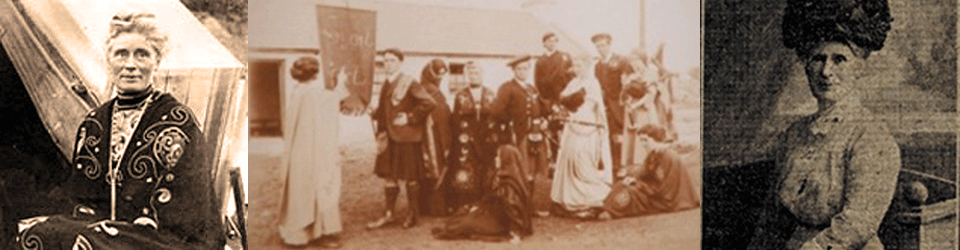
French

Emily Weddall was fluent in French, a language that she would speak with anyone that would converse with her in it. She would have learned French as a schoolgirl at the Irish Clergy Daughter’s School. Her education there was geared towards finding employment as a governess, or a similar profession. At the time Emily attended the principal was Lady Mrs Danner. The subjects offered were; Holy scripture, English, French, German, Italian, Latin, geography, arithmetic, reading, needlework, pianoforte, vocal music and drawing.

Clergy Daughter’s School

Established in 1843 and incorporated by scheme of the Education Endowments Commissioners, 1894 the school was situated on Earlsfort Terrace, Dublin and shared premises with Alexandra College. Its object was to assist the clergymen and families of clergymen with limited means in the education of their children. The School catered for girls aged ten to eighteen whose fathers were Church of Ireland clergymen. The school closed in 1969. The site in Earlsfort Terrace was sold and the funds used to support boarding at Alexandra College and elsewhere.

Earlsfort Terrace, Dublin, where Emily attended school in the 1870’s and 80’s.

Emily did not pursue a career as a governess but instead as nurse. It was not necessary to have a second language to study nursing, but it did help to broaden her nursing options. Being a fluent French speaker helped her secure employment in France.

Sources
Clergy Daughter’s School Reports 1868 – 1886. Courtesy of Church of Ireland Library.


Language

Emily was a fluent French speaker. She also had a good command of German, and lastly she spoke Irish too, perhaps not as well as the first two. She may have grown up listening to her father speak in his native tongue but she would not have been taught it at school, given the time it was not encouraged. When the Gaelic League was set up in the 1890’s it became ‘fashionable’ to speak Irish.

The Gaelic League, or Conradh na Gaeilge, was founded in Dublin on July 31, 1893 by Douglas Hyde (Dubhghlas de hÍde in Irish), a Protestant from Frenchpark, County Roscommon with the aid of Eugene O’Growney, Eoin MacNeill, Luke K. Walsh and others. The league developed from Ulick Bourke’s earlier Gaelic Union and became the leading institution promoting the Gaelic Revival…

Read more:https://www.cnag.ie/en/info/the-irish-language/a-brief-history-of-conradh-na-gaeilge.html

As a Nationalist Emily promoted the Irish language, speaking it when and where possible. The purpose of Scoil Acla was to promote the speaking of Irish. She was also masterful at writing it too, as a regular correspondent with the Gaelic League’s weekly, An Claidheamh Soluis.

Achill Summer School
The Achill Summer School has been closed for this year. It was small but in every way a remarkable success. Its promoters claim that it has accomplished all that they had hoped from its institution. it has turned the tide of Anglicisation. it has been a pure well of Gaelic spirit and enthusiasm in an arid and neglected district. It has refreshed and renewed all who have had the happiness to visit it. Its good work has made itself felt all over the country side. Next year it will open with a reputation already made.

Emily Weddall  


Sources
https://www.cnag.ie/en/info/the-irish-language/a-brief-history-of-conradh-na-gaeilge.html
An Claidheamh Soluis September 16th 1911  P. 8

Superstition

The superstition around Fr. Manus Sweeney is what myths are made of. There is superstition around his life and death that even reach beyond the grave.  Bridie Mulloy recorded much of it in her folklore collection. Most of the informants stories matched with of course slight variations but the general consensus was that the was certainly something myth-like about the patriot priest.

The most mysterious occurrence which is sadly fading from living memory has to be when Emily, Anita, Eva and the committee for the erection of a monument dedicated to Fr. Sweeney back in 1944. Theresa McDonald recorded the folklore of the event in her book Achill Island;

The people of Achill decided to build a monument to commemorate his death, but could not agree on a suitable location. One evening, two men saw a bright light down on the shore beside Fr. Manus’s old home in Dookinella and, needless to say the monument was erected there, where it stands to the present day.

1798 Monument in Castlebar

1798 Monument in Castlebar

A myth that lives on but is all but forgotten is the one that since Fr. Sweeney was hanged it always rains on market day in Newport!

Market Day in Newport in the Rain

Market Day in Newport in the Rain


Sources
McDonald, Theresa. Achill Island. Tullamore: I.A.S, 1997. p341
Mayo News 1893-2004*, 26.08.1944, page 3

Curse

So the Rebel Priest was hanged at Newport, Co. Mayo;

“Shortly afterwards a game-keeper passed by with his dog and gun, and saw the priest hanging on the crane. But instead of saying “Beannacht Dia ar a anam” no fada mar sin” he looked up and said he “Nac ard ara saol an saggart croicad  iniu” The scoundrel he was a noted rascal that fellow, he was one of Sir George O’Donnell’s nominees, but he got his reward, he did then. He went to the mountain with is dog and gun and he never returned, he got lost and there was no trace of him till several days afterwards when the dogs of the town found his remains on the mountain and dragged them thought the streets. I never heard of what happened to the body of Fr. Manus”

Fr. Sweeney remains were taken nearby Burrishoole Abbey, where he was buried with his parents. In 1922 a monument was erected to the memory of the Patriot Priest. He was not forgotten at his birthplace of Achill, when in 1944 Emily, Anita and Eva with the help of a committee and the islanders erected a monument too.

Fr Manus Sweeney Monument, Achill

Fr Manus Sweeney Monument, Achill


Sources
Pat Molloy, Keel, Achill;  NFC 1015: 54-9
http://www.mayo-ireland.ie/en/towns-villages/newport/history/fr-manus-sweeney.html
Special Thanks
Dr. Críostóir Mac Cárthaigh, Interim Director National Folklore Collection / Cnuasach Bhéaloideas Éireann University College Dublin / An Coláiste Ollscoile, Baile Átha Cliath


The Sentence

dscf3453“They held a special court and sentenced him to be hanged from an old crane in the market square. This crane was usually used fro weighing commodities, potatoes and and such like. We come to the day of this execution now. On that day in June 1799 all the business places in the town were closed up, land there was no traffic allowed on the thoroughfare.

When he was about to be hanged, the priest called for a drink of clean water, but there was no response to his request from his executioners. At the same time there was an old man of the name of Barrett walking along the street. He heard the priest calling for a drink, but there was no means of getting any vessel, cup, mug or anything else to bring it to him. This poor man Richard Barrett took off his boot and cleaned it, and went to a stream and brought it back full of cold water to the priest. The priest took it, and drank and said in Irish to him Fad  saol is sean agat agus glor na bfalathas ar an saol eile agat:” We are told that that man lived to a great age and died a most peaceful and happy death. He was from a place called Tirwaley.”

Sources
Pat Molloy, Keel, Achill;  NFC 1015: 54-9
Special Thanks
Dr. Críostóir Mac Cárthaigh, Interim Director National Folklore Collection / Cnuasach Bhéaloideas Éireann University College Dublin / An Coláiste Ollscoile, Baile Átha Cliath