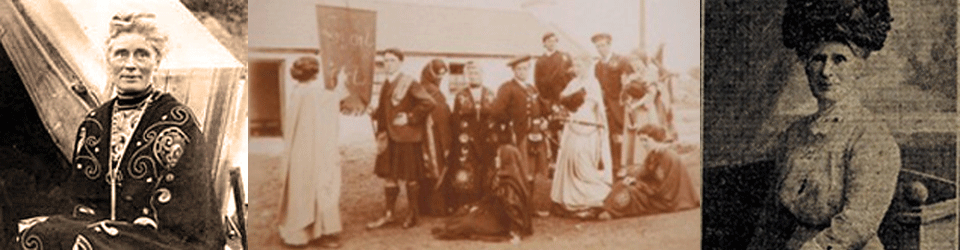
Emily’s Great Grandfather

Two hundred years ago Daniel Graisberry’s obituary appeared in the London News. Daniel Graisberry was well respected and liked in the print trade and in his personal life. He often sat on committees and was a member of the City of Dublin Grand Jury.

Daniel Graisberry died at the relatively young age of forty three or four, leaving a wife and five daughters behind. Although his ancestors did well during the golden age of printing in the previous century the family fortune had waned over the years. After his death his wife, Ruth was thrown into turmoil over how to support her family. As mother of five yet to be married daughters, it was left to her to provide for them. But Ruth Graisberry was a resourceful woman. Wasting no time she petitioned Trinity College, where her late husband was official printer, to allow her to take up where he had left off. Her case was helped greatly by the backing of some of the well respected printers of the city, resulting in the college keeping her on as their chief printer. She took on an apprentice, Michael Gill, who eventually became her printing partner.

Long Room in Trinity College Dublin, where Daniel Graisberry was College printer

In the years that followed the five Graisberry sisters married. Mary her eldest married bookseller, Richard McArthur, whom were parents to Richard junior and Emily, Emily’s mother.

Sources

The News (London) 10 March 1822

Saunders’s News-Letter 30 April 1821

https://www.dib.ie/biography/graisberry-daniel-a3568

15 June 1825 – Saunders’s News-Letter – Dublin, Dublin,

The Irish Constitution February 1922

From February to May 1922, The Shelbourne played host to its most historic meetings: the drafting of Ireland’s first Constitution. Under the chairmanship of Michael Collins, the committee met in room 112, to write the Constitution of the Irish Free State. This room is now The Constitution Suite, and contains the original table and chairs.

https://www.theshelbourne.com/history
Courtesy of the Shelbourne Hotel

In February 1922, when the Irish Free State was about a month old, the provisional government held a special meeting to set the Constitution.

Courtesy of Shelbourne Hotel

“The team: Mr. Michael Collins, Chairman; Mr. Darrell Figgis, Acting Chairman: Mr Hugh Kennedy, Mr. James Murnaghan, Mr James MacNeill, Professor Alfred O’Rahilly, Mr. Kevin O’Neill, Mr. John Byrne. Assistance is being given by persons who are acting in specialized capacities.”

Munster News 01 February 1922
Courtesy of The Shelbourne Hotel

The Constitution took about six months to complete was ratified by the Dail in October 1922. Darrell Figgis, vice-chairman, did the lions share of work on it as chief, Michael Collins was frequently absent from the committee, due to his other political commitments. Having spent so much time working on it, later that year he published a book entitled; The Irish constitution explained.

Sources

https://www.theshelbourne.com/history

Munster News 01 February 1922

https://www.gutenberg.org/files/32612/32612-h/32612-h.htm

https://www.dib.ie/biography/figgis-darrell-a3078

Playboy

On this day 115 years ago Playboy of the Western World premiered at the Abbey Theatre. Instead of being applauded at by an appreciative audience, it was met by a booing hissing and stamping of feet, in what became known as the “Playboy Riots”. The play caused much consternation among Nationalists who were affronted by Synge’s depiction of Irish peasantry. The moralistic members of society were scandalised by the mention of the word ”shifts” (lady’s undergarments).

Playboy of the Western World, main character Christy Mahon was based upon the life of notorious Achill man, James Lynchehaun. Although when asked if Lynchehaun was his muse, Synge did not confirm nor did he deny leaving critics of the time guessing. “Well, all I can say is, that it if he based it on the true facts of Lynchehaun’s escape he could have made a play that would at least be good melodrama” one proclaimed.

Synge, who was too ill to attended the opening night was eventually forced to write to the press to defend his work:

Synge’s letter to the press

Abbey Theatre manager, W.B. Yeats, who was also absent on the opening night due to a commitment in Scotland, invited a live audience to an open discussion on “The Freedom of the Theatre and Mr. Synge’s Play”.

It is difficult to say how Emily, who was a good friend of J M Synge felt about the controversy surrounding his latest work. She was a dyed in the wool Nationalist, suggesting that she might have disapproved of his portrayal of the Irish peasantry. Emily, always loyal where her friends were concerned may very well have been happy for his unconventional success.

Sources

Dundee Courier 31 August 1903 p 3

Search terms Download PagePrint Page Back to Search Results Image (purchased)

Irish News and Belfast Morning News 31 January 1907

https://discover.hubpages.com/education/The-Playboy-and-the-Yellow-Lady

Dublin Evening Telegraph 31 January 1907

http://www.achill247.com/writers/jmsynge5.html

Keys of the Castle

On this day one hundred years ago the British Government handed over the keys of Dublin Castle, to Michael Collins. https://www.dublincastle.ie/16-january-1922-remembering-the-handover-of-dublin-castle-to-michael-collins/

Collins issued the following press release: ‘The Members of the Provisional Government received the surrender of Dublin Castle at 1.45 pm today. It is now in the hands of the Irish nation’.

If Emily was in the crowd that day, it was only to have the pleasure of seeing a foreign power leave, and certainly not in support of the Irish Free State instead the Republic proclaimed on the steps of the GPO in 1916.

Sources

https://www.dublincastle.ie/16-january-1922-remembering-the-handover-of-dublin-castle-to-michael-collins/
(https://www.rte.ie/history/the-ban/2020/0401/1127789-cumann-na-mban-a-photo-essay/)

Freeman’s Journal 17 January 1922

Weekly Freeman’s Journal 21 January 1922

Voting on the Treaty

One Hundred years ago today the Anglo Irish Treaty was ratified by Dail Eireann. It was signed in London on December 6th 1921, by a negotiation team of Michael Collins, Arthur Griffiths, Arthur Robert Barton, Eamonn Duggan and George Gavan Duffy. When they made the return journey to Dublin they did so with heavy hearts knowing well that it would spit political and public opinion.

Eamon de Valera, who had refused to travel to London as part of the delegate rejected it completely, as did many other Dail members. Democratically the terms of the Treaty was opened to debate inside the Dail chambers. Tempers flared, members quit and the discussion continued throughout Christmas 1921 and into the first week of the New Year. On January 7th, the matter finally went to vote, resulting in the Treaty being ratified by a very slim margin of 64 to 57.

tps://www.rte.ie/centuryireland/index.php/articles/dail-votes-for-historic-treaty-by-margin-of-just-seven-votes

Oak Room in the Mansion House Dublin Jan 1922

Emily along with the majority of Cumann na mBan rejected the terms of the Treaty completely. A convention to for early February to; “reaffirm their alliance to the Republic of Ireland”. At the convention every member cast their vote. A staggering eighty six per cent of members were against the Treaty.

Sources

https://www.irishtimes.com/news/negotiating-the-treaty-1.95329Documentation-Discoveries/Artefact/The-Signing-of-the-Anglo-Irish-Treaty,-1921/7a49e7e5-7cf7-4218-b3b4-c974d4adafa6

https://www.rte.ie/history/the-ban/2020/0401/1127789-cumann-na-mban-a-photo-essay/)

https://www.irishexaminer.com/news/spotlight/arid-40774302.html

(https://www.rte.ie/history/the-ban/2020/0401/1127789-cumann-na-mban-a-photo-essay/)
Cumann na mBan. Copy Agenda of the Cumann Na MBan Special Convention.

Freeman’s Journal 06 January 1922

Illustrated London News 21 January 1922