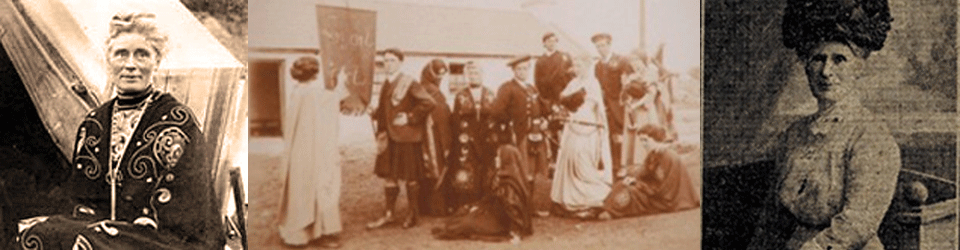
On this day, December 6th 1921, the Anglo Irish Treaty was signed. A press release written by Arthur Griffith announced the result of many months of negotiating between the British Government and the Treaty delegation team of Griffith, Michael Collins, Robert Barton, Eamonn Duggan and George Gavan Duffy.
“I have signed a Treaty of peace between Ireland and Great Britain. I believe that treaty will lay foundations of peace and friendship between the two Nations. What I have signed I shall stand by in the belief that the end of the conflict of centuries is at hand”.
On this day 1976 RTE aired a documentary about Three Candles Press on Radio na Raidio na Gaeltachta. Founder, Colm O’Lochlainn was one of the original members of Scoil Acla and a friend of Emily’s. In 1926 he founded Three Candles Press. Each candle represented one of the principles of truth, wisdom and knowledge. The business, was ahead of its time in the way it put the quality of its work and care of its employees ahead of profit.
His real love over printing and the politics of the Revolutionary period, which he was involved in for a time, was music and the collection of Irish Ballads, which he made his life’s work. Along with his friend Seamus Ennis, contributed greatly to the collection and retention of tunes that may have, without their intervention have got lost in the mists of time.
Sources
William Gerard O’Loughlin was born in Dublin on the 11th of October 1892. His father John O’Loughlin was a travelling sales representative for a printing company. His mother was a Delia (Bridget) Carr from Limerick City whose family were wealthy and in the printing business...Read more
This is a very short ghost story, perhaps the shortest ever told. Complete in three sentences it tells a lot but explains little.
“There was a woman in Achill who was expecting visitors one night. It was getting late. And she sat on the chair and she fell asleep. When she got up she saw a funeral outside the window. Then she said “Lord save me” and it disappeared.”
After the Easter Rising more than 3,000 were arrested for their part or their supposed part. One was Emily, who was held on Remand at Tullamore Gaol for a week, for “…acting in such a manner as to give reasonable grounds for suspecting that she was about to act in a manner prejudicial to the Defense of the Realm”. The Act was passed when WWI broke out in 1914 to control communications at the ports around Britain and Ireland, and subject civilians to the rule of military courts. It was also under D.O.R.A the leaders of the Rising were tried and condemned to death under. Those who were not given the Death Penalty, were given various sentences, the more extreme rebels were sent to prisons across Britain, such as Emily’s friend Darrell Figgis. One such prison was Frongoch in Wales.
The abandoned distillery was repurposed as a prisoner of war camp during WWI
Frongoch, an abandoned distillery was initially used to house prisoners of war. It was sort of repurposed as a detention centre for prisoners of the Rising. The camp comprised of cold, dank, rat infested huts, equally if not more dismal than prison cells. The internees only real comfort was that they were free to mix and mingle with one another. Nevertheless they overheated in the summer and frozen in the colder months of late autumn and early winter, but were ‘saved by the bell’ when they were released just before Christmas 1916 otherwise some may have perished during coldest time of the year. As early as the summer Irish MP, Mr. Ginnell put it to the Home Secretary whether the food given to the Irish prisoners was sufficient for the healthy young countrymen. Mr. Samuel replied; “The diet is identical with that supplied to military and naval prisoners of war and is amply sufficient to keep the prisoners in good health”. It was not. But the Committee of the Irish National Aid and volunteer Dependents’ Fund, which Emily collected and gave generously to, intervened. They set out to make sure that the internees were not deprived of ‘celebrating’ “Hallow Eve”. They put the notice below in the newspapers:
On this day 1867 Emily was born at Windsor Terrace, Edenderry, County Offaly, then King’s County.
On this day one hundred years ago Emily turned 54. At the time a treaty between Ireland and Britain was in the process of being ironed out between both sides. But there was there was a lot more to do with many letters, telegrams and phone calls crisscrossed the Irish Sea until the situation came to a head in December. He spoke at an event in aid of Irish Republican Prisoners in Shelbourne Park, Dublin, that Emily if she was in Dublin at the time would have attended.
Sources
Derry Journal 25 September 1867
30 September 1921 – Freeman’s Journal – Dublin, Dublin, Republic o