Five years ago today the first blog post of ‘The Life and Times of Emily M. Weddall’ went live. Happy fifth anniversary!

Special thanks to Tina O’Rourke https://missdaisypatterns.com/
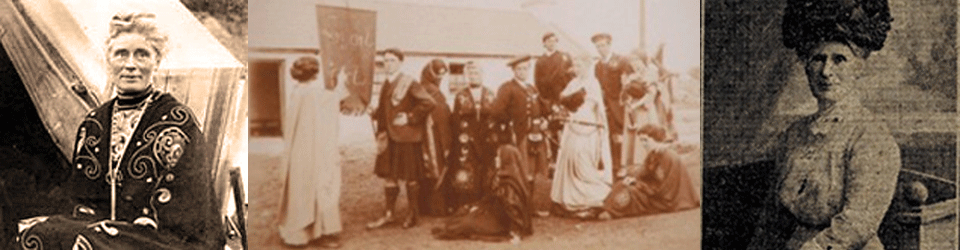
Five years ago today the first blog post of ‘The Life and Times of Emily M. Weddall’ went live. Happy fifth anniversary!
Special thanks to Tina O’Rourke https://missdaisypatterns.com/
Seachtain na Gaeilge (Irish language week)
Established by Conradh na Gaeilge in 1902, the festival runs from 1 – 7 March every year and has gone from strength to strength in recent years. It is now one of the biggest international celebrations of our native language and culture.
https://cnag.ie/en/
By 1904, two years after Seachtain na Gaeilge was introduced the festival was well established, and well attended thanks to the efforts of the Gaelic League. By 1905 the festival became a demonstration of Irish Ireland.

The Irish Language procession yesterday through the principal thoroughfares of the city afforded, one again, a very striking proof of the hold which the moment initiated by the Gaelic League has taken upon the Metropolis of Ireland and the districts adjoining. In most respects the features of the procession closely resembled those of previous years. the several branches of the League in the city and suburbs ewer well represented, and walked may hundreds strong, in the ranks of the processionists.
Irish Independent 13 March 1905

In 1905 the Great Language Procession, was an advance of the previous three years. It had by and large a political as much as a cultural element. It was as much a cultural protest; “The powerful protest against the hostility of the G.P.O. expressed dramatically in tableau, repeated in hundreds of printed legends, and echoed in countless personal denunciations.” as reported in the Irish Independent. It was a showcase for indigenous Irish industries too. Baker’s showed off their bread and cakes, even boot-makers showed off their wares too. The youth named as “Young Ireland” was well represented by pupils from the Christian Brother’s as well as other organisations.
The good and the great of the Gaelic League were present founder, Douglas Hyde, Dr. Walsh Archbishop of Dublin and Patrick Pearse, lead the procession. Other lesser known attendees, including Emily were listed too:

A few days later Saint Patrick’s Day was celebrated with equal pageantry, a fortnight later Emily Burke made her way to London to become the second Mrs. Weddall and eleven years later in 1916 outside the mentioned G.P.O, some of the people listed declared Ireland a Republic.
Sources
Irish Independent 13 March 1905 Wicklow People 12 March 1904In February 1920 when the War of Independence was but a year old a curfew was enforced on the people of Dublin:

At the time Emily was resident in Ranelagh and employed as a nurse. Fortunately, for Emily, exceptions were considered for Clergymen, doctors and nurses engaged on duty. As might be expected she had to apply in writing to the permit officer at Dublin Castle. She may well have applied, but not necessarily for medical purposes. It was not uncommon for members of Cumann na mBan, like Emily to move about the city delivering secret messages between Irish Republican Army members. Hiding behind her nurse’s uniform, she was almost above suspicion, however she could be challenged by any policeman, non-commissioned officer or an on duty soldier. If she failed to comply with orders in any way it would have been as advised on notices at her own peril. None of the rules would have bothered Emily!
Sources
Weekly Freeman’s Journal 28 February 1920
In February 1920 Anita McMahon wrote to three national newspapers making a good case for why the Achill Railway should have been extended as far as Keel. It make a lot of sense at the time, “motor services” were thin on the ground, with few cars and lorries on the road. Goods were transported locally by horse and cart. Times were changing even then.
The fishing industry on Achill could flourish and provide more local employment was not flourishing as it could. The fish caught on the island was going to waste as there was no way to transport it inland while fresh. There were other industries on the island that could benefit from a better goods transport system too.

Anita explained that Achill had a very large population, about 6000 at the time, who were very intelligent and industrious. A extension to the railway at Achill Sound would not be wasted as there would surely be developments in the industries already on Achill, should the extension be built. She also pointed out that “the Congested Districts Board would of course welcome any project to develop the Island.” The reply:

The railway was never extended to Keel. Years later in 1937 the railway closed for good. The reason at the time was that the roads were to be developed and the railway was no longer required.

Sources
Dublin Evening Telegraph 26 February 192026 February 1920
27 February 1920 – Irish Times – Dublin, Dublin, Republic of Ireland
07 July 1951 – The Sphere – London, London, England
Derry Journal 15 September 1909
It was almost a year since the first shots of the War of Independence were fired. The conflict which was ratcheting up all over the country at the dawn of 1920. The country was heading fast into one of the most turbulent times in Irish history. The attacks and ambushes that typifies guerilla warfare were commonplace. There was no knowing when a brutal attack would occur.

Emily who was no stranger to violence. As a daughter of convert priest, brutal attacks on her and her family were all too frequent. She was more equipped than most to deal with the turmoil that was unfolding in her country. She traveled between Dublin and her home in Achill. Her financial situation which fell on hard times in the wake of the Russian Revolution of 1917, when her shares in Russian industry were wiped, forced her to return to her old profession of nursing to keep her house in Keel. She was living at an address in Ranelagh, Dublin in the early 1920’s and was working as a nurse in the old Meath Hospital at the time. There was evidence by the way of the local Gaelic League that she spent time in Achill.

Sources
Dublin Evening Telegraph 03 January 1920
Weekly Freeman’s Journal 27 November 1920