Category Archives: Nursing

The Last Days of Darrell Figgis (1)

Darrell and Millie Figgis spent almost a decade on Achill. They were friends of Emily and possibly knew her from before their arrival on the island in 1913. Emily was possibly related to Millie and may have shared a grandfather Richard McArthur, who was originally Northern Ireland as was Millie. Emily may have known Darrell Figgis too as her family were in the book trade as were some branches of his.

The Figgis’ and Emily lives were closely linked during the Revolutionary years and for a brief period after. The trio attended the historical funeral of Jeremiah O’Donovan Rossa at Glasnevin Cemetery in 1915, a well documented event. They even appear in photographs of the event, but not together.


When Figgis spent time in jail in 1918 Emily, who was a nurse by trade, took time out from her busy schedule to nurse Millie, when she was struck by the deadly virus, that claimed more that the previous war had. Millie who had a weak heart was not expected to live. Emily forthright as ever took it upon herself to write to the Chief Secretary of Ireland’s office to grant Millie’s husband compassionate leave from his internment. Unfortunately Emily’s word alone did not carry much weight as was noted by the authorities:

“Mrs Weddalll is a Nurse in the Meath Hospital; she belongs to Achill, and is a personal friend of Mrs Figgis. It is said that this Nurse holds Extreme Views.”

Darrell Figgis was granted leave and Millie survived. But the worst was yet to come.


Sources
Easter Rising Stories by Marcus Howard
Public Record Office of Britain CO 94/201/141


Typhus

Typhus fever (Epidemic louse-borne typhus)

Cause

Rickettsia prowazekii.

Transmission

The disease is transmitted by the human body louse, which becomes infected by feeding on the blood of patients with acute typhus fever. Infected lice excrete rickettsia onto the skin while feeding on a second host, who becomes infected by rubbing louse faecal matter or crushed lice into the bite wound. There is no animal reservoir.

Nature of the disease

The onset is variable but often sudden, with headache, chills, high fever, prostration, coughing and severe muscular pain. After 5–6 days, a macular skin eruption (dark spots) develops first on the upper trunk and spreads to the rest of the body but usually not to the face, palms of the hands or soles of the feet. The case–fatality rate is up to 40% in the absence of specific treatment. Louse-borne typhus fever is the only rickettsial disease that can cause explosive epidemics. (World Health Organisation)

One hundred and four years ago there was an outbreak of typhus in Connemara. The poverty in the area at the time was rife, people were malnourished, making them more susceptible to disease. The occasion was reported on in several newspapers including the Irish Independent.

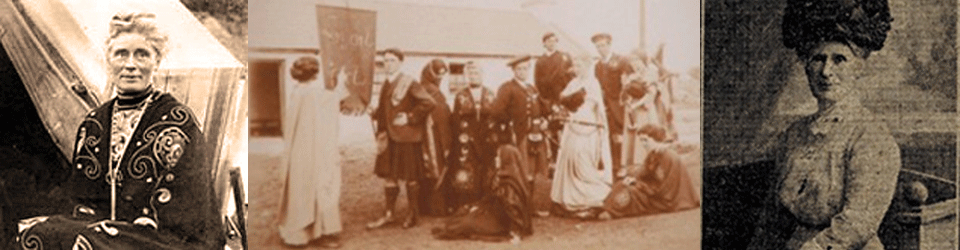
Mrs. Emily M. Weddall,Widow of the late Captain Weddall of Burnby,Yorkshire, and Rockfield House, Keel, Achill, who has hastened to Connemara to nurse the fever-stricken victims there. Founder of the Achill Irish Summer School, who is best known in Gaelic circles as Bean Ui Uadal, and it is for the sake of this last remnant of the Irish-speaking nation she is making such a heroic sacrifice.

The site where the fever hospital in Oughterard one stood

Emily however did not revel in the publicity generated by her kind gesture, but used it to highlight the poverty in that part of the county. She put pen to paper and composed the following letter to the Cliadheamh Soulis telling of the dire conditions in which the patients were living in, and the lack of basic facilities such as decent health care. She praised the Gaelic League for being the first to step up to help the poor of Connemara.

I came away last week to help look after the poor typhus patients here. I found all the typhus cases in Oughterard Fever Hospital, and only a few typhoid patients (who can’t be moved) in their own homes. I was going to write to you to ask you to insist on the establishment of a temporary hospital into which fresh cases (which are sure to occur) could be moved, but today the government representatives have at last arrived on the scene, Mr Birrrell, Sir Acheson McCullagh (Local Government Board), John Fitzgibbon, M.P., C.D.B., and Mr. O’Malley M.P. for the district. The doctor tells me that they have provided the hospital, and it is about time! The people have been treated worse than beasts should be treated, and they are almost all that remains to us of the unsullied ancient Irish race. I am glad the Gaelic League was first on the scene, but we ought to do something efficient to preserve these people and to enable them to find a livelihood in their own country…

Emily joined Rodger Casement, Augustine Birrell, Chief Secretary for Ireland and Jane Tubridy,  who was the schoolmistress at Carraroe, who saw the poverty firsthand on a daily basis, made a big campaign to attract aid to Connemara. Their combined efforts drew it the needed publicity to help remedy the poverty in the area. Under the influence of Rodger Casement a fund was set up. One contributor was William Cadbury a philanthropist and a member of the chocolate making family Cadbury’s. The campaign paid off and by Christmas of that year all children in the area were given a hot meal a day.

This is a good  example of Emily’s generosity and better example of how she used her con

connections to influence.

Connemara 1913 An Claidheamh Soluis


Sources
http://www.rte.ie/centuryireland/index.php/articles/typhus-outbreak-in-connemara
Irish Independent 1905-2011 Date:May 21, 1913;Section:None;Page Number:3
An Claidheamh Soluis May 1913. p 8
http://www.irishtimes.com/opinion/an-irishman-s-diary-1.477184
The Beginning of a Beautiful Friendship

April 1896 was the time and Hotel Splendid was the place when Emily first met her husband to be Edward Weddall. It is only a guess, because there is no true way to tell. The odds are more than average, that she first encountered the sea captain, who may have been staying on the French Riviera, to improve his health. Emily had just qualified as a nurse and may have been on one of her first jobs. Private nurses or nursemaids were high in demand by families and individuals traveling through on staying on on the area. In his book. Wintering in the Riviera, William Miller explains the appeal of Mentone for the ailing and indeed the healthy.

“We stayed but one night at Nice, although we went several times afterwards from Mentone to spend the day there. I do not therefore pretend to know it well. It is the most expensive town in the Riviera, but is alluring to those who go in good health for pure enjoyment. For promotion of enjoyment and gaiety, it is, I presume, everything[163] that can be desired; but although the climate is better than that of some other places, being, it is said, equal or similar to the climate of Florence, it wants the shelter which is so necessary to invalids.”

Edward Weddall was newly widowed at that time only loosing his wife a year or so before. He may have been there on for his health, Emily on the other hand, who enjoyed good health all her life could have been those “who go in good health for pure enjoyment” but, she was most likely there as a nurse. Either way she found the time to collect for the families of the Kingstown Lifeboat Disaster of 1895. Helping those less fortunate than herself was a character trait, which may possibly have attracted the sea captain to her. Kindness was only one of her attributes, she also had an attractive and vibrant personality. Captain Weddall made an ostentatious contribution to Emily’s fund raising.  That may just have been the beginning of a beautiful friendship.


Sources
http://gutenberg.polytechnic.edu.na/4/7/4/6/47463/47463-h/47463-h.htm#ill235
The Irish Times – Page 5, Saturday 18 April 1896

The Advantage of a Foreign Language

Emily a fluent French speaker had an added advantage when seeking work abroad. She could translate freely between employer and the locals when required. The below taken from Wintering in the Riviera, by William Miller describes the advantage of speaking the local language had.

The first great stumbling-block in the way of going abroad is to many, especially elderly persons, the want of knowledge of the language of the country to which they wish to direct their steps, or the want of power to converse in it freely.

There can be no doubt that it is of great consequence to have an acquaintance with the language of the country in which one desires to travel or reside for a time. People are saved much inconvenience and often money when they can talk it with fluency, and can comprehend what the natives say—usually the more difficult operation. At the same time, in all frequented parts of France, Italy, and Switzerland, either English or French will carry any one through.

Although Emily had a command of the French language, she would have got by without it in the South of France. Most hotels had at least one English speaker, and some even to Emily’s delight had an Irish representative.

At the hotels, unless they be what I have called English hotels, one usually meets with people of all countries. In one hotel in France, I was informed we had representatives of eight different nations, counting English, Scotch, and Irish as one. It has struck me, however, that although the French language is so generally spoken, the French themselves, while found travelling in every part of their own land, are very seldom seen in other countries.

Lost in translation

In his book Wintering in the Riviera, William Miller explains the sometimes disadvantages of speaking the language of the visited country. In his and Emily’s time they did not have the advantages of television or the internet, although there were plenty travel guides, but few ways of experiencing another country before visiting it. It was common to experience some kind of culture shock. William Miller gave the following advice for those who might partied with the locals;

There is nothing so difficult as to get merry with those who speak another language, into which everything has mentally and slowly to be translated, and the flashes of merriment often will neither brook translation nor abide deliberative meditation.

How Emily fared in the situation is hard to say now but always sociable she seemed to have fitted in easily. During her stay at Hotel Splendid in Mentone she seemed to be on friendly enough terms with the other guests to ask them to contribute to Kingstown Lifeboat disaster fund of 1895.

Sources
http://gutenberg.polytechnic.edu.na/4/7/4/6/47463/47463-h/47463-h.htm
The Irish Times – Page 5 Saturday 18 April 1896

France

According to her biographer Iosold Ni Dheirg, Emily worked for a family as a private nursemaid and traveled with them to France and Germany. It is not clear how long she stayed in France as a nursemaid with that particular family. She certainly stayed long enough in the country to become a fluent French speaker

With French and a good command of German she had certainly had the option to travel as a nurse. Iosold Ni Dheirg, who knew Emily personally mentioned that she had a great sense of adventure, another reason behind her visit. The third possible reason could possibly have been that she was on a tour of Europe, not an uncommon for young ladies at her time. Having lost her parents and all but one of her siblings, her other relations may have taken her to the Continent as part of her education.

Either one of the ways described or another way completely young Emily found herself in the South of France in the Spring of 1896, having  brush with destiny too.


http://gutenberg.polytechnic.edu.na/4/7/4/6/47463/47463-h/47463-h.htm

Sources
Ní Dheirg, Íosold. Emily M. Weddall: Bunaitheoir Scoil Acla. Baile Atha Cliath: Coisceim, 1995
http://gutenberg.polytechnic.edu.na/4/7/4/6/47463/47463-h/47463-h.htm