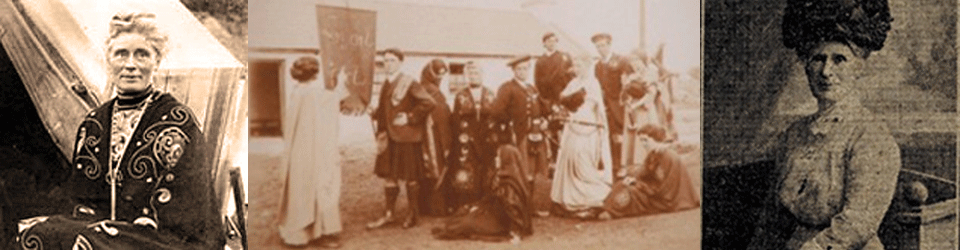
Category Archives: Nursing

Fever

When Emily married in 1905 she gave up nursing as a career, although she still nursed her husband, Captain Edward Weddall, through bouts of an illness he picked up on his travels. When he died in 1908, she did not return to her career, but focused her time and energies on the Irish language revival and Gaelic League.

When there was an outbreak of typhus in 1913 Emily did not waste a minute but rushed to Connemara to lend her nursing services the victims, especially those from Gaelteacht, who only spoke Irish. Emily’s heroic action was reported on by the Irish Independent;

Mrs. Emily M. Weddall,Widow of the late Captain Weddall of Burnby,Yorkshire, and Rockfield House, Keel, Achill, who has hastened to Connemara to nurse the fever-stricken victims there

The site where the fever hospital in Oughterard one stood

The site where the fever hospital in Oughterard one stood

. Founder of the Achill Irish Summer School, who is best known in Gaelic circles as Bean Ui Uadal, and it is for the sake of this last remnant of the Irish-speaking nation she is making such a heroic sacrifice.

When Emily arrived on in Connemara (Oughterard) she was appalled at the authorities neglect of the area. He strong social conscience, compelled her to write and highlight the problem. She put pen to paper and composed the following letter to the Cliadheamh Soulis.

I came away last week to help look after the poor typhus patients here. I found all the typhus cases in Oughterard Fever Hospital, and only a few typhoid patients (who can’t be moved) in their own homes. I was going to write to you to ask you to insist on the establishment of a temporary hospital into which fresh cases (which are sure to occur) could be moved, but today the government representatives have at last arrived on the scene, Mr Birrrell, Sir Acheson McCullagh (Local Government Board), John Fitzgibbon, M.P., C.D.B., and Mr. O’Malley M.P. for the district. The doctor tells me that they have provided the hospital, and it is about time! The people have been treated worse than beasts should be treated, and they are almost all that remains to us of the unsullied ancient Irish race. I am glad the Gaelic League was first on the scene, but we ought to do something efficient to preserve these people and to enable them to find a livelihood in their own country…

The letter shows the beginning of Emily more involved in politics, and it would be because of that, that Emily would be back using her nursing skill again.

Sources
Irish Independent 1905-2011 Date:May 21, 1913;Section:None;Page Number:3
An Claidheamh Soluis May 1913. p 8


Russia

Sometime between April 1901 and March 1905 Emily traveled to Russia. She may have had some nursing work there or went as a lady’s companion, who may have required some nursing services. Due to the absence of records it is impossible to say exactly when and under what circumstances she went there, only local legend and a few facts that Iosold ni Dheirg remembered from the time she spent with Emily in her later years. In her biography Emily M. Weddall: Bunaitheoir Scoil Acla, Iosold ni Dheirg mentions that Emily had been to one of the palace of the Tsars, and that she kept a photo of the three Russian princesses in her house many years later.

Emily’s time in Russia is shrouded in mystery, and possibly will never be solved. Her time spent there was eventful and may have been the beginning of her developing a strong social conscience, which she was noted for all her life. One particular incident would have an strong effect on her character. It happened one snowy night…

Emily was awoken from her sleep by a commotion outside. She looked out her bedroom window to see a big group of poor men, in shackles been led of the work in the harsh climate of Siberia as a punishment to whatever crime they may have committed. It was snowing heavily. It was the most alarming sight she had seen in her life so far.

irishtimesdolls

She would see similar scenes but the next time it would be in her own country many years later.

Sources
Ní Dheirg, Íosold. Emily M. Weddall: Bunaitheoir Scoil Acla. Beann Éadair, Baile Átha Cliath: Coiscéim, 2010.
Photo by Ciaran Parkes

Travel

Emily Burke’s nursing career afforded her the opportunity to travel. In the late 1890’s she spent some time traveling with her work. She may have got the job through her family connections or with the Florence Nightingale Nurses who had branches in Europe . As Emily was fluent in a few European languages, from her schooldays  she was had an added advantage to get jobs on the continent. Where or who she worked for  is lost in time but in her biography by Iosold ni Dheirig, Emily M. Weddall :bunaitheoir Scoil Acla mentioned she spent some time as a nursemaid for a family that traveled to France and Germany.

Emily returned to Ireland in the early 1900’s and according to the 1901 census she lived at Waltham Terrace, Blackrock, Co. Dublin. Her occupation was a nurse and it appeared that she may have been either a nurse to the elderly man or nursemaid to his grandchildren. It is impossible to say how long she remained in that particular job, but sometime after that and before 1905 she would get the opportunity to travel again, which was a life altering experience for her.


DSCF1650Sources
Ní Dheirg, Íosold. Emily M. Weddall: Bunaitheoir Scoil Acla. Beann Éadair, Baile Átha Cliath: Coiscéim, 2010.
http://www.census.nationalarchives.ie

Inspiration 3 Lady Dudley

Emily and The Lady Dudley Nurses Scheme

About Lady Dudley

Rachel_Dudley_circa_1900
Lady Dudley was the wife of a controversial Lord Lieutenant of Ireland, William Humble Ward, Third Earl of Dudley, who served from 1902 to 1905. In 1903, concerned at the extreme poverty in the congested district boards of the west, she began to fund raise to provide a district nursing service for the counties along the western seaboard. The link with the viceroy ensured the nursing associations were seen as fashionable charities, with fundraising led by the old ascendancy families who held garden parties in aid of the Jubilee and Dudley nursing schemes.
When Lady Dudley realised the extreme poverty in Ireland she was determined to do something to combat it through providing nurses to the worst affected areas. The West of Ireland including Achill was the prime area of her attention. She was so moved with what she saw in these areas that she felt compelled to write to the New York Times appealing for donations to fund the scheme she set up.

May I be permitted through the medium of your paper to appeal to the Irish people in America for a share of their charity on behalf of an undertaking which would, I think; recommend itself to them were they better acquainted with the necessity for it? I speak of the fund for the establishment of district nurses in the poorest parts of Ireland which has been in existence for nearly a year.

When Emily married in 1905, she more or less retired from nursing as a career but always supported nursing causes in her local community. When she moved to Achill she befriended the local district nurse, Miss Comerford. Emily was always quick to help where needed and when a local collector for the Lady Dudley Scheme was no longer able to continue in his post Emily Weddall took over from him. “Mrs Weddall has most kindly consented to take his [Mr. Hector] to take his place… We are thankful to Mrs. Weddall for coming to our help.”

Having Emily as the collector for the Lady Dudley Scheme, proved a great asset as Emily had a talent for being influential and was also well respected. “Mrs. Weddall, who was assisting Nurse Comerford with gifts; she was also instrumental in ‘obtaining some subscribers”.


Sources
The New York Times, March 14, 1904, Section , Page 8
The Irish Times – Monday, May 16, 2011, An Irishman’s Diary
Muintir Acla, Winter 1999, Sile A. NicAodha, p. 31.
Photo of Lady Dudley: https://upload.wikimedia.org/wikipedia/commons/5/5d/Rachel_Dudley_circa_1900.jpg


Inspriation 2 Margaret Huxley

When Emily began her training as a nurse Miss Margaret Huxley R.G.N. had just taken station in in Sir Patrick Dunns Hospital.  Like Florence Nightingale, Miss Huxley revolutionised nursing, especially in Ireland. She had taken up her position at Sir Patrick Dun’s just before Emily began her training. Now doubt her methods would have impacted Emily’s early nursing days, and stayed with her all her life. DSCF2310

As part of her pioneering work she established Sir Patrick Dun’s School of Nursing as the leading Nursing School in Ireland. Through this school and in cooperation with other training schools she continually strove to raise the educational standards of nurses and by extension the status of nursing in Ireland and abroad.


Margaret Huxley’s obituary of February 1940 in the British Journal of Nursing

In 1883 she came to Ireland, from that time until her death all her interests were centred in this country. Her first post was that of Matron of the National Eye and Ear Hospital, Molesworth Street, Dublin, where she remained for less than a year. The Board of Sir Patrick Dun’s Hospital, having heard of her worth, appointed her their Lady Superintendent, which post she held until 1902.

Systematic training for Nurses was non-existent when Miss Huxley took up duty at Sir Patrick Dun’s Hospital, but it was not long before the Nurses trained by her were everywhere in demand throughout the country.
In 1891, while still Lady Superintendent of Sir Patrick Dun’s Hospital, realising the need for nursing care and medical and surgical treatment for private patients, she acquired an ordinary dweling-house and opened it as the first Nursing Home in this country. she formed a company to run it, and trained Nurses were appointed to staff it and at the same time, some of the probationers from Sir Patrick Dun’s Hospital were sent there to gain experience in the care of private patients.

Miss Huxley worked ceaselessly for a uniform system of education and training for Nurses, and for State Registration. this book both time and money. In 1893, with the help of Dr. Richard Hayes, she was instrumental in starting a Central School where the nurses in training in a large number of the Dublin Hospitals received Lecture, and were examined. this school was ready, when State Registration came, to carry on and give all the theoretical truing required for the State Examinations, and it has proved of inestimable value to the nurses in training, and to the participating hospitals.

Nursing in Emily's time

Nursing in Emily’s time

It is easy to see Miss Huxley’s influence on Emily career on many occasions. Years later, when Emily had officially retired from nursing she made a comeback, when her services were required. In 1913, when typhus broke out in an Irish speaking area of Connemara, Emily went to the fever hospital to lend her services, as she could speak to the patients in their native tongue, making easier for them to communicate, easing their suffering. That is only one example of many.

Sources
http://www.oscailtmagazine.com/unitarian%20magazine/Great%20Woman.html
http://rcnarchive.rcn.org.uk/data/VOLUME088-1940/page027-volume88-february1940.pdf retrieved 02/06/2014
An Cliamheadh Soulis, July 1915
An Cliamheadh Soulis 21/06/1913