Category Archives: Friends

The Last Days of Darrell Figgis (3)

The photo below is of modern day Grenville St. Bloomsbury in London. Somewhere on this street Darrell Figgis spent his last night.


His last days were filled with misery after loosing his wife and the added trauma of the death and the circumstances surrounding it of his mistress. His friend  of many years, Frank Julian Maurice described the Figgis he encountered just before his death below:

On his last night he spent a few hours at the Automobile Club but not be persuaded to join friends for a drink instead he returned to his lodgings on Grenville Street alone.

His funeral was made more poignant by it’s austerity. Few mourners showed up, his family and one or two friends. His father seemed to be absent, this however could have been due to bad health, according to his brother Bryan. His mother an elderly woman made her way from Ireland accompanied by his siblings, to his burial at West Hampstead Cemetery. His grave would be all but forgotten for decades until it was rediscovered a few years ago.

Whatever was thought of him in life one thing that cannot be denied he was never dull, and he is perhaps remembered more that what written history would suggest. There is a rumor that fans leave cards and other offerings each year on his birthday.

Sources
Weekly Irish Times 07 November 1925
Taunton Courier, and Western Advertiser 04 November 1925

The Last Days of Darrell Figgis (2)

Darrell Figgis did not have a long life, it tragically ended when he was only 43, his last days marred with tragedy. A sad series of events that began a year before his death left those who knew him well not completely surprised, when his lifeless body was found by a housemaid in a Bloomsbury bedsit, London in October 1925.

After the breakup of his marriage a few years beforehand it seemed that his life began to slowly unravel. The tensions of the Revolutionary years along with physical and personal attacks not to mention long periods of incarceration all took a toll on the lives of the Figgis’. All that and the possible discovery that her husband proved too much for Millie.

Sometime afterward the break up of their marriage Figgis met dancer Rita North, who more than twenty years his junior, she became his constant companion and then his lover. It is impossible to say if that his affair with the young woman was the last straw for Millie. One November night in 1924 she hired a taxi to take her to the ominous spot of the Hell Fire Club in the Dublin Mountains. She did not get there, just before the cab left the outskirts of the city, Millie took out a gun, put it to her head and pulled the trigger. She did not die straight away but was taken to the Meath Hospital, where Emily once worked. She lasted the night but died the next day.

Figgis somehow put the pieces of his life back together. His relationship with his mistress continued. They were free now to marry if they wanted to but that was not to be. Within the year both she and he would be dead.

In October 1925 the couple arrived in London. Her with a secret Figgis claimed that he did not know. When she eventually told him she had already booked into a hospital to have a termination. Illegal in those days, when besides such an operation carried serious risk. unfortunately the risky operation proved fatal. She quickly developed toxemia and peritonitis and died as a result. Figgis was called as a witness in the inquest but he too died before the verdict:

“…Peritonitis following an artificial abortion, but there was not sufficient evidence how the abortion was procured.”

Sources
Birmingham Daily Gazette 20 November 1924
Birmingham Daily Gazette 28 October 1925
Hendon & Finchley Times 06 November 1925

The Last Days of Darrell Figgis (1)

Darrell and Millie Figgis spent almost a decade on Achill. They were friends of Emily and possibly knew her from before their arrival on the island in 1913. Emily was possibly related to Millie and may have shared a grandfather Richard McArthur, who was originally Northern Ireland as was Millie. Emily may have known Darrell Figgis too as her family were in the book trade as were some branches of his.

The Figgis’ and Emily lives were closely linked during the Revolutionary years and for a brief period after. The trio attended the historical funeral of Jeremiah O’Donovan Rossa at Glasnevin Cemetery in 1915, a well documented event. They even appear in photographs of the event, but not together.


When Figgis spent time in jail in 1918 Emily, who was a nurse by trade, took time out from her busy schedule to nurse Millie, when she was struck by the deadly virus, that claimed more that the previous war had. Millie who had a weak heart was not expected to live. Emily forthright as ever took it upon herself to write to the Chief Secretary of Ireland’s office to grant Millie’s husband compassionate leave from his internment. Unfortunately Emily’s word alone did not carry much weight as was noted by the authorities:

“Mrs Weddalll is a Nurse in the Meath Hospital; she belongs to Achill, and is a personal friend of Mrs Figgis. It is said that this Nurse holds Extreme Views.”

Darrell Figgis was granted leave and Millie survived. But the worst was yet to come.


Sources
Easter Rising Stories by Marcus Howard
Public Record Office of Britain CO 94/201/141


101 Years Ago

Easter week 1916 began as any other for the people of Achill, Emily and Darrell Figgis alike. Nothing out of the ordinary apart from the unseasonably good weather as Figgis described in in his book A chronicle of jails, more or less his prison diary of his time incarcerated during 1916-17.

Tues, April 25th 1916 was filled with sunshine in token of the summer that was on the way while a keen wind from the north came in reminder of the winter that was passing.

No one would have been any the wiser that there was an uprising taking over the capital if on the island. Only a few would have noticed that there was something amiss, those waiting on the post, which Darrell Figgis was one.

It was not till some hours after noon that, looking along the road for the post that was so unaccountably late, I saw a friend making her way toward the house on her bicycle. As she came nearer and dismounted I could see the traces of tears on her cheeks, and wondered.

“The post is very late,” I said.

“There is no post,” she replied, “but there’s terrible news. There has been fighting in Dublin. they say Dawson Street is full of dead and wounded men. the Volunteers hold the General Post Office, the Bank of Ireland, and a number of buildings all over Dublin…”

It is impossible to say if the friend of Darrell Figgis was Emily, there is a high likelihood that it was, either way Emily got the news and headed to Dublin to play her role in the Rising, except she never got there. Two days later and half way there she was intercepted in Rochfordbridge, Co. Westmeath and brought to court there.

Tullamore Prison Gates

The record still exists and contains the following details:

Name of Justice: M. S. Moore R. M.
Defendant: Emily Weddall
Cause of Complaint: Defense of the Realm
That Defendant on the 28th of April 1916, at Mulling in the county of Westmeath was acting in such a manner as to vie reasonable ground for suspecting that she was about to act in a manner prejudicial to the Defense of the Realm and that she is thereby guilty of an offense against the Regulations made under the Defense of the Realm Act 1914 and was arrested by the Constable Thomas Forkin R. I. Constabulary in accordance of said regulations.

Particulars of order of dismissal: Defendant remanded in Custody for seven days from this as for further examination.

The Complainant was listed as ‘The King’.

Emily was sent to Tullamore Gaol for the duration of the Rising. She was released without further ado. On May 3rd her niece, Enid made her way across the country from Achill to Tullamore to meet her aunt at the prison gates. Enid was only 17 and at the time on Easter holidays from school.

By the time Emily returned to Achill, the Rising was over, Dublin was in ruins, some of her friends including Darrell Figgis were imprisoned and some were no more, executed for their part.

An Cliadeamh Soluis 24/04/1916

Sources
Figgis, Darrell, and William Murphy. A Chronicle of Jails. Dublin: University College Dublin Press, 2010.
findmypast.ie/record?id=ire%2fpettys%2f005174188%2f00427,parentid=ire%2fpettys%2f005174188%2f00427%2f2687504
http://www.rte.ie/centuryireland/index.php/articles/chronology-of-the-easter-rising
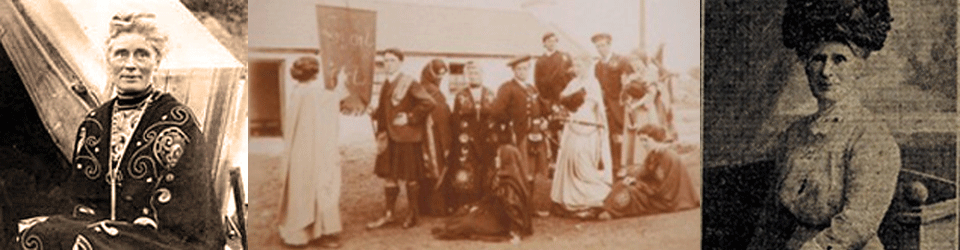


Generosity and History Repeats Itself

In April 1917 there was a gift sale held at the Mansion House in Dublin in aid of the Irish National Aid and Volunteer Dependents. Emily, out of generosity and always ready to make a contribution to a cause close to her heart, donated a motor coat, which fetched £20.

“Relics As Bargains

The desk on which Gerald Griffin wrote “The Collegtans” was bought for 22s 6d and two L’enian pikes got £1. A case of butterflies collected in India by the Late Michael Mallin, one of the executed leaders, together with two books of music containing his autograph, presented by his widow bought £1 10s. Twenty pounds were paid for a motor coat presented by Mrs. Weddall and a motor coated lined musquash, given by Mme O’Reilly, reached £10. forty pounds were given for a pan of 6in antique silver candle sticks, Dublin hallmark 1725. Robert Emmet’s Wallet fetched £10 and the block on which he was beheaded was sold for £5 10s. Ten pounds were paid for a silver dish 1774.”

History Repeats Itself

The mentioned block that Robert Emmet was beheaded on is still doing the rounds to this day. It was on display in the entrance hall in the Pearse Museum, St. Enda’s Park associated with Emmet and for a time at Kilmainham Gaol, where he was held before his execution in 1803, completing the full circle. Read more on Robert Emmet:

The donation of the motor coat by Emily was most generous, as at the time the cold reality of her dire financial state was beginning to dawn on her. She was on the eve of becoming penniless. Up until early 1917 Emily was reliant on her income from her stock and shares and any other investments she had in Russia. In March of 1917 the Revolution began to unfold and any finance from there was under threat. Emily was not the most financially astute person and overlooked the bills and notices from the bank stacking up.


Sources
Freeman’s Journal 21 April 1917
Staffordshire Advertiser 31 May 1919
http://pearsemuseum.ie/online-tour/tour-of-the-house/
http://kilmainhamgaolmuseum.ie/
http://www.history.com/topics/russian-revolution
Ní Dheirg, Íosold. Emily M. Weddall: Bunaitheoir Scoil Acla. Baile Atha Cliath: Coisceim, 1995.