Category Archives: Friends

Claud Chavasse on Achill

Claud Chavasse was somewhat of a ledgend in his own lifetime in Galway, where he lived most of his life. Before he settled there in 1917, he lived on Achill.  His sister Marguerite Chavasse, ran a lace making industry on the Island and he stayed with her, while there.  Emily Weddall, a friend of Marguerite, must have been enthralled with her brother Claud, not only for his interest and commitment to Gaelic Culture, but with his refusal to speak any language other than Irish. He and Emily became friends and soon joined forces with others to found the Irish language and cultural summer school, Scoil Acla.

Chavasse taught Irish classes as part of the summer school curriculum, and any other time this service was required, where he was ever willing teacher.

Claud Chavasse teaches Irish classes on Achill in 1915

Claud Chavasse teaches Irish classes on Achill in 1915

Sources
http://www.nuigalway.ie/arts_office/art_database/index.php
An Claidheamh Soluis

Claud Chavasse

Claud Chavasse arrived on Achill sometime in the early 1910’s, possibly to visit his sister Marguerite, who had settled on the Island shortly before, where she had set up a lace making industry.  English by birth, with French ancestry, Claud Chavasse did not have any family links as such with Ireland, however when he arrived on her shores he must have felt it was it his true home, as he ended up staying for the rest of his life.

Born on April 2 1885 to Albert Sydney Chavasse, and Isabella Florence nee Mann. The Chavasse family lived at Oxford, where their father was a professor of classical languages at the University. Claud would follow the family’s academic tradition, first by attending Wellington College in Berkshire, where he won a scholarship to continue his studies at Christ Church College, Oxford in 1903. It was at Christ Church College that he first began his love affair with Irish culture.

After befriending  Sir John Rhys, a Celtic scholar Chavasse took up Celtic Studies. He also became friends with a group of Irish students, Diarmuid Trench, Éamon Cuirtéis, and Robert Barton. This group of young men established an Irish Society, hosting discussions on Irish language and culture. It was with the same group that he first visited Ireland in 1905, a trip that inspired him to set up the Oxford Gaelic League, where in 1909 he became head of the branch.

Portrait of Claud Chavasse, by Sadhbh Trinseach. Kindly reproduced with permission of NIUG Art Collection

Portrait of Claud Chavasse, by Sadhbh Trinseach. Courtesy of NIUG Art Collection


Sources
Ní Dheirg, Íosold. Emily M. Weddall: Bunaitheoir Scoil Acla. Baile Atha Cliath: Coisceim, 1995.
Liverpool Echo February 10, 1916, page 6
Reading Mercury 27 June 1903. P6
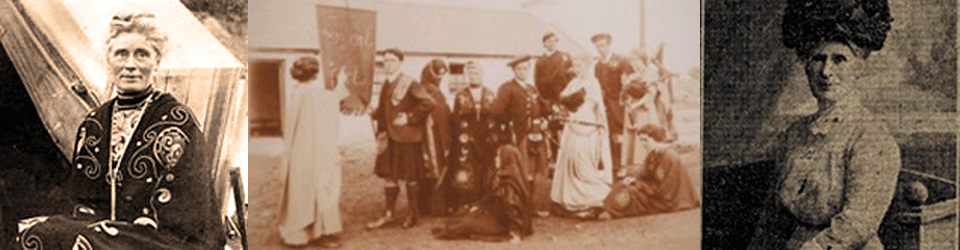
 

Dr Kathleen Lynn

Dr Lynn

Dr Lynn

Dr. Kathleen Lynn was born in Mayo. Like Emily Weddall her father was a Church of Ireland Minister. She was educated in Alexandria College, Dublin before completing her medical training at Cecilia Street (a Catholic University medical school).
Dr Lynn worked at Sir Patrick Dun’s Hospital, where Emily did her nurses training, but at different times.  Emily the older by a few years, attended Sir Patrick Dun’s in the 1890’s, Kathleen began working there in 1899, after completing medical school. At the time it was hard for female doctors to secure work, Sir Patrick Dunn’s progressive for it’s time took her on, on her own merit.

It is not clear when and where both women first became acquainted, it was likely through the Gaelic League, Cumann na mBan or through medical circles.  Kathleen Lynn either attended or helped with Scoil Acla as she was named on a list of attendees and supporters in a Mayo News article in the summer of 1915. They were life long friends, and would be meet many times again over the following four decades.

Kathleen Lynn: A Revolutionary Doctor | An Dochtúir Reabhlóideach

Kathleen Lynn was one of our first female medical graduates.  During the course of a distinguished life, she was a medical leader, campaigning feminist and social activist, a rebel of the emerging Irish nation, a suffragette and a public representative.  She had a pioneering medical career whilst taking part in Ireland’s War of Independence…To read more about Kathleen Lynns remarkable life:http://www.ucd.ie/medicine/ourcommunity/ouralumni/alumniprofilesinterviews/drkathleenlynn/

Sources
http://www.mayosinnfein.com/constituencies/9485/Retrieved 08/07/2011
Mayo News August 1915
http://www.ucd.ie/medicine/ourcommunity/ouralumni/alumniprofilesinterviews/drkathleenlynn/
Photo: 04 August 1917 – Daily Mirror – London, London, England


Sunday after Easter Sunday; “All the Leaders are not dead will be.”

Ella Young explains describes the end of the Rising, again in a few sentences. She gives the bare bones of the situation but it is enough.


All the leaders are not dead will be

This is Sunday, April 30th, the Sunday after Easter Sunday. Pearse signed the order to surrender yesterday. It is his own death warrant, and the death warrant of those with him who proclaimed the Irish Republic. All the leaders who with him proclaimed the Irish republic. all the leaders who are not dead will be executed: but the surrender saves the lives of a few young fighters, and ends the slaughter of civilians. Sentries are still on all canal bridges. No one can go into Dublin Town without a military permit.

It rains and rains, and rains.DSCF2150

Sources
Young, Ella, and Stephen Griffin. Flowering Dusk: Things Remembered Accurately and Inaccurately. New York, Toronto: Longmans, Green and Co., 1945.

Easter Saturday; Surrender

Emily has just spent her first night in prison. She was on remand and could be held for a full week, which she was. It must have been very frustrating for her to be locked up in a cell when her friends and fellow Nationalists were fighting for their country. By now though it was all but over and Emily’s involvement would not have made any difference.

Tullamore Prison at night

Tullamore Prison at night


In Dublin it was all over. To read more on the surrender: Irish Times

Ella Young from a safe distance in Rathmines sensed that it was over too. Her account of Easter Saturday contained only three short sentences;

Firing has ceased. There is a horrible silence. They are all dead or is it surrender!

Sources
Irish Prison Registers 1790-1924 Transcriptionhttp://search.findmypast.ie/record
Young, Ella, and Stephen Griffin. Flowering Dusk: Things Remembered Accurately and Inaccurately. New York, Toronto: Longmans, Green and Co., 1945.
http://www.irishtimes.com/culture/books/an-easter-rising-timeline-saturday-april-29th-1916-1.2192252