Category Archives: Friends

Enid Settles in Ireland

Emily Weddall enrolled her niece Enid or now Siobhan Betts in Alexandria College, Dublin. Emily attended its sister school for Daughter’s of the Irish Clergy in the 1870’s and 80’s. Emily good friend Kathleen Lynn attended Alexandria College too, making it an idea choice to send fifteen year old Enid after she arrived in Ireland.

During the school holidays she returned to Achill to spend the summer with her aunt Emily on the Island. The summer of 1913 was a pivotal to the cultural life on the Island and to Emily and Enid alike, a far cry from her experience of life in Australia.

Advertisement for Scoil Acla 1913

Advertisement for Scoil Acla 1913

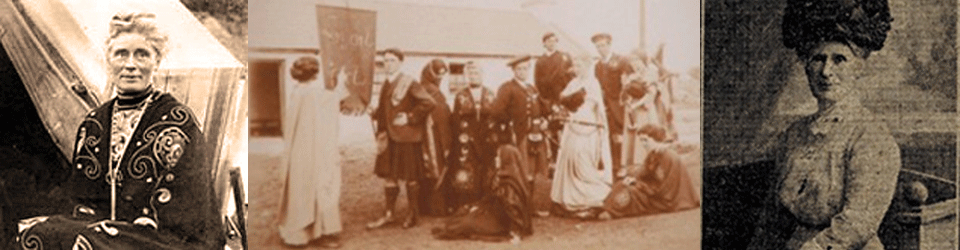
That summer saw the final Scoil Acla until it’s revival in 1985, when the war and the political situation prevented it from continuing. This particular year the Trench girls from Dublin attended Scoil Acla which was documented by Frances, or Cessca in her diaries. Both Emily and Enid or Siobhan as she was known in Gaelic circles featured as some of the main protagonists.

The summer began with the Oireachtas or Ardfheis in Galway and ended with the Scoil Acla summer school in August. Siobhan Betts met up with people who would influence her future and remain friends with for life.

Sources
Chenevix Trench, Frances Georgiana, and Hilary Pyle. Cesca’s Diary, 1913-1916: Where Art and Nationalism Meet. Dublin: Woodfield Press, 2005. Ní Dheirg, Íosold.
Emily M. Weddall: Bunaitheoir Scoil Acla. Baile Atha Cliath: Coisceim, 1995.

Emily Joins Cumann na mBan

In 1914 Emily joined the newly formed Cumann na mBan, translating as the Irish Women’s Council. Her friends such as Margot and Frances (Saidbh) Trench and Antia McMahon had already joined and Eva O’Flaherty was connected with the organisation too. DSCF3596Cumann na mBan was formed on 2nd April 1914 in Wynn’s Hotel in Dublin City Centre. Emily may have been at the founding meeting too, although it is impossible to find out now. She would have been in agreement of their aims.

They adopted a constitution which stated their aims were:

– To Advance the cause of Irish liberty
– To organise Irish women in the furtherance of that objective
– To assist in arming and equipping a body of Irish men for the defence of Ireland
– To form a fund for these purposes to be called the ‘Defence of Ireland Fund’.

Cumann na mBan needed a wide range of volunteers ,of which nurses were of utmost importance. Emily could and did lend her skills there. Many years later fellow Cumann na mBan member Kathleen Walsh from Waterford in an article The Fighting Spirit of Waterford: Cumann na mBan Memories;

“A Mrs Weddall a most efficient nurse was sent to us from Headquarters. She also gave us a course of lectures..”


Untitled (1)

To read more about the formation of Cumann na mBan: http://www.rte.ie/news/2014/0328/605079-cumann-na-mban-centenary

Sources
Munster Express 28 October 1955. Page 9
http://www.rte.ie/news/2014/0328/605079-cumann-na-mban-centenary
Photos: http://irishvolunteers.org

Inspiration 3 Lady Dudley

Emily and The Lady Dudley Nurses Scheme

About Lady Dudley

Rachel_Dudley_circa_1900
Lady Dudley was the wife of a controversial Lord Lieutenant of Ireland, William Humble Ward, Third Earl of Dudley, who served from 1902 to 1905. In 1903, concerned at the extreme poverty in the congested district boards of the west, she began to fund raise to provide a district nursing service for the counties along the western seaboard. The link with the viceroy ensured the nursing associations were seen as fashionable charities, with fundraising led by the old ascendancy families who held garden parties in aid of the Jubilee and Dudley nursing schemes.
When Lady Dudley realised the extreme poverty in Ireland she was determined to do something to combat it through providing nurses to the worst affected areas. The West of Ireland including Achill was the prime area of her attention. She was so moved with what she saw in these areas that she felt compelled to write to the New York Times appealing for donations to fund the scheme she set up.

May I be permitted through the medium of your paper to appeal to the Irish people in America for a share of their charity on behalf of an undertaking which would, I think; recommend itself to them were they better acquainted with the necessity for it? I speak of the fund for the establishment of district nurses in the poorest parts of Ireland which has been in existence for nearly a year.

When Emily married in 1905, she more or less retired from nursing as a career but always supported nursing causes in her local community. When she moved to Achill she befriended the local district nurse, Miss Comerford. Emily was always quick to help where needed and when a local collector for the Lady Dudley Scheme was no longer able to continue in his post Emily Weddall took over from him. “Mrs Weddall has most kindly consented to take his [Mr. Hector] to take his place… We are thankful to Mrs. Weddall for coming to our help.”

Having Emily as the collector for the Lady Dudley Scheme, proved a great asset as Emily had a talent for being influential and was also well respected. “Mrs. Weddall, who was assisting Nurse Comerford with gifts; she was also instrumental in ‘obtaining some subscribers”.


Sources
The New York Times, March 14, 1904, Section , Page 8
The Irish Times – Monday, May 16, 2011, An Irishman’s Diary
Muintir Acla, Winter 1999, Sile A. NicAodha, p. 31.
Photo of Lady Dudley: https://upload.wikimedia.org/wikipedia/commons/5/5d/Rachel_Dudley_circa_1900.jpg


Emily Alone

Over the course of five years Emily had lost both of her full brothers in quick succession and her only sister, Miriam had emigrated to Australia, married and had her own family.

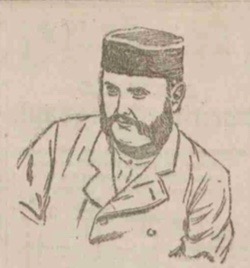
To make matters worse around the time of Richard’s sickness and subsequent death there was another family tragedy unfolding across the water in Yorkshire, England. Her half brother, William Henry’s life had spiraled into chaos, too horrific to imagine. He had lived a somewhat privileged life as a a doctor, but he had difficulties too and drank heavily, loosing his family as a result. He got lost in his own sadness and died in 1889 at the age of only 43.

Emily's brother, William Henry

Emily’s brother, William Henry

This final blow must have hit Emily hard, but somehow she overcame this horrible period in her young life. It is possible that she got help and guidance from the Revell/Joly family, who were known for their generosity.

In 1893, at the age of 25 she began her training in Sir Patrick Dunn’s Hospital in Dublin as a nurse.

Sources
The York Herald Tuesday November 26, 1889
The Sheffield Evening Telegraph, Monday, February 6 1888
Thanks
Thanks to Mary Revell Dinnin, for sharing her family history with me.


Memorial

DSCF2262

Unmarked in 2010

DSCF2913

Scoil Acla members at the unveiling of Emily’s headstone 24 November 2012. Photo by Carmel Feeney
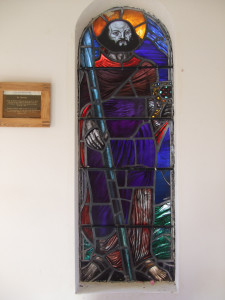
DSCF2396.JPG

Stained glass window, by Wilhelmina Geddes that Emily bequeathed to Our Lady of the Universe Church, Curran, Achill

On this day (November 24th) 1952 Emily died. Her funeral was attended by the Nationalists of the time, and her contemporaries that were still alive, at 85 she had outlived most of them. One, was her life long friend Dr. Kathleen Lynn. Apart from a niece and nephew in Australia she was the last of her bloodline too. She was laid to rest beside the Republican Plot in Glasnevin Cemetery.

Her grave lay unmarked for six decades. But it was not forgotten, by the people of Achill. The committee and members of the present Scoil Acla, the summer school that she co-founded in 1910 commissioned a gravestone. It was unveiled on 24th November 2012, on her 60th anniversary.

The Scoil Acla members and others  that had established a connection with her formed a small group at the gates of Glasnevin Cemetery, and followed a lone piper to her graveside where they laid items of significance to her life, a framed photo, a wreath (inscribed O Acla, identical to the one she and the Figgis’ laid on the grave of O’Donovan Rossa), and the book; Emily M. Weddall: bunaitheoir Scoil Acla by her friend and biographer Íosold Ní Dheirg. The ceremony that followed thanked  and praised her generosity and her legacy to the people of Achill.

The inscription on her gravestone;

Emily M Weddall

Bunaitheoir Scoil Acla

Member of Cumann na mBan

1867 – 1952

Failte Roimh Gach Gael

The occasion was recorded in poetry by Ciaran Parkes;

Poem For Emily

A holiday crowd
down from Achill
and other places,
people who knew her
when she was alive,
others, who came to know her
after she had died.

They follow the bright
Scoil Acla banner
past the famous
Glasnevin tombs
to where her new
gravestone is unveiled,
lonely no longer.

A lone piper plays,
people leave presents
around her grave,
flowers from Achill,
a copy of her biography,
tell the stories
to make her come alive again.

It’s like a party,
so many friends together
in the same small space
and her gravestone –
a stained glass panel
to let the light shine through,
bright and warm and multi-coloured.

I think of Emily
sitting on a hillside
somewhere in Achill
with two friends, her small dog,
in an old photograph,
pausing from her adventures,
smiling, looking down.

Ciarán Parkes