Category Archives: History

Countess

On this day in 1927 Countess Markievicz died. She breathed her last in a public ward in Sir Patrick Dunn’s Hospital, Dublin, not the usual setting for a Countess. She had reneged upon a pampered life for a one of service to the poor of her country and then on to fight for that same country.

To read more about her remarkable life:

Countess Markievicz

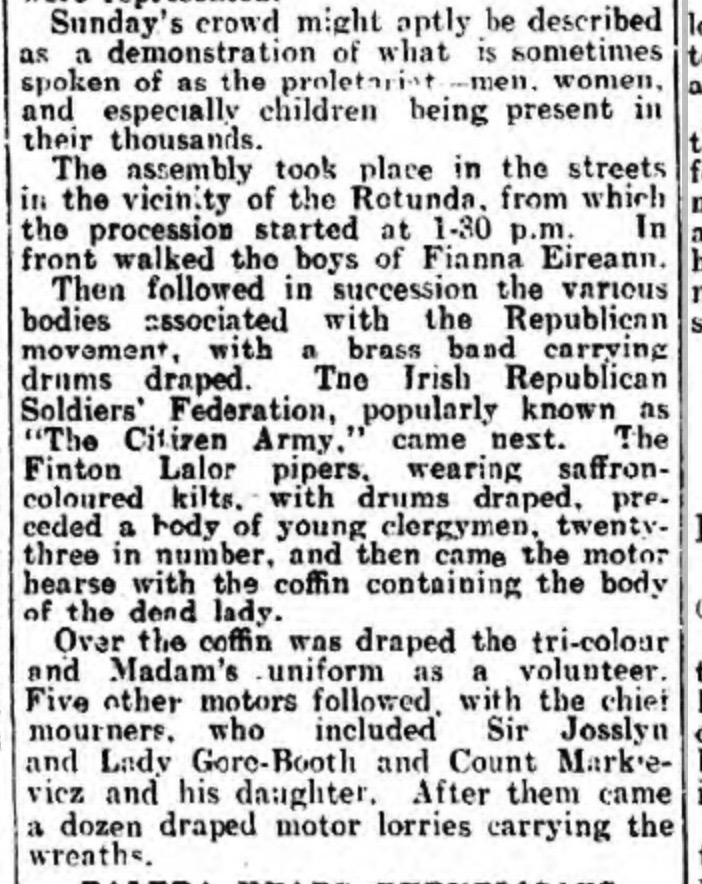
Her funeral attended by thousands, was held over three days. Her body lay in repose at the Rotunda, on Parnell Square. From there crowded lined to route to Glasnevin Cemetery, to be interned alongside her friends and fellow Republicans, who had gone before her.  
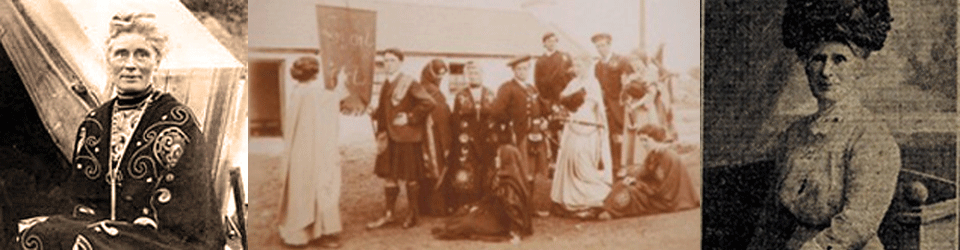
It is impossible to say if Emily Weddall attended the funeral, chances were she was there in the crowd or marching with fellow members of Cumman Na mBan.

The funeral procession took place on Sunday but the burial was not until the following day, Monday as the gravediggers union forbade them to work on Sunday. The Countess’ coffin was held in a vault in the O’Connell Circle, where the founder of the cemetery, and Irish Liberator was originally buried (he was reinterred in a crypt beneath the Irish round tower) in 1869. If she were alive she may have been pleased as;

“DANIEL O’CONNELL (1775-1847) –Daniel O’Connell was a politician, Lord Mayor and human rights activist. He achieved Catholic emancipation and fought for the repeal of the Act of Union between Great Britain and Ireland.” (Glasnevin Trust)

Last Post.

The Countess was buried with almost full military honors, the only exclusion was the firing of shots over her grave. At the time such was band by the state, but she did get the all other honors due to her. As a personal touch her uniform, worn during the Rising of 1916 was buried with her.

Over the years she was joined by her friends and fellow Republicans, one by one until that generation came to an end. Emily rests nearby next to Cathal Bruagh and across from Maude Gonne. The Republican Plot is part of the Glasnevin tours, and the graveyard is one of the top Dublin tourist attractions and well worth a visit: https://www.glasnevinmuseum.ie/daily_tours/

Filmed and edited by Marcus Howard. On the 90th anniversary of Countess Constance Markievicz’s death, The 1916 Relatives Association held a special commemorative event in Glasnevin Cemetery. To watch the video;

https://youtu.be/TnaY5mT-SGI

Sources
23 July 1927 – Ballymena Weekly Telegraph – Ballymena, Antrim, Northern Ireland
http://lissadellhouse.com/countess-markievicz/
02 October 1917 – Daily Mirror – London, London, England
https://www.youtube.com/channel/UClH7iRo8l6OmCYSZBzwrVbw
https://www.glasnevintrust.ie/visit-glasnevin/interactive-map/daniel-oconnell/

Widowhood

When Emily was widowed in 1908 she had barely escaped the Victorian period, in which prolonged periods of mourning were commonplace. This elaborate process began when Queen Victoria lost her husband, Albert in 1861, at the relatively young age of 42. At that time the accepted length of mourning was one year, however the inconsolable queen plunged into mourning which never truly ended. She would reign for another 40 years.

At 11pm, 14 December 1861, Prince Albert died. He was buried nine days later, the Queen too grief-stricken to attend the funeral.”

Along with being unable to attend her husband’s funeral, the room he died in was left in the same way, unaltered until she died herself. During her reign manuals on death and mourning were produced and could be consulted to what etiquette to observe depending on how close a relationship one had with the deceased. In Emily’s case it would have been two years as a spouse.

Even though Emily was not English nor widowed in the Victorian period, her husband was English and very much of that that time.

Emily did obey the some of the rules, but having strong Nationalistic sensibilities she also observed the Irish funeral rites too. She ‘waked’ her husband in their house, the corpse house as, the homes of those who died were called. Write, Sean O’Longain, who lived on Achill when Captain Weddall died, remembered;

“… I did so and offered my sincere sympathy to Mrs. Weddall, after which she invited me into the room to see captain laid out.”

Even though Captain Weddall died during the Edwardian period in Ireland there were still etiquette to be followed, which his wife honored. She put the obituary in both the Irish and British newspapers alike. The funeral was held some days later allowing time for anyone to travel the  distance to the West of Ireland. It is impossible to say if she wrote personally to those who attended the funeral or how long she wore black. There is a clue that it may have been a long time. Her Celtic costume was made of black velvet, not in keeping with the colours of the Celtic Revival costumes of the time.


Sources
Irish Times 08 June 1908
http://www.victorian-era.org/edwardian-era-funeral-customs.html
http://www.historyinanhour.com/2011/12/14/death-of-prince-albert/
http://www.avictorian.com/mourning.html
Connaught Telegraph 1830-current

Emily goes to England

In July 1908 Emily crossed the Irish Sea to England. She had been widowed just a month when she made the journey from Rosslare by the Great Western Railway Company’s Express Mail Boat. She may have been going to England to visit her in laws or sort out business matters relating to her late husband. As there is no way of telling why Emily made the journey, but because it was soon after her husband’s death it may have been related to that.


Sources

The Last Will and Testament of Richard Burke

A day before he died Richard McArthur Burke made his will. He was so weak that he had to get his friend, Richard Bradley to write it out for him.

At the age of 23 he hadn’t accumulated very much, books, a bicycle and some sporting equipment and perhaps his most personal possession, his watch and chain, which he left to his older sister Miriam, the sibling he was the closest to in age. His sport equipment went to the children of his friend, Richard Bradley. After his debts were paid and the £100 borrowed from his sister Miriam was returned, the remainder of his money was left to his younger, brother John Jasper. Emily was only named as a beneficiary if John Jasper should die before he could inherit (reach the age of 21, he was only about 17 at the time). In the case of John Jasper not reaching his 21st birthday his share was to be divided between Miriam and Emily. John Jasper did live see 21, but did not survive long beyond his 23rd, just like his brother Richard. 

Sources
https://search.findmypast.ie/record?id=IRE/ORIGINALWILLREGISTERS/007604093/00169&parentid=IRE/ORIG/WILL/REG/302/6


Emily’s loses another brother

At the end of June 1888 it became apparent that Emily’s brother Richard would loose his battle with Bright’s Disease. Known nowadays Nephritis at the time there was no cure. Their mother had died of the same disease just a few year before but she was in her fifties with most of her life behind her. Richard had a promising future as a banker and enjoyed a full life as as any young man in his position at the time. Like his half brother William Henry he was a sports man, playing tennis and canoeing, until disease consumed him.

The Clonmel and Waterford Chronicle and Advertiser of the morning of 27th June 1888 contained the following Death Notice:


Burke June 26th at Queen St., Clonmel. Richard M’Arthur Burke, son of the late Rev. William J Burke, Incumbent of Castle Jordon, aged 23 Years. “Asleep in Jesus”. Funeral will leave for Marlfield at 8 o’clock on Thursday Morning.

Sources
Ancestry.com. Ireland, Select Births and Baptisms, 1620-1911 [database on-line]. Provo, UT: Ancestry.com Operations, Inc., 2011.
Ancestry.com. Ireland, Civil Registration Deaths Index, 1864-1958 [database on-line]. Provo, UT, USA: Ancestry.com Operations, Inc., 2011.
Clonmel Chronical, Tipperary and Waterford advertiser. Saturday Evening, June 30 1888. Page 3.
http://www.jeaniesgenealogy.com/2015/06/they-died-of-what-causes-of-death
http://www.clonmelrowingclub.com/#