Category Archives: History

Anita Arrives on Achill

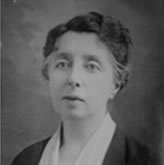
Anita McMahon, a Cork native arrived for the 1912 Scoil Acla to learn Irish. She had intended to leave after the summer but like many before her, ended up staying for most of her life. From her arrival her destiny on Achill seemed to have been set.

On her way to Irish class one morning an event was unfolding outside her lodgings of the Amethyst Hotel in Keel.  On a platform was the Protestant Agent collecting the rents from a group of men. Curiosity caused her to stop and listen to the ‘commotion’, which turned out to be the agent extracting rather than collecting rent from the men. Appalled at how the agent was treating the men “just like dogs”, as she later wrote, Anita felt compelled to do something about the plight of these men.  Instead of going to her Irish class she returned to the hotel and questioned the proprietor about the what she had just witnessed.

At the time the Amethyst Hotel was owned by a Mr. Patton who was able to give he a little background on what was going on outside. He told her that the rent at the time (1912) was about £1 a year which sounds like very little but was a extraordinary amount then, even by today’s standards. These high rates often resulted in tenants not being able to pay and subsequent eviction.

Anita was qualified journalist and wasted not time in putting pen to paper, writing to the local newspaper The Mayo News requesting a column in the paper. She received  a very courteous reply from the manager, telling her she could have “as much space as she wished”, but he could not pay her.  She did not wish for payment, only space. So she got down to work to “expose the scandal”. Her work was not in vain her actions gained such momentum, that the following week the Mayo News had blaring headlines on ‘The Achill Scandal’. This was continued the following week, and so on, pouring further light on the conditions under which the Achill people existed.
anita_mcmahon

Anita

Emily backed her on her endeavor and the two women became lifelong friends and allies…

Sources
http://www.presentation-sisters.ie/content/view/83/107
ehttp://scoilacla.ie/history/founding-members/anita-mcmahon/


Emily Joins Cumann na mBan

In 1914 Emily joined the newly formed Cumann na mBan, translating as the Irish Women’s Council. Her friends such as Margot and Frances (Saidbh) Trench and Antia McMahon had already joined and Eva O’Flaherty was connected with the organisation too. DSCF3596Cumann na mBan was formed on 2nd April 1914 in Wynn’s Hotel in Dublin City Centre. Emily may have been at the founding meeting too, although it is impossible to find out now. She would have been in agreement of their aims.

They adopted a constitution which stated their aims were:

– To Advance the cause of Irish liberty
– To organise Irish women in the furtherance of that objective
– To assist in arming and equipping a body of Irish men for the defence of Ireland
– To form a fund for these purposes to be called the ‘Defence of Ireland Fund’.

Cumann na mBan needed a wide range of volunteers ,of which nurses were of utmost importance. Emily could and did lend her skills there. Many years later fellow Cumann na mBan member Kathleen Walsh from Waterford in an article The Fighting Spirit of Waterford: Cumann na mBan Memories;

“A Mrs Weddall a most efficient nurse was sent to us from Headquarters. She also gave us a course of lectures..”


Untitled (1)

To read more about the formation of Cumann na mBan: http://www.rte.ie/news/2014/0328/605079-cumann-na-mban-centenary

Sources
Munster Express 28 October 1955. Page 9
http://www.rte.ie/news/2014/0328/605079-cumann-na-mban-centenary
Photos: http://irishvolunteers.org

Fever

When Emily married in 1905 she gave up nursing as a career, although she still nursed her husband, Captain Edward Weddall, through bouts of an illness he picked up on his travels. When he died in 1908, she did not return to her career, but focused her time and energies on the Irish language revival and Gaelic League.

When there was an outbreak of typhus in 1913 Emily did not waste a minute but rushed to Connemara to lend her nursing services the victims, especially those from Gaelteacht, who only spoke Irish. Emily’s heroic action was reported on by the Irish Independent;

Mrs. Emily M. Weddall,Widow of the late Captain Weddall of Burnby,Yorkshire, and Rockfield House, Keel, Achill, who has hastened to Connemara to nurse the fever-stricken victims there

The site where the fever hospital in Oughterard one stood

The site where the fever hospital in Oughterard one stood

. Founder of the Achill Irish Summer School, who is best known in Gaelic circles as Bean Ui Uadal, and it is for the sake of this last remnant of the Irish-speaking nation she is making such a heroic sacrifice.

When Emily arrived on in Connemara (Oughterard) she was appalled at the authorities neglect of the area. He strong social conscience, compelled her to write and highlight the problem. She put pen to paper and composed the following letter to the Cliadheamh Soulis.

I came away last week to help look after the poor typhus patients here. I found all the typhus cases in Oughterard Fever Hospital, and only a few typhoid patients (who can’t be moved) in their own homes. I was going to write to you to ask you to insist on the establishment of a temporary hospital into which fresh cases (which are sure to occur) could be moved, but today the government representatives have at last arrived on the scene, Mr Birrrell, Sir Acheson McCullagh (Local Government Board), John Fitzgibbon, M.P., C.D.B., and Mr. O’Malley M.P. for the district. The doctor tells me that they have provided the hospital, and it is about time! The people have been treated worse than beasts should be treated, and they are almost all that remains to us of the unsullied ancient Irish race. I am glad the Gaelic League was first on the scene, but we ought to do something efficient to preserve these people and to enable them to find a livelihood in their own country…

The letter shows the beginning of Emily more involved in politics, and it would be because of that, that Emily would be back using her nursing skill again.

Sources
Irish Independent 1905-2011 Date:May 21, 1913;Section:None;Page Number:3
An Claidheamh Soluis May 1913. p 8


Inspriation 2 Margaret Huxley

When Emily began her training as a nurse Miss Margaret Huxley R.G.N. had just taken station in in Sir Patrick Dunns Hospital.  Like Florence Nightingale, Miss Huxley revolutionised nursing, especially in Ireland. She had taken up her position at Sir Patrick Dun’s just before Emily began her training. Now doubt her methods would have impacted Emily’s early nursing days, and stayed with her all her life. DSCF2310

As part of her pioneering work she established Sir Patrick Dun’s School of Nursing as the leading Nursing School in Ireland. Through this school and in cooperation with other training schools she continually strove to raise the educational standards of nurses and by extension the status of nursing in Ireland and abroad.


Margaret Huxley’s obituary of February 1940 in the British Journal of Nursing

In 1883 she came to Ireland, from that time until her death all her interests were centred in this country. Her first post was that of Matron of the National Eye and Ear Hospital, Molesworth Street, Dublin, where she remained for less than a year. The Board of Sir Patrick Dun’s Hospital, having heard of her worth, appointed her their Lady Superintendent, which post she held until 1902.

Systematic training for Nurses was non-existent when Miss Huxley took up duty at Sir Patrick Dun’s Hospital, but it was not long before the Nurses trained by her were everywhere in demand throughout the country.
In 1891, while still Lady Superintendent of Sir Patrick Dun’s Hospital, realising the need for nursing care and medical and surgical treatment for private patients, she acquired an ordinary dweling-house and opened it as the first Nursing Home in this country. she formed a company to run it, and trained Nurses were appointed to staff it and at the same time, some of the probationers from Sir Patrick Dun’s Hospital were sent there to gain experience in the care of private patients.

Miss Huxley worked ceaselessly for a uniform system of education and training for Nurses, and for State Registration. this book both time and money. In 1893, with the help of Dr. Richard Hayes, she was instrumental in starting a Central School where the nurses in training in a large number of the Dublin Hospitals received Lecture, and were examined. this school was ready, when State Registration came, to carry on and give all the theoretical truing required for the State Examinations, and it has proved of inestimable value to the nurses in training, and to the participating hospitals.

Nursing in Emily's time

Nursing in Emily’s time

It is easy to see Miss Huxley’s influence on Emily career on many occasions. Years later, when Emily had officially retired from nursing she made a comeback, when her services were required. In 1913, when typhus broke out in an Irish speaking area of Connemara, Emily went to the fever hospital to lend her services, as she could speak to the patients in their native tongue, making easier for them to communicate, easing their suffering. That is only one example of many.

Sources
http://www.oscailtmagazine.com/unitarian%20magazine/Great%20Woman.html
http://rcnarchive.rcn.org.uk/data/VOLUME088-1940/page027-volume88-february1940.pdf retrieved 02/06/2014
An Cliamheadh Soulis, July 1915
An Cliamheadh Soulis 21/06/1913

Inspiration 1Florence Nightingale

The Lady with the Lamp

DSCF3030.JPGA generation before Emily nursing had become a reputable career for young women. Florence nightingale had made a name for herself and revolutionized the profession.

During the Crimean War, a public fund for training nurses was set up . With the money raised the Nightingale School at  St Thomas’ Hospital was opened in 1860.

Florence became actively involved in the Nightingale School at St Thomas’ in the 1870’s in order to avert a crisis. The first student nurses or ‘probationers’ were receiving little formal training. A student from Sweden complained that in eights months she had learned only how “to be obedient and humble and not to think much of herself” The drop out rate was alarmingly high.

Once Florence learned this she set about reform, appointing a new sister and involving St Thomas surgeon, John Croft, to give lectures and set examinations.

With that her nurses were known world wide and took up positions as matrons. There was a branch in Ireland too, perhaps Emily had contact with them, as part of her training or may have reached a level of competence as a nurse that she could register with the Nightingale Nurses to find employment.DSCF3033.JPG

Many went on to lead the reform of nursing and raise it’s status as a profession. In Isold ni Dheirg, Emily’s biographer suggests that Emily may have had some training with the Nightingale Nurses in London after she finished at Sir Patrick Dunns Hospital or travel to the continent when she nursed in France and Germany.DSCF3041.JPG

Sources
Ní Dheirg, Íosold. Emily M. Weddall: Bunaitheoir Scoil Acla. Beann Éadair, Baile Átha Cliath: Coiscéim, 2010.
http://rcnarchive.rcn.org.uk/data/VOLUME088-1940/page027-volume88-february1940.pdf retrieved 02/06/2014
Photographs curtesy of the Florence Nightingale Museum, London