Category Archives: Places

Easter Wednesday; Emily sets off for Dublin

By Easter Wednesday Emily is well on her way to Dublin to fight for her country. How she traveled is impossible to say,  as Dublin was in lock down by then. All modes of transport to the Capital had screeched to a halt. She may have made her way by coach, horse and cart or on foot, which ever way she was determined to get to the heart of the fighting and play her part…

DSCF3600

In Dublin however, Ella Young keeps in touch with the events as best she can. She gets firsthand account from her mother’s servant girl, whose sweetheart came up from the country to fight in Jacob’s Factory. The girl had to see him just in case he did not survive. She made some excuse about a sick mother that she had to visit and the soldier on duty at Portobello Bridge let her through. She was able to return with more news for Ella, and most importantly got to see her sweetheart.

Portobello Bridge

Portobello Bridge

“Every Little servant Girl can get Across.

A sound of heavy guns fro the river, accompanied b heavy guns from another point, the English are shelling some important position. It must, by the direction, be Liberty Hall.

No one can get into Dublin City across any canal bridge without a pass signed by a a British officer. But every little servant girl can get across she has only has to sidle up to one of the Tommies marching up and down there with a rifle on his shoulder and a general look of boredom. After a little conversation, she tells him her sick mother or something of equal importance and slips through to town… “


Sources
Flowering Dusk; Thing Remembered Accurately and Inaccurately, Young Ella, Longmans, Green & Co. New York, Toronto. 1945

Easter Monday 1916; “It is terrible and splendid.”

Easter Monday 1916 on Achill dawned and closed with it’s inhabitants being blissfully unaware of the events unfolding in Dublin. The GPO was taken over by the Rebels and no communications were getting through. Any news would have taken time to reach that far west. Slowly rumors of the Rising were making their way down the country, but it was not till the following day that the news reached Achill.

In Dublin things were different. From the vantange point of Rathmines close to the scenes of Rising Ella Young kept a vigil form a safe distance, not that she chose safety but the city was closed off at checkpoints such as Portobello Bridge.

“It is terrible and splendid.”
Easter Monday the sun is shining, but it seems to have the only brightness. Nothing is happening. It does not seem that anyone expected anything to happen. Sounds of shots! Everyone is tense and alert, something is happening. I hurry from my lodgings in Leinster road to the town hall at Rathmines. People are standing there wondering. From Rathmines one can see as far as Portobello Bridge. One can see the Portobello Barracks, where for some time the English “Tommies” have been leaning over the back walls and trading rifles, blankets and other equipment for bottles of whiskey pressed on them by ear patriots. There is a stir in the barracks, soldiers are marching out from the barracks along the canal bridge into Dublin City. More and more shots! “Must be a riot of some kind”, mutters a bystander. “It is more than that it is a rising of sorts”.

More shots further off now, dull and muffled. News begins to creep along the knot of bystanders. “They say that Pearse is in the General Post Office, that they have taken half of the city. That the Volunteers held up ta train load of soldiers. “ They’ll win with the help of God”. It can’t be! “They cant hold out more than a day, do their best!”

Seumas O’Sullivan and Estella Solomns come up to me as I stand listen with all my ears to every shot, to every rumour. “The telegraph wires are cut!. Railway stations are in the hands of the Volunteers” says Seumas. “It is terrible and splendid. If it could true that they are rising everywhere in Ireland.”

The trams are not running. No one can get across the Canal Bridge at Portobello. English soldiers are posted there. People who like in Rathmines are turned back from the bridge, and wander aimlessly, telling each other news that they have heard or invented. “The English have a warship in the Bay!” “They are sending gunboats up the Liffey.” “The Irish are rising everything. God bless them.”

Portobello Bridge over the Canal, as it is today.

Portobello Bridge over the Canal, as it is today.


Sources
Figgis, Darrell. A Chronicle of Jails. Dublin: The Talbot Press, 1917
Young, Ella, and Stephen Griffin. Flowering Dusk: Things Remembered Accurately and Inaccurately. New York, Toronto: Longmans, Green and Co., 1945.

The Time Line of the Rising and Achill

The Rising

Easter Sunday, 23 April

From the National Library of Ireland:

They [the leaders] decided to go ahead with the Rising, but postponed it until noon the following day, Easter Monday, to give them time to send couriers throughout the country to inform the Irish Volunteers that the Rising was indeed taking place…Read more of the day by day account of the Rising on the National Library of Ireland’s website: http://www.nli.ie/1916/exhibition/en/content/rising/

Miles away on Achill Island life went on as normal. The Easter celebrations went on as normal for the population of the Island. Emily’s niece Enid (Siobhan) was on school holidays from school, Alexandra College in Dublin to spned  her Easter holidays with her aunt. Little did she know that before she returned to the Capital that she would be on her way to Tullamore to ‘collect’ her aunt and that the Dublin she left days before would look a lot different to the one she left behind.

Clearys of O'Connell Street, seen from the GPO

Clearys of O’Connell Street, seen from the GPO

Closer to Dublin City centre, at Rathmines, home to Ella Young, the stirring of things to come was detected by the writer:

Easter Sunday a day of uncertainty. Parades, manoeuvres and marches of the Irish Republican Army should have taken place today. We hear they have been called off. What does that mean? They were to signal for the rising after so much hope and preparation has the Rising fizzled out? No none seems to know. It is said that Eoin MacNeill himself has called off the manoeuvres. a slack, uncertain day filled with rumours.

Sources
http://www.nli.ie/1916/exhibition/en/content/rising/
http://search.findmypast.ie/record/browse?id=ire%2fprisr%2frs00018281%2f4492703%2f00115
Flowering Dusk; Thing Remembered Accurately and Inaccurately, Young Ella, Longmans, Green & Co. New York, Toronto. 1945

Ella and Emily

Emily and Ella’s paths would have intertwined quite a bit between the early days of  Scoil Alca and when Ella left for the States in the mid twenties. They shared similar interests and would have mixed in both Gaelic League and Nationalist circles. They also met socially in artistic circles too. In an Irish Times article Irish Artists “At Home”, both Emily and Ella were listed as attendees at the exhibition opening. Quite a few Nationalists were present too, names such as Countess Markieviez, whose husband was showing work, the Gifford sisters and a Miss Comerford, all future members of Cumann na mBan. In a few short years these women would meet up again but under completely different circumstances.

DSCF3596Mr. George Russell’s Pictures
By Our Lady Correspondent.
On Saturday afternoon Mr, George Russell, Mrs Baker, and Count Markieviez were “at home” to their friends to their friends at the Hall, Merrion Row. The gathering was extremely interesting, and representative of the artists who are taking a prominent part in the Irish renaissance. Painters, actors, dramatists, and poets were there in genial intercourse, and the “rigidity” of the ordinary “at home” was entirely absent in the atmosphere of Upper Bohemia…

In 1912 Ella moved to rural Co. Wicklow. She was part of a network of people that stored guns obtained from the Howth Gun Running incident of 1914.The same year Cumman na mBan was formed but she did not join the organisation at the time, but she did begin writing for Sinn Féin.  She was in Dublin at the time, but did not take part in the Easter Rising for she was not informed of the plans, as she was seen to be more of an artist that a revolutionary; Helena Molony who was in Liberty hall during Easter week explains Ella’s position in her Witness Statement to the Bureau of Military History many years later.

“About 6.30 or 7 on Holy Saturday evening, while the shop was still open, I went out for a half an hour to give a letter to Ella Young. I knew I was going to fight the next day and I wanted to hand it to her her, so that I must have then that the Rising was to be on Easter Sunday. I should think I knew it a week beforehand, although I cannot now say how I knew it. I do not remember being told definitely I intended to race to where Ella Young lived and leave the letter not telling her anything about the coming fight. I was closely associated with her and she was very much with us but was more of an artist.”

She was a suspect but evaded imprisonment. In the following posts there will be a day to day account of the Rising, as  documented by Ella.Influenced by the Rising and Countess Markievicz’s release from prison in 1917 Ella Young Then became a member of Cumann na mBan, and in 1919 began distributing arms again.
After the Ireland gained its freedom she went to the US on a lecture tour and  ended up staying on, lecturing in Celtic Mythology in Berkeley University in California.

After touring the US as a lecturer for six years, she was granted citizenship and settled in California to teach at the University of California at Berkeley and continue her folklore studies, shifting her focus to Mexican and Native American legends. Retiring only when she no longer had the energy to teach, she lived out the rest of her life gardening, writing, and attending to the whims of her cats. Read more

Ella's cat Mascot. Courtesy  of National Library of Ireland

Ella’s cat Mascot. Courtesy of National Library of Ireland

In 1951 at the age of 81 she wrote her autobiography Flowering Dusk; Things Remembered Accurately and Inaccurately. She died in the USA in 1956 aged 88 never having returned to live in the country that she played a part in freeing.


Sources
http://d.lib.rochester.edu/camelot/creator/ella-young
Irish Times Articles, Monday September 13 1913 Page 9
http://www.bureauofmilitaryhistory.ie/reels/bmh/BMH.WS0391.pdf#page=32
No Ordinary Women; Irish Female Activists in the Revolutionary Years 1900-1923, McCoole Sinead,2003, The O’Brien Press, Dublin, Pages 213-214.
Flowering Dusk; Things Remembered Accurately and Inaccurately, Young Ella, 1945, Logmans, Green and Co., New York, Toronto. 1945
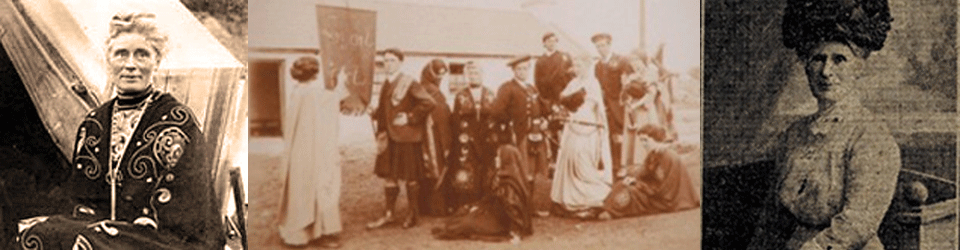
Ella Young

Emily Weddall made many friends through the Gaelic League and the cultural circles that were associated with the movement. One such person was Ella Young. Ella was no stranger to Achill as she spent time there in the early 1900’s, learning the folk and fairy lore of the Island. Her and Emily’s paths may have crossed then for the first time. Later she would attend Scoil Acla classes, where the two women would have definitely met. Over the years they would have moved in the same circles and would have had many friends in common such as the Pearse family, George Moore, George (AE) Russell and the Trench sisters Cessca and Margot.

Ella Young was born in Co. Antrim in 1865. Sometime in early childhood her family moved to the Bog of Allen, a area that left a deep impression on her, in her autobiography; Flowering Dusk: Things Remembered Accurately and Inaccurately, she recalled: ” what did I carry away from that countryside of horizons? I sense of spacious skies of great embattled clouds, of fiery sunsets and rose-red dawns”. Later on her family relocated to Rathmines, Dublin. She graduated from the Royal University of Ireland (UCD), originally on Earlsfort Terrace in history and law. It was was there that she  first took an interest in Irish mythology and folklore.

Ella; produced by kind permission of the National Library of Ireland

Ella; produced by kind permission of the National Library of Ireland

Sources
Young, Ella, and Stephen Griffin. Flowering Dusk: Things Remembered Accurately and Inaccurately. New York, Toronto: Longmans, Green and Co., 1945.
Mayo News June 5th 1915
http://d.lib.rochester.edu/camelot/creator/ella-young