Category Archives: Places

Enid’s Life in Australia

Enid Betts, lost her father before she was one years old, she had however her mother, full brother, six other step siblings and numerous relatives as the Betts were a big family and had lived in Vale Head area of Moolong for many years. Young Enid would have led a comfortable and somewhat of a society life in Australia as there are some local newspaper articles that named her receiving school prizes, attending garden parties and various functions.

In 1895, Mr. Betts married Miss Miriam Sophia Burke, a daughter of the Rev. Wm. John Burke, rector of Castlejordan, Westmeath, Ireland. The consummation of this happy union was one son (John Ulick DeBurge) and one daughter (Enid Cecily Patricia) ; the latter being an infant under twelve months old.

DSCF0484When Enid was barely fifteen years old her mother fell ill. It was not a serious illness as Miriam Betts lived on into her seventies but her ailment was enough to send her daughter on a the ten thousand mile journey form Australia to Ireland. Enid appeared to have traveled alone, the journey would have taken weeks to arrive at her destination,  to a new country and to a new life with an aunt she had never met before.

Sources
http://oa.anu.edu.au/uploads/obituaries/1163/betts_h.pdf
http://trove.nla.gov.au/
Ní Dheirg, Íosold. Emily M. Weddall: Bunaitheoir Scoil Acla. Baile Atha Cliath: Coisceim, 1995.
Class: BT26; Piece: 561; Item: 67. Ancestry.com. UK, Incoming Passenger Lists, 1878-1960 [database on-line]. Provo, UT, USA: Ancestry.com Operations Inc, 2008

Enid

Enid Patricia Cecily Betts,  was born in 1898 to Emily’s Sister Miriam Sofia and her husband  Henry Samuel Marsden Betts. Enid  was their second child and only daughter. Her brother John Ulick, was born three years before her in 1895.

Births.
BETTS.—May 29, at Vale Head, Molong, the wife of H.   S.M.Betts, of a daughter.

IMG_0955

Miriam was Henry Betts third wife. His previous wives Charlotte and Louisa died young and between them bore him at least eight children, Enid and her brother John Ulick made up his family of ten. Henry Betts was a well respected and from a prominent family in the Parramatta area of New South Wales. He was a Justice for Peace for thirty or more years.

Henry Betts died in 1899, after an unfortunate accident when Enid was only one years old. It appeared that he was getting better from his injuries but his health took a turn for the worst;

KICKED BY A HORSE,
MOLONG, Monday.— Mr. H. S. M. Betts, of Vale Head, was kicked by a horse which he was turning out of his paddock on Saturday afternoon. Mr. Betts’s leg was broken below the knee by the kick. Dr. Lamb set the limb soon after the accident, and the patient is progressing towards recovery.

The above story was carried by The Sydney Morning Herald on February 7th 1899, but less than three weeks later the same paper contained Henry Betts’ death notice;

BETTS.—February 24, at his late residence, Vale     Head, Molong, Henry Samuel Marsden Betts, J.P.,   aged 60, son of John Betts, M.A., Camb., of The Vineyard, Parramatta, and grandson of the Rev. Samuel Marsden, M.A., Senior Chaplain of N.S.W.

Miriam was less than five years married when she lost her husband, which seemed to be a trend in her maternal line. Her grandmother and great grandmother alike lost their husband’s shortly after marriage. Emily shared the same fate.

Betts, Henry Samuel Marsden (1839–1899)
On the 24th ult. word was received at Molong (N.S.W.) of the death of Mr. Henry Samuel Marsden Betts, of Vale Head Station. The deceased gentleman had been kicked by a horse a few weeks previously, and death was the result of the injuries then received. Mr. Betts was one of the oldest residents of the district, was a magistrate for many years, member of the local Land Board and licensing bench, and had been several times mayor of Molong. He took an active interest in church matters, and was a warden and lay reader at St. John’s Anglican Church. The funeral was largely attended by all classes of the community, thus evincing the general respect in which deceased was held.
The deceased gentleman was a grandson of the Rev. Samuel Marsden, a New South Wales chaplain in the days of “the system,” and Vale Head Station was a grant to Mr. Marsden. In the early days of the colony the house at Vale Head, it is stated, was a public-house, kept by a brother of Richard Cobden, the Corn Law reformer.

 Sources
“Family Notices.” The Sydney Morning Herald (NSW : 1842 – 1954) 1 Jun 1898: 1. Web. 29 Oct 2013 <http://nla.gov.au/nla.news-article14139882>.
“KICKED BY A HORSE.” Evening News (Sydney, NSW : 1869 – 1931) 7 Feb 1899: 3. Web. 29 Oct 2013 <http://nla.gov.au/nla.news-article113707716>.
“DEATH OF MR. H. S. M. BETTS.” Evening News (Sydney, NSW : 1869 – 1931) 25 Feb 1899: 5. Web. 29 Oct 2013 <http://nla.gov.au/nla.news-article113700460>.
 

Emily Joins Cumann na mBan

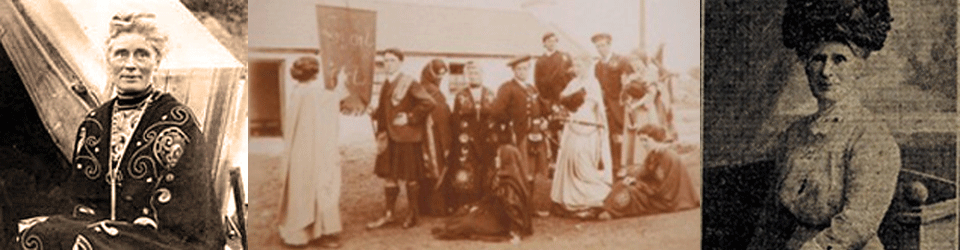
In 1914 Emily joined the newly formed Cumann na mBan, translating as the Irish Women’s Council. Her friends such as Margot and Frances (Saidbh) Trench and Antia McMahon had already joined and Eva O’Flaherty was connected with the organisation too. DSCF3596Cumann na mBan was formed on 2nd April 1914 in Wynn’s Hotel in Dublin City Centre. Emily may have been at the founding meeting too, although it is impossible to find out now. She would have been in agreement of their aims.

They adopted a constitution which stated their aims were:

– To Advance the cause of Irish liberty
– To organise Irish women in the furtherance of that objective
– To assist in arming and equipping a body of Irish men for the defence of Ireland
– To form a fund for these purposes to be called the ‘Defence of Ireland Fund’.

Cumann na mBan needed a wide range of volunteers ,of which nurses were of utmost importance. Emily could and did lend her skills there. Many years later fellow Cumann na mBan member Kathleen Walsh from Waterford in an article The Fighting Spirit of Waterford: Cumann na mBan Memories;

“A Mrs Weddall a most efficient nurse was sent to us from Headquarters. She also gave us a course of lectures..”


Untitled (1)

To read more about the formation of Cumann na mBan: http://www.rte.ie/news/2014/0328/605079-cumann-na-mban-centenary

Sources
Munster Express 28 October 1955. Page 9
http://www.rte.ie/news/2014/0328/605079-cumann-na-mban-centenary
Photos: http://irishvolunteers.org

Fever

When Emily married in 1905 she gave up nursing as a career, although she still nursed her husband, Captain Edward Weddall, through bouts of an illness he picked up on his travels. When he died in 1908, she did not return to her career, but focused her time and energies on the Irish language revival and Gaelic League.

When there was an outbreak of typhus in 1913 Emily did not waste a minute but rushed to Connemara to lend her nursing services the victims, especially those from Gaelteacht, who only spoke Irish. Emily’s heroic action was reported on by the Irish Independent;

Mrs. Emily M. Weddall,Widow of the late Captain Weddall of Burnby,Yorkshire, and Rockfield House, Keel, Achill, who has hastened to Connemara to nurse the fever-stricken victims there

The site where the fever hospital in Oughterard one stood

The site where the fever hospital in Oughterard one stood

. Founder of the Achill Irish Summer School, who is best known in Gaelic circles as Bean Ui Uadal, and it is for the sake of this last remnant of the Irish-speaking nation she is making such a heroic sacrifice.

When Emily arrived on in Connemara (Oughterard) she was appalled at the authorities neglect of the area. He strong social conscience, compelled her to write and highlight the problem. She put pen to paper and composed the following letter to the Cliadheamh Soulis.

I came away last week to help look after the poor typhus patients here. I found all the typhus cases in Oughterard Fever Hospital, and only a few typhoid patients (who can’t be moved) in their own homes. I was going to write to you to ask you to insist on the establishment of a temporary hospital into which fresh cases (which are sure to occur) could be moved, but today the government representatives have at last arrived on the scene, Mr Birrrell, Sir Acheson McCullagh (Local Government Board), John Fitzgibbon, M.P., C.D.B., and Mr. O’Malley M.P. for the district. The doctor tells me that they have provided the hospital, and it is about time! The people have been treated worse than beasts should be treated, and they are almost all that remains to us of the unsullied ancient Irish race. I am glad the Gaelic League was first on the scene, but we ought to do something efficient to preserve these people and to enable them to find a livelihood in their own country…

The letter shows the beginning of Emily more involved in politics, and it would be because of that, that Emily would be back using her nursing skill again.

Sources
Irish Independent 1905-2011 Date:May 21, 1913;Section:None;Page Number:3
An Claidheamh Soluis May 1913. p 8


Russia

Sometime between April 1901 and March 1905 Emily traveled to Russia. She may have had some nursing work there or went as a lady’s companion, who may have required some nursing services. Due to the absence of records it is impossible to say exactly when and under what circumstances she went there, only local legend and a few facts that Iosold ni Dheirg remembered from the time she spent with Emily in her later years. In her biography Emily M. Weddall: Bunaitheoir Scoil Acla, Iosold ni Dheirg mentions that Emily had been to one of the palace of the Tsars, and that she kept a photo of the three Russian princesses in her house many years later.

Emily’s time in Russia is shrouded in mystery, and possibly will never be solved. Her time spent there was eventful and may have been the beginning of her developing a strong social conscience, which she was noted for all her life. One particular incident would have an strong effect on her character. It happened one snowy night…

Emily was awoken from her sleep by a commotion outside. She looked out her bedroom window to see a big group of poor men, in shackles been led of the work in the harsh climate of Siberia as a punishment to whatever crime they may have committed. It was snowing heavily. It was the most alarming sight she had seen in her life so far.

irishtimesdolls

She would see similar scenes but the next time it would be in her own country many years later.

Sources
Ní Dheirg, Íosold. Emily M. Weddall: Bunaitheoir Scoil Acla. Beann Éadair, Baile Átha Cliath: Coiscéim, 2010.
Photo by Ciaran Parkes