Married Life

Emily was Captain Weddall’s second wife. The retired mariner had been widowed over a decade, when he married Emily. From the scant accounts of his life that had been documented, it appeared that he was a reticent man who liked routine, somewhat opposite in character to his more gregarious wife. What the couple had in common was their lack of practically around money, which they frittered away without much thought. Both were quite generous and were happy to help out local causes.

One such example was for the St. Patrick’s Day concert of 1907 and 1908 Edward Weddall treated the cast and crew of the show as well as those who traveled long distances to refreshments afterwards. His wife for her part worked tirelessly behind the scenes to put the show on. Edward Weddall, a stoic man was probably proud of his enthusiastic and energetic wife.

Emily’s involvement with the St. Patrick’s Day concert and her work with the local Gaelic League, would helped integrate the Weddall’s somewhat into the local community. It is impossible to tell nowadays how well the couple were received into the community. They would have stood out among the local people. He an older man and she much younger, both dressed in fashionable rather than functional clothes and speaking with accents much different from the local. They were not completely out of place, Englishmen and daughters of clergymen like Emily had made the island their home before.

The couple’s generosity may have won people over too. Emily was always on hand to help where needed and gave freely to any cause that touched her heart.  The writer Sean O’Longain, who was an Irish traveling teacher in the early 1900’s remembers the Weddall’s;

“They [The Weddalls] lived in a beautiful bungalow and were very comfortable and happy in the little village called Pollach, overlooking an inlet of Clew Bay. This Russian [he was in fact English] captain was a man of large statute, great avoirdupois, corpulent, of a retiring disposition and not very communicative.

Mrs Weddall, his wife was quite the opposite; she was in the first place an ardent Gaelic League, charitable to the poor of the Island, always on the move seeking out those who may be in need of help.”

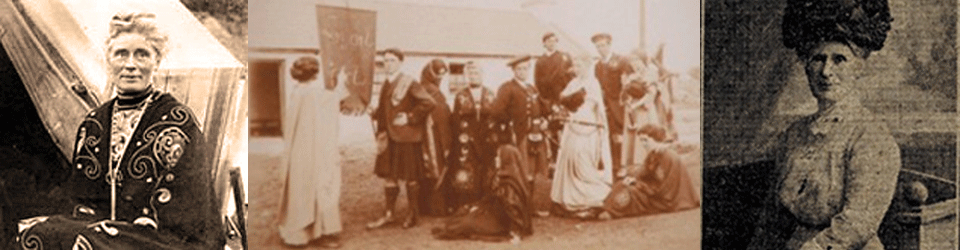
Emily in her earlier days on Achill. No known photo of Edward Weddall exists

Sources
Mayo News, March 30 1907. Page 4
April 04 1908. Page 3
Connaught Telegraph 1830-current, 19.05.1956, page 4
Photo courtesy of John ‘Twin’ McNamara

Honeymoon

It is hard to say if Emily went on honeymoon with her new husband, Captain Weddall. At the time between them they certainly had the means to do so. It was just becoming fashionable to do so. The newlyweds were not in any way stingy in fact they spent their cash freely. This was displayed on many occasions throughout Emily’s life.

Below is an advert from the early 1900’s advertising honeymoon hotels in London. Similar ad could be found in the daily newspapers advertising similar hotels all over Britain and the Continent.


Edward Weddall may have brought his new bride to meet his family in Pocklington, Yorkshire. The couple would have arrived at the local station depicted below. It was not the first time Emily was in Yorkshire as she visited her half brother William in Barnsley under less joyful circumstances when she was still in her teens in 1888.


Courtesy of http://www.pocklingtonhistory.com

Courtesy of http://www.pocklingtonhistory.com

The above photo is of Regent Street in 1905 the same year Emily and Edward married. If she visited her news husband’s hometown she would certainly have walked down the street. There is a possibility the couple may have lived there for a while before the moved to Ireland the following year.


Sources
12 September 1903 – Dundee Evening Telegraph – Dundee, Angus, Scotland
Barnsley Chronicle, etc. 12 May 1888
Thanks to
Andrew Sefton, Archivist/Webmaster of pocklingtonhistory.com , by whose kind permission the old photos of Pocklington are reproduced.

http://www.pocklingtonhistory.com

Wedding Bells

St Marys Church Islington, where Emily and Captain Weddall Married in April 1905

Emily became the second Mrs. Weddall on April 27th 1905. She and her new husband Captain Edward Weddall were married in St. Mary’s Church Islington, London. Unlike modern or society weddings of the day theirs was a simple affair. They exchanged vows without friend or family present, with just two witnesses one which was the church clerk.

Emily and Edward were married by licence, which meant in their case they were not “of the parish”. Emily gave the address of Waverly Terrace, Rathgar in Dublin, Edward gave a Yorkshire address.  They had to get permission from a bishop to get married. The other advantages to the marriage licence they could get married quicker than if they opted for the marriage banns which had to be read out in church at least three weeks beforehand.

As the bride and groom did not have friends or family present the still put the announcement in their local newspapers, the Beverley and East-Riding Recorder and the Irish Weekly Times.  This practice was common at the time, but also a good way of letting the wider world know of their exchange of vows.


Sources
Beverley and East Riding Recorder 06 May 1905
Weekly Irish Times 13 May 1905
http://archiver.rootsweb.ancestry.com/

Emily Gets Married

When Emily married in 1905 a time when big weddings were uncommon unless it was a society one. This was not so in Emily and Edward Weddall’s case. It was just the two of them with two witnesses and the Vicar. This austerity possibly extended to the bride’s dress. It was not that Emily was miserly, in fact the complete opposite could be said of her it was a sign of those times. Below is an article, The World of Women, from the same year taken from the Penny Illustrated:

We are so utilitarian in these days; if we purchase or learn anything, then that thing must be purchased or learned only if it is likely to prove useful. wear carrying this utilitarian principle to the bride’s dress and the writer takes the liberty of thinking that it it not entirely a wise step.

The argument in favour of this application of the “useful” to the wedding garments is this: The young people are not very well circumstanced it is therefore, better than the bride should have a wedding dress that will easily “come in” for ordinary wear, instead of spending money on a garment that must, in all probability be laid aside after the ceremony…

Yet is it not a pity to banish the poetry from the most solemn, the most important and most poetical of all events of a girl’s life…

Whatever Emily wore to her wedding it was certainly set off by a hat. Emily had a lifelong liking for millinery, wearing the biggest hat available, which usually dwarfed her tiny frame, nevertheless she wore them well.

Sources
The Penny Illustrated 3rd June 1905


The Bride to be arrives at Islington

The newly built Highbury Station where Emily arrived before her wedding in 1905

Emily Burke arrived in London in April 1905. She made the journey alone as her only remaining sister lived in Australia at the other side of the world. Emily perhaps at this stage was used of being alone and the journey to London to become the second Mrs. Weddall would not have fazed the “intrepid” Emily too much. This ‘fly by the seat of her pants’ approach shows up in Emily’s life on many occasions.

Emily knew the sea captain for about ten years before they walked down the Isle together in St. Mary’s church in Islington. They met at least once in France in 1896, when Emily made a collection for the families of the Kingstown Lifeboat Disaster of 1895. Edward Weddall made an ostentatious contribution to the fund. Maybe it was the sea captain’s way of impressing young Emily. It took it’s time but it worked and a decade after first meeting the couple married.

Old map of Islington