Scoil Acla 2016; Meetings and Remeetings

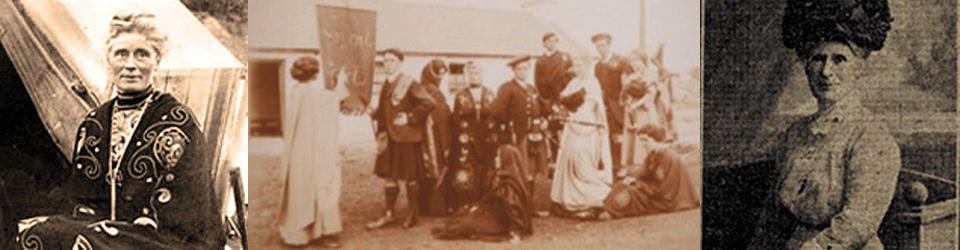
On July 26th and 27th  four of the founding members of Scoil Acla,  were reunited by a series of lectures for the present summer school.  Our absent friends Emily Weddall,  Eva O’Flaherty, Darrell Figgis and Anita McMahon brought together again posthumously through the talks given by Maria Gillen, Mary J Murphy, Edward King, and Sheila McHugh respectively making for a truly auspicious occasion.

In conjunction with the above talks Dr. Hillary Pyle, gave an illustrated lecture on the life and works of  Cesca Chenevix Trench (Sadhbh Trinseach), the Irish nationalist artist, who attended the original Scoil Acla. Both nights were captured on camera beautifully by Minette Glynn.

The events of  brought together the stories of five fantastic individuals who’s lives are interlinked now through the speakers as they were a century ago, when the cultural revolution met the political.


scoil acla 2016 & more, d'lissane, cmore for sale etc 041 scoil acla 2016 & more, d'lissane, cmore for sale etc 046 scoil acla 2016 & more, d'lissane, cmore for sale etc 085 scoil acla 2016 & more, d'lissane, cmore for sale etc 049Photos by Minette Glynn

http://scoilacla.ie/

Achill Commemoration: Easter ’16

On Easter Monday 2016 Achill people and current members of Scoil Acla commemorated the Easter Rising. A special wreath, a replica of the one Emily and Darrell Figgis put on the grave of Jeremiah O’Donovan Rossa in August 1915, was laid at the gatepost of Hala Acla, built by Emily Weddall c. 1910.

The photos below taken by Minette Glynn documented the event.

fioncaitJ 'Twin'achill easter mon 28 march 2016 038 fioncaitJ 'Twin'achill easter mon 28 march 2016 030 fioncaitJ 'Twin'achill easter mon 28 march 2016 028 fioncaitJ 'Twin'achill easter mon 28 march 2016 022 fioncaitJ 'Twin'achill easter mon 28 march 2016 027 fioncaitJ 'Twin'achill easter mon 28 march 2016 018 fioncaitJ 'Twin'achill easter mon 28 march 2016 015

Claud Chavasse on Achill

Claud Chavasse was somewhat of a ledgend in his own lifetime in Galway, where he lived most of his life. Before he settled there in 1917, he lived on Achill.  His sister Marguerite Chavasse, ran a lace making industry on the Island and he stayed with her, while there.  Emily Weddall, a friend of Marguerite, must have been enthralled with her brother Claud, not only for his interest and commitment to Gaelic Culture, but with his refusal to speak any language other than Irish. He and Emily became friends and soon joined forces with others to found the Irish language and cultural summer school, Scoil Acla.

Chavasse taught Irish classes as part of the summer school curriculum, and any other time this service was required, where he was ever willing teacher.

Claud Chavasse teaches Irish classes on Achill in 1915

Claud Chavasse teaches Irish classes on Achill in 1915

Sources
http://www.nuigalway.ie/arts_office/art_database/index.php
An Claidheamh Soluis

Claud Chavasse

Claud Chavasse arrived on Achill sometime in the early 1910’s, possibly to visit his sister Marguerite, who had settled on the Island shortly before, where she had set up a lace making industry.  English by birth, with French ancestry, Claud Chavasse did not have any family links as such with Ireland, however when he arrived on her shores he must have felt it was it his true home, as he ended up staying for the rest of his life.

Born on April 2 1885 to Albert Sydney Chavasse, and Isabella Florence nee Mann. The Chavasse family lived at Oxford, where their father was a professor of classical languages at the University. Claud would follow the family’s academic tradition, first by attending Wellington College in Berkshire, where he won a scholarship to continue his studies at Christ Church College, Oxford in 1903. It was at Christ Church College that he first began his love affair with Irish culture.

After befriending  Sir John Rhys, a Celtic scholar Chavasse took up Celtic Studies. He also became friends with a group of Irish students, Diarmuid Trench, Éamon Cuirtéis, and Robert Barton. This group of young men established an Irish Society, hosting discussions on Irish language and culture. It was with the same group that he first visited Ireland in 1905, a trip that inspired him to set up the Oxford Gaelic League, where in 1909 he became head of the branch.

Portrait of Claud Chavasse, by Sadhbh Trinseach. Kindly reproduced with permission of NIUG Art Collection

Portrait of Claud Chavasse, by Sadhbh Trinseach. Courtesy of NIUG Art Collection


Sources
Ní Dheirg, Íosold. Emily M. Weddall: Bunaitheoir Scoil Acla. Baile Atha Cliath: Coisceim, 1995.
Liverpool Echo February 10, 1916, page 6
Reading Mercury 27 June 1903. P6


Easter ’16. Now and then; 1916 Rebellion Tour

On this day 100 years ago, April 24th, the  Easter Rising began. It is hard to imagine, now in 2016 what it was like to have lived through what happened a century ago. The Old photos, film footage and newspaper reports along with modern day takes can help to paint the picture of the pivotal week in Irish history.

The International Bar on Wicklow St., where the tour begins

The International Bar on Wicklow St., the starting point of the tour

One such way of ‘reliving’ history is by taking the 1916 Rebellion Walking Tour. Established 20 years ago by Lorcan Collins the tour has been informing, educating and enthralling those join Lorcan and fellow tour guide, Conor Kostick. It is a walking history lesson following in the footsteps of those who dared to take on the biggest empire of the time.

Both men are well versed historians who have the ability to transport you back in time to the lead up, event and aftermath of the Rebellion. Stopping at the key buildings, streets, and alleyways, through their stories you can well picture the dramatic scenes of one hundred years ago.

Conor and Lorcan

Conor and Lorcan

The journey beginning at the International Bar on Wicklow St., will take you to locations such as Dublin Castle, Liberty Hall, O’Connell St. and to the principal site of the Rising, the GPO and beyond. To book a tour and hear Lorcan and Conor relay the story of the Rebellion go to http://www.1916rising.com/

“That is why they were so magical and beautiful in my eyes because they just continued on the way they did in the aftermath, when all the odds were stacked up against them. We now continue to Moore St. where they took their last stand…” Lorcan Collins

GPO

GPO