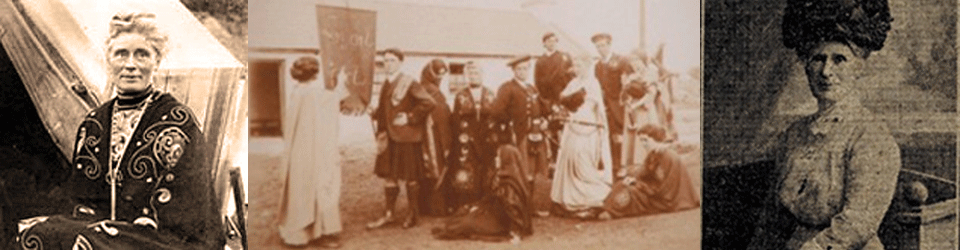
Dr Kathleen Lynn

Dr Lynn

Dr Lynn

Dr. Kathleen Lynn was born in Mayo. Like Emily Weddall her father was a Church of Ireland Minister. She was educated in Alexandria College, Dublin before completing her medical training at Cecilia Street (a Catholic University medical school).
Dr Lynn worked at Sir Patrick Dun’s Hospital, where Emily did her nurses training, but at different times.  Emily the older by a few years, attended Sir Patrick Dun’s in the 1890’s, Kathleen began working there in 1899, after completing medical school. At the time it was hard for female doctors to secure work, Sir Patrick Dunn’s progressive for it’s time took her on, on her own merit.

It is not clear when and where both women first became acquainted, it was likely through the Gaelic League, Cumann na mBan or through medical circles.  Kathleen Lynn either attended or helped with Scoil Acla as she was named on a list of attendees and supporters in a Mayo News article in the summer of 1915. They were life long friends, and would be meet many times again over the following four decades.

Kathleen Lynn: A Revolutionary Doctor | An Dochtúir Reabhlóideach

Kathleen Lynn was one of our first female medical graduates.  During the course of a distinguished life, she was a medical leader, campaigning feminist and social activist, a rebel of the emerging Irish nation, a suffragette and a public representative.  She had a pioneering medical career whilst taking part in Ireland’s War of Independence…To read more about Kathleen Lynns remarkable life:http://www.ucd.ie/medicine/ourcommunity/ouralumni/alumniprofilesinterviews/drkathleenlynn/

Sources
http://www.mayosinnfein.com/constituencies/9485/Retrieved 08/07/2011
Mayo News August 1915
http://www.ucd.ie/medicine/ourcommunity/ouralumni/alumniprofilesinterviews/drkathleenlynn/
Photo: 04 August 1917 – Daily Mirror – London, London, England

 

Aftermath; Emily is Released

An Cliadeamh Soluis 24/04/1916

An Cliadheamh Soluis 24/04/1916


DSCF2517 DSCF2489By May 5th the Rising was over and some of the leaders already executed. Emily was released from prison. Her niece Enid (Siobhan) may have had to make her way from Achill all the way to Tullamore to meet her at the prison gates. Enid was still on Easter holidays from Alexandra College. She was only seventeen, but all too familiar with the adult world of Nationalism through her aunt.

Tullamore Prison Gates

Tullamore Prison Gates

On returning to Achill Emily would become aware of the fate of her friends. Darrell Figgis would be arrested and taken to Prison in Castlebar, on to Dublin and then to Durham Prisons. Claude Chavasse was held in Richmond Barracks and the Pearse brothers, Patrick and William she would never see again.

Sources

Irish Prison Registers 1790-1924 Transcriptionhttp://search.findmypast.ie/record
Figgis, Darrell. A Chronicle of Jails. Dublin: The Talbot Press, 1917.
Find my Past. The Weekly Irish Times, Sinn Fein Rebellion Handbook, Easter 1916. 1917 Transcription

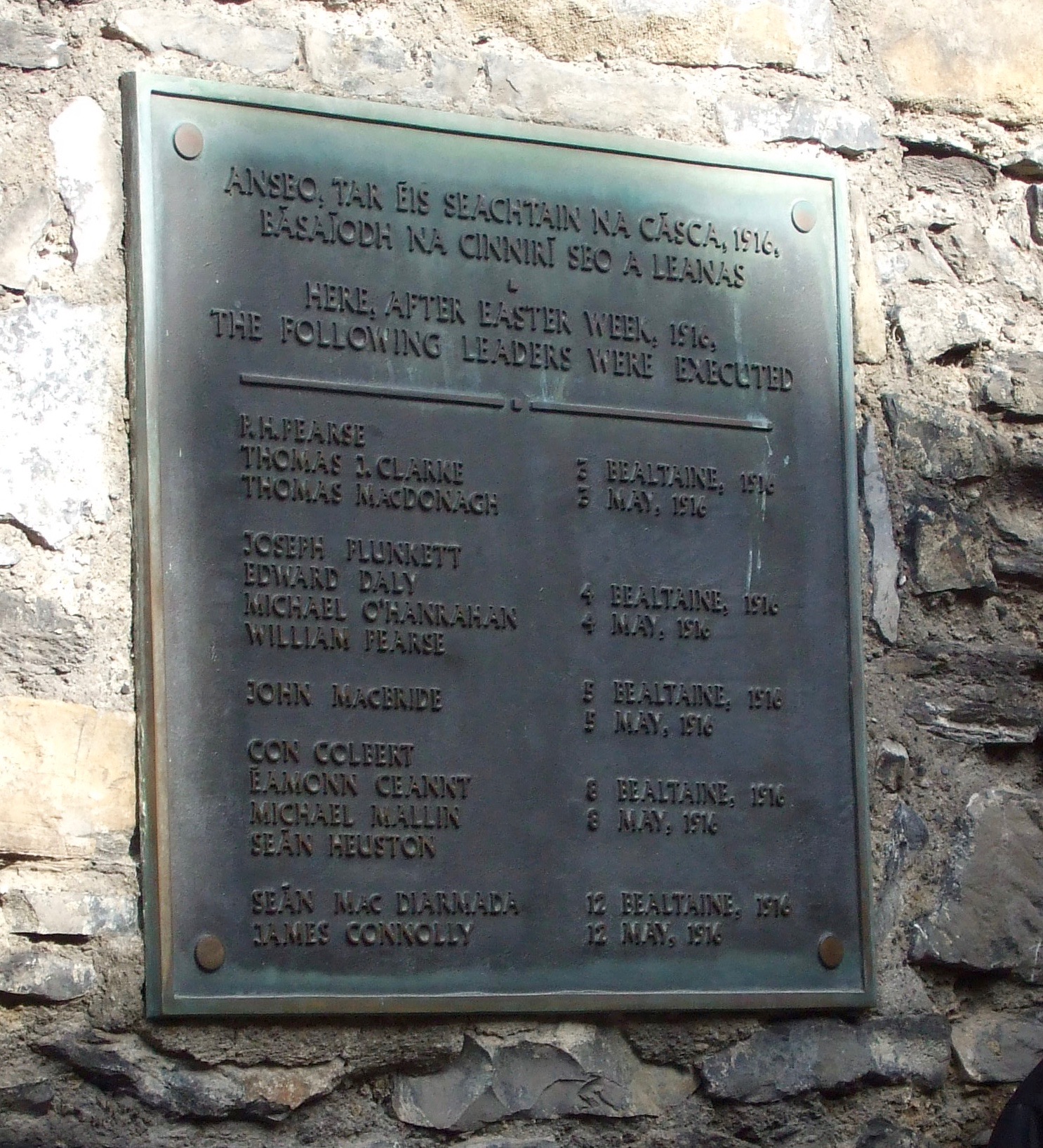
Sunday after Easter Sunday; “All the Leaders are not dead will be.”

Ella Young explains describes the end of the Rising, again in a few sentences. She gives the bare bones of the situation but it is enough.


All the leaders are not dead will be

This is Sunday, April 30th, the Sunday after Easter Sunday. Pearse signed the order to surrender yesterday. It is his own death warrant, and the death warrant of those with him who proclaimed the Irish Republic. All the leaders who with him proclaimed the Irish republic. all the leaders who are not dead will be executed: but the surrender saves the lives of a few young fighters, and ends the slaughter of civilians. Sentries are still on all canal bridges. No one can go into Dublin Town without a military permit.

It rains and rains, and rains.DSCF2150

Sources
Young, Ella, and Stephen Griffin. Flowering Dusk: Things Remembered Accurately and Inaccurately. New York, Toronto: Longmans, Green and Co., 1945.

Easter Saturday; Surrender

Emily has just spent her first night in prison. She was on remand and could be held for a full week, which she was. It must have been very frustrating for her to be locked up in a cell when her friends and fellow Nationalists were fighting for their country. By now though it was all but over and Emily’s involvement would not have made any difference.

Tullamore Prison at night

Tullamore Prison at night


In Dublin it was all over. To read more on the surrender: Irish Times

Ella Young from a safe distance in Rathmines sensed that it was over too. Her account of Easter Saturday contained only three short sentences;

Firing has ceased. There is a horrible silence. They are all dead or is it surrender!

Sources
Irish Prison Registers 1790-1924 Transcriptionhttp://search.findmypast.ie/record
Young, Ella, and Stephen Griffin. Flowering Dusk: Things Remembered Accurately and Inaccurately. New York, Toronto: Longmans, Green and Co., 1945.
http://www.irishtimes.com/culture/books/an-easter-rising-timeline-saturday-april-29th-1916-1.2192252

Easter Friday; Emily is Captured

On Easter Friday Emily is is almost half way to Dublin but, that is a far as she gets. Somewhere on the road near Rochfordbridge she was intercepted by the police. What she did or how she got caught is lost in time. Only a brief transcription from Tullamore Prison Register book tells of her arrest. Only her vital statistics and her conviction: Suspected of an Offense against the Defense of the Realm Act 1914, are listed. No further notes or even a brief explanation of the suspected offense. No other record remains not even a court listing. Nevertheless the authorities believed her to be dangerous in some way and she was sent to nearby Tullamore Prison until the Rising was well and truly over.

The prison sentence must have been more frustrating than frightening to intrepid Emily, her mission to fight for her country scuppered. Her dreams of freeing Ireland from British Rule, put on hold. She would get her chance again but for now she would bide her time until her seventeen year old niece Enid could make her way from Achill to Tullamore to get her aunt out of prison.

Tullamore Gaol

Tullamore Gaol

In Dublin, the place Emily could not get to, her friend Ella Young was kept informed on the progress of the rebels. She was also noted as a subversive.

DSCF1953


City Hall Dublin

They must Burn to the Bone or Surrender

Phyllis MacMurdo came to see me. Since she is the niece of General Sir William MacMurdo, and strongly pro-British in sympathy, she is in touch with the military here. She has authentic news: Pearse, Clarke, Connolly, The O’Rahilly and others are still in the charred Post Office, they must burn to the bone or surrender. A small column of the citizen army, under Sean Connolly, almost captured Dublin Castle. Emear [Helena] Moloney and Dr. Kathleen Lynn were with that column that barricaded itself inside of City Hall. They are prisoners now. Sean Connolly is dead. Sheedy-Skeffington, the noted pacifist (who had nothing to do with the Rising), was shot in Portobello Barracks on Wednesday. The English arrested him on O’Connell Street on Tuesday night when he was trying to stop the looting of the big shops. It is pandemonium there, unchecked and even encouraged by the soldiery. Plate-glass splintered on the sidewalk, men, women and children staggered under fur coats, damask armchairs, and bales of silk. Diamond rings and jeweled watches are sold in the streets for little more than the price of a drink. Phyllis came to warn me that I must leave Dublin at once. She has information that my name is on a “black list”.

Portobello now Cathal Brugha Barracks

Portobello now Cathal Brugha Barracks

I shall stay, but will be advisable to take my pistol to my fathers house (he is pro-British).The ammunition I can hide. Rodger Casement is in the hand of the English. They will hang him.

Sources

Irish Prison Registers 1790-1924 Transcriptionhttp://search.findmypast.ie/record
Young, Ella, and Stephen Griffin. Flowering Dusk: Things Remembered Accurately and Inaccurately. New York, Toronto: Longmans, Green and Co., 1945.