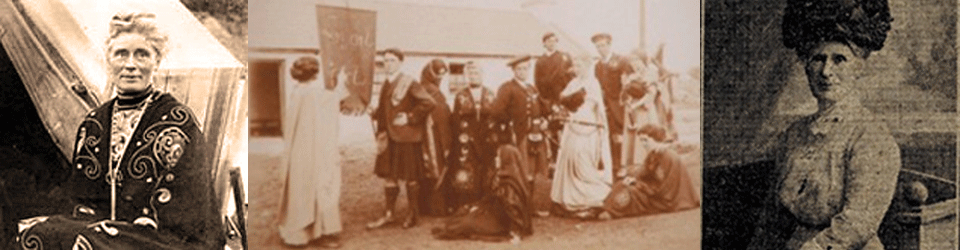
On June 16th 1922 the public of Ireland went to the poles to have their say on the Treaty and the general politics of the new state.
It is unclear to where Emily voted, as she went between Achill and Dublin, the former was her official residence. What was clear was how she voted, against the Treaty. She made her feelings clear in a letter to the mother of her comrade, Michael Moran, who had died a few months before on active service: “For Michael’s sake vote against the Treaty, that Michael would have fought against. Remember for his sake.”(Read more about Michael Moran)
“The Irish general election is won by pro-Treaty Sinn Féin, who gain 58 seats to defeat anti-Treaty Sinn Féin’s 36. In advance of the election, Collins and de Valera had drawn up a pact to ensure that Sinn Féin representatives on both sides of the divide would not run in opposition to each other.”
On the night of of June 12th, 1922 Millie Figgis answered the door of her at her and her husband Darrell’s apartment on Kildare Street, Dublin. It was in the led up to the first general election of the new Irish State, which Darrell Figgis was running in as an independent candidate. He was also pro-Treaty, urging other candidates especially non Sinn Fein members, whom he had fallen out with earlier in the year to follow suit. His change of course enraged some republicans, who thought he had betrayed them.
When Millie opened the door a party of three men pushed roughly past her, setting upon her husband…
“Certainly. It has made me, if possible, all the more determined.” was his reply to a reporter, who asked if he intended to proceed with his election campaign after the traumatic incident. All in all the publicity around his bearding, garnered much public support, and played no small part in helping him obtaining over 15,000 votes. He won a seat in the constituency of South County Dublin as an independent candidate.
Darrell Figgis, noted for his vanity, both physical and intellectually, perhaps with good reason too, it was a huge slight on him to have it cut off, but he bore it with good grace and dignity. Even his ‘enemies’ could not believe his composure, after the assault. Within weeks his beard was restored to its original splendor, enough to merit a short report in the Daily Mirror.
Daily Mirror 31 August 1922
Sources
Londonderry Sentinel 15 June 1922
https://www.dib.ie/biography/figgis-darrell-a3078, by William Murphy
By May 1922 the tension between the pro and anti- Treaty sides was heating up to boiling point. The was a palpable sense, that those hostilities could erupt in to combat at any moment in the atmosphere. That did come to pass in Kilkenny City on May 2nd.
Kilkenny Moderator 06 May 1922
About 300 members of the IRA took the city centre, which included one of the cathedrals, the city hall and the Castle. In counteraction the The Free State Army on behest of The Provisional government took over the Barracks, Jail and the Bank of Ireland. The government sent in over 200 troops from Dublin to remove the irregulars by force if necessary. It was. Fighting broke out causing many to be injured and eighteen deaths. A ceasefire, followed by a truce was negotiated and the fighting drew to a halt.
Weekly Freeman’s Journal 06 May 1922Kilkenny Castle; Weekly Freeman’s Journal 06 May 1922
Under the instruction of the provisional government 200 troops were dispatched by train to Kilkenny. It was not a peaceful operation as a shootout ensued with a total of 18 casualties. The following day civil war is just about prevented when the Anti-Treaty members of the Dail announce a truce.
At the other side of the country there after the IRA enter and rob a bank in Buncrana, Donegal. There was a shootout between them and the Free State Army, in which two members of the IRA and young female civilian are killed and numerous injured. Again troops are sent in from the Free State Army, but were ambushed at Newtowncunningham, and three are killed.
As May 1922 progressed there was a spate of bank raids by the IRA, around the country. In one such raid in Westport, the irregulars left a note stating that as the state refused to finance them, they were only taking the money to cover their expenses.
Weekly Freeman’s Journal 06 May 1922
As the violent flare ups around the country continued it was becoming increasingly clear that civil war could easily break out in an instant. A ‘pact’ was drawn up between Eamonn de Valera and Michael Collins, to establish the most peaceful way forward. The agreement resulted in the call for a general election, with view to forming a coalition party which would include both the pro and anti-Treatyites. The move allowed the public to have their say on the Treaty and the general politics of the new state. Polling day was set for June 16th. But as May drew to a close even Michael Collins had his doubts about a peaceful outcome. He told a reporter from the Chicago Tribune: “If this peace conference fails, then there will be no other, and we will have to take strong action to restore order in the country.”
Six years after the Easter Rising a new organisation was formed to honour “Men of Easter Week”. Named the “1916 Club”, they held their first annual church parade. Before the procession that began at St. Mary of Angles on Church Street and continued to Glasnevin Cemetery, where some of the fallen of Easter Week were buried. At the time, the Republican Plot didn’t exist as such, as many of who are now buried there, were still alive at the time. None of the executed leaders of the Rising were buried their neither, their final resting place in Arbour Hill Cemetery.
In spite of the political tension between the pro and anti Treaty supporters, which could have erupted at any moment the commemorations continued. Large crowds lined the route from Church Street to the Parnell Monument, stopping all traffic on the route. When the parade reached O’Connell Bridge, they slowed down and the St. James Pipe Band began playing a lament, as the reached the GPO, still a burnt out hollow behind it’s facade at the time.
On the approach to Glasnevin Cemetery, the parade slowed down again to the solemn music of the “Dead March”. Again a crowd had formed to greet them at the cemetery gates. Inside wreaths were laid on the graves of the dead heroes of more recent times and of old in various locations throughout the cemetery. The Rosary was recited in Irish, which formed a Republican tradition, that still exists, regardless of the patriot’s religious faith.
The event concluded by the band playing “The Soldier’s song” and “Wrap the Green Flag Round Me.”
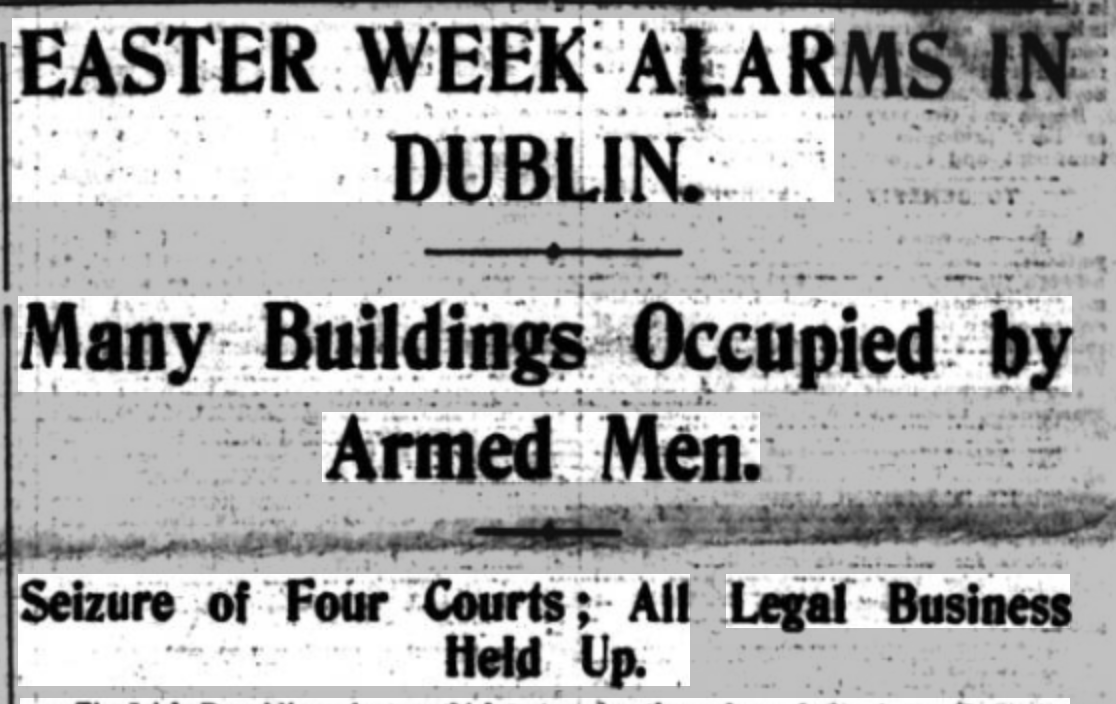
On this day one hundred years ago, on Good Friday the Anti-Treaty IRA occupied the Four Courts. Led by Rory O’Connor, and about two hundred men took possession of the building. He issued a statement to make it clear that the action was no coup d’etat, that he required a building to house his men and no more.