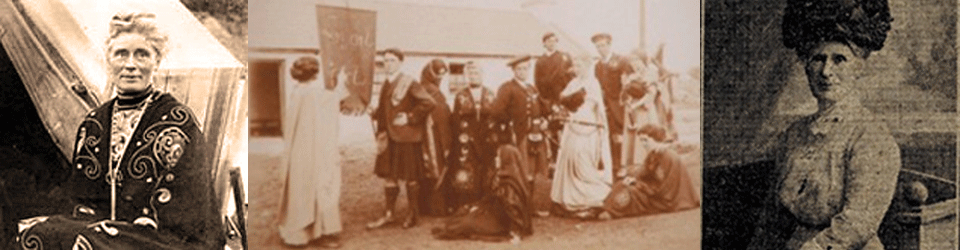
Inspiration 1Florence Nightingale

The Lady with the Lamp

DSCF3030.JPGA generation before Emily nursing had become a reputable career for young women. Florence nightingale had made a name for herself and revolutionized the profession.

During the Crimean War, a public fund for training nurses was set up . With the money raised the Nightingale School at  St Thomas’ Hospital was opened in 1860.

Florence became actively involved in the Nightingale School at St Thomas’ in the 1870’s in order to avert a crisis. The first student nurses or ‘probationers’ were receiving little formal training. A student from Sweden complained that in eights months she had learned only how “to be obedient and humble and not to think much of herself” The drop out rate was alarmingly high.

Once Florence learned this she set about reform, appointing a new sister and involving St Thomas surgeon, John Croft, to give lectures and set examinations.

With that her nurses were known world wide and took up positions as matrons. There was a branch in Ireland too, perhaps Emily had contact with them, as part of her training or may have reached a level of competence as a nurse that she could register with the Nightingale Nurses to find employment.DSCF3033.JPG

Many went on to lead the reform of nursing and raise it’s status as a profession. In Isold ni Dheirg, Emily’s biographer suggests that Emily may have had some training with the Nightingale Nurses in London after she finished at Sir Patrick Dunns Hospital or travel to the continent when she nursed in France and Germany.DSCF3041.JPG

Sources
Ní Dheirg, Íosold. Emily M. Weddall: Bunaitheoir Scoil Acla. Beann Éadair, Baile Átha Cliath: Coiscéim, 2010.
http://rcnarchive.rcn.org.uk/data/VOLUME088-1940/page027-volume88-february1940.pdf retrieved 02/06/2014
Photographs curtesy of the Florence Nightingale Museum, London

Training

When Emily began her nursing career she was already 25 years old. It was the lower age limit at the time. Below is a nice example of the criteria of the day for the nursing vocation:

SIR PATRICK DUN’S TRAINING SCHOOL FOR NURSES AND MIDWIVES

GENERAL NURSES.
Women desirous of being trained as Hospital, District and Private Nurses, should apply to the Lady Superintendent of Sir Patrick Dun’s Hospital; and if suitable, they will be received as Probationers under the following arrangements:-

1. Must pay an Entrance Fee.

2. Must be from twenty-three to thirty years of age.

3. Must read and write well, and bring testimonials of  good character.

4. They will only be received on the distinct understanding that they remain three months: subject, however to the approval of the Lady Superintendent at the end of one month, when if they are considered unsuitable to train, their services will no longer be required.

5. At the expiration of three months, if retained they will be provided with indoor uniform clothing.

6. The Probationers and Nurses will be required to wear the uniform clothing while at the Home or on duty elsewhere. Their outdoor uniform they will provide themselves.

7. If found efficient at the end of three months the following scale of wages will begin:- First year, £10; to be increased £2 every year during the term of training.

8. It is expected that at the end of eighteen months the Probationers will be fitted for Nurses, and heir engagement will then require them to serve two years and six months more in Hospital, District, or Private Nursing; to sick among the rich or the poor whenever called upon to do so.

9. At the expiration of three months from date of entry, every Probationer will be required to write a letter to the following effect:-

“To the BOARD OF GOVERNORS of Sir Patrick Dun’s Hospital.
“GENTLEMEN, – Having now become practically acquainted with the duties of a Nurse, I am satisfied that I shall be able and willing, on the completion of my training, to enter into service as a Nurse in an Hospital, District or in Private Houses; and I promise to continue in such service for the space of at least two and a-half years afterwards, in whatever situation the Lady Superintendent shall thin suitable to my abilities.
I am, Gentlemen,…”


Image courtesy of the Royal College of Physicians of Ireland

Image courtesy of the Royal College of Physicians of Ireland

Sources
Reproduced by kind permission of the Royal College of Physicians of Ireland, End of Year Report 1889-1899, p47.


An Excellent Education


Untitled (2) Mrs Dunnan, the headmistress of The Clergy Daughter’s School received visitors and inspectors reguluarly, Keeping very high standards. The school was always impeccable and the reports glimmering. The above newspaper clipping tells of dignitaries such as the Lord Lieutenant, and the Duchess of Marlborough.

The below gives insight into the standard of  Emily received, the subjects offered and how it prepared young ladies for their future.

Report of the visiting ladies
Checked the below categories:

School Business

Order and regularity
Religious Instruction
Needle work
English education, geography, arithmetic, and reading
Languages
Music and drawing

General appearance of pupils and school
Health
cleanliness and tidiness
Manners and deportment
Attention of superintendents
State of apartments
Suggestions for benefits of the institution

Professors and teachers
Principal Lady Mrs Dunner

Subjects:
Holy scripture, English, French, German, Italian, Latin, pianoforte, vocal music, drawing.

The principles adopted by the school along with the subjects studied more than set Emily for her nursing career. Emily finished her education around 1887, when she turned 20 at that was the upper age limit for the Clergy Daughter’s Schools.

She came out trained in a broad range of subjects and skills. She seemed to excel in languages, speaking Russian, German, French and her native Irish. All her skills would have more than prepared for her career as a nurse and the ability to travel with her job.

Sources
Dublin Daily Express 13 May 1879
Clergy Daughter’s School Reports 1868 – 1886. Courtesy of RCB, Church of Ireland Library, Dublin
Ní Dheirg, Íosold. Emily M. Weddall: Bunaitheoir Scoil Acla. Beann Éadair, Baile Átha Cliath: Coiscéim, 2010.

A School for Young Ladies


Rules of Entrance

The lady principle of Irish Clergy Daughter’s School at the time Emily was a pupil was Mrs Dunnan. Mrs Dunnan ran an excellent institution and had the highest of standards for the school and the pupils. It appeared that she was rule abiding and enforced strict instructions as seen below. Also included is a list of the items of clothing and personal effects the girls were required to have on entrance.

It is required that applications for admission be accompanied by references to two or more clergymen acquainted with the circumstances of the applicant.

Reference must be given to some respectable person, who will garnet the regularity of the quarterly payments, which will fall due on 1st January, 1st April, 1st July and 1st October, in each year and in advance.

Each pupil will bring with her, at entrance the following articles; and the whole supply should be kept by her parents or friends as long as she remains at the school, viz –

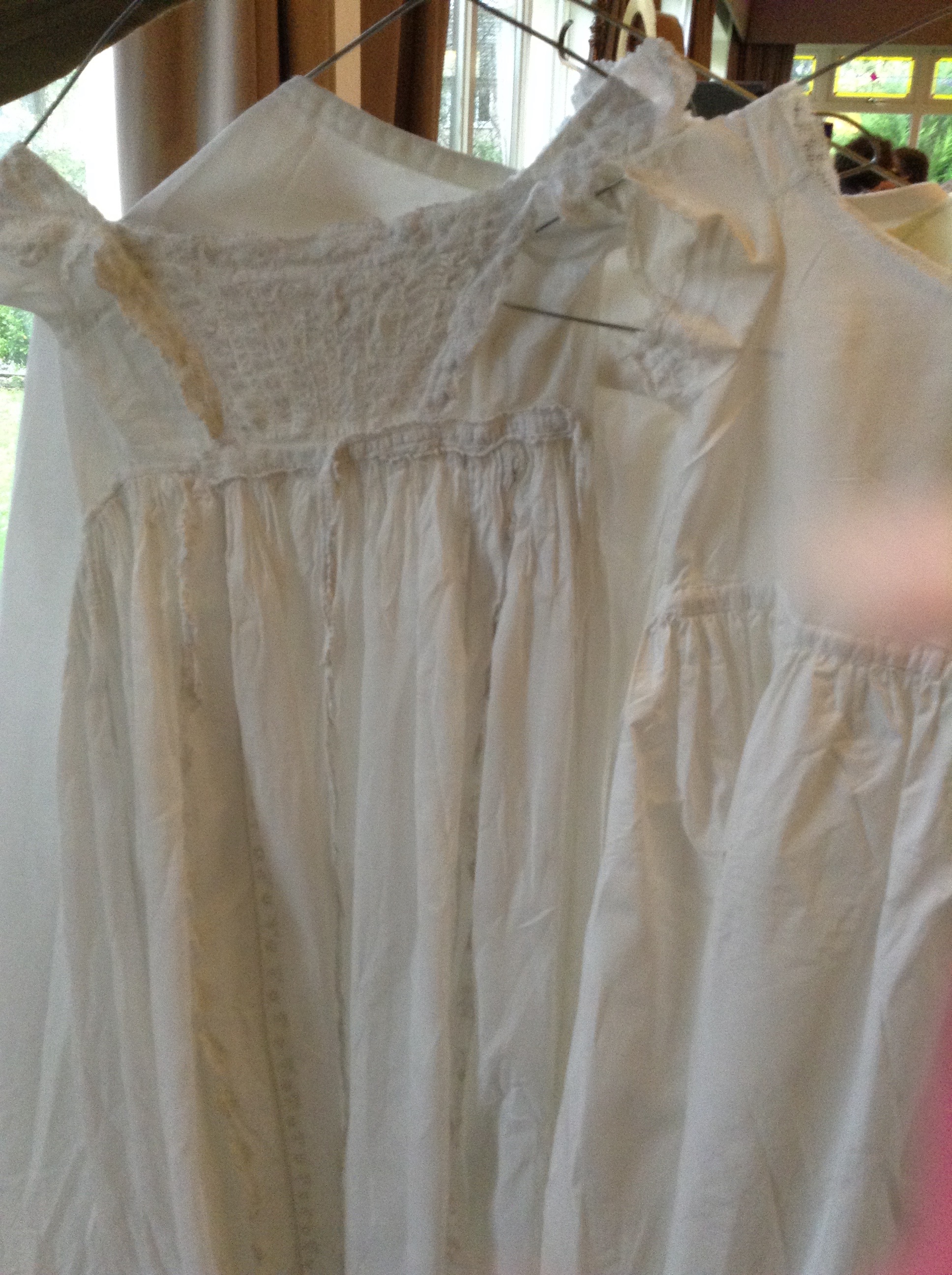
Nightwear from the time Emily attended school

Nightwear from the time Emily attended school

A Bible and prayer book
1 Best summer dress
2 Calico do
1 Best winter do
1 Everyday do
3 Day chemises
3 Night do
3 Night nets
12 Pocket handkerchiefs
2 Bodices or stays
3 Flannell petticoats
2 White or colour do
1 Dark warm do
3 Calico bodices
2 Aprons (Black alpaca)
2 Pairs of house shoes
2 Pairs of strong boots
6 Linen collars or frills
3 Pairs of woollen stockings
4 Paris of cotton stockings
2 Brush-bags
1 Warm lined Dressing Gown
1 Calico Dressing Gown for summer (Every article to be marked with indelible ink – the name in full)
Winter and summer gloves of each (2 paris)
Comb and brushes
Work box and writing case, thimbles and scissors
1 Umbrella, 1 clothes brush and 1 sponge
Boots bought when needed and repaired will be charged in the quarterly accounts

Sources:
Clergy Daughter’s School Reports 1868 – 1886. Courtesy of RCB, Church of Ireland Library, Dublin
Thanks to my good friend Maureen Rose Rendell for sharing her photos and research into costume with me