Educating Emily 2

The Clergy Daughter’s schools were charitably funded making it possible for Miriam and Emily to attend. There they would have received a top education for the time, in some ways on a par with today’s standards. In a letter to the newspaper in 1860’s the committee of the school made an appeal to the public to support the school. They bandied around the terms Christian sympathy and public benevolence to appeal to peoples better nature encouraging donations. They put forward the fact that some of the girls attending had lost at least one if not both parents, such was the case of Emily and her sister.

Earlsfort Terrace, Dublin, where Emily attended school in the 1870's and 80's.

Earlsfort Terrace, Dublin, where Emily attended school in the 1870’s and 80’s.

Both the Rev Burke and his wife died in 1883, leaving their four children without a guardian or much financial means. The charitable organisation of the Clergy Daughter’s School would have offered the girls an education now that they were alone in the world and had to provide for themselves in those times. The boys would have attended the male equivalent.

The annual report of 1883 of the Clergy Daughter’s School, the time Emily and her sister Miriam where pupils there stated:

10 pupils were admitted, three of which were orphans. In the course of the past year eight pupils left the school, and eight were elected to fill their places. One of those at present on the books thirty one in number or has neither father nor mother; three have lost their mothers, and four have experienced the heavier affliction of being deprived of their fathers, having lost withe them their chief means of support. In no case except two at present in the school, does the proportion of income to each member of the family reach £30 per annum.

It might be interesting to mention, as evidence of the utility of the Irish Clergy Daughters’ School, that many of those who have received their education within its walls have subsequently supported themselves by teaching others. From a tabular statement, recently drawn up, it appears that, within the last fourteen or fifteen years, eleven obtained appointments as governesses in various families, and five others performed the important duties of the same office towards their younger brothers and sisters, on their return home.

The Burke children received a great education at these schools, enabling them all to lay down the foundations for a self-sufficient life. Richard trained as a bank clerk, and secured a position The Bank of Ireland in Clonmel, Co. Tipperary. Her other brother John Jasper emigrated to Australia as did her sister Miriam. Emily’s education at the Clergy Daughters’ School would certainly have laid down the foundation for her nursing career.

Sources
Dublin Evening Mail 30 March 1863

Educating Emily

Emily attended the Clergy Daughter’s School on Earlsfort Terrace, Dublin. She may have began her education there when she was ten years old, the entrance age.

Untitled (1)

Clergy Daughter’s School

Established in 1843 and incorporated by scheme of the Education Endowments Commissioners, 1894 the school was situated on Earlsfort Terrace, Dublin and shared premises with Alexandra College. Its object was to assist the clergymen and families of clergymen with limited means in the education of their children. The School catered for girls aged ten to eighteen whose fathers were Church of Ireland clergymen. The school closed in 1969. The site in Earlsfort Terrace was sold and the funds used to support boarding at Alexandra College and elsewhere.

 Sources
Dublin Evening Packet and Correspondent14 July 1853
Clergy Daughter’s School Reports 1868 – 1886, courtesy of Church of Ireland RCB Library, Dublin


Emily Alone

Over the course of five years Emily had lost both of her full brothers in quick succession and her only sister, Miriam had emigrated to Australia, married and had her own family.

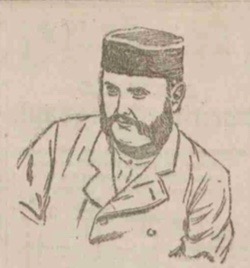
To make matters worse around the time of Richard’s sickness and subsequent death there was another family tragedy unfolding across the water in Yorkshire, England. Her half brother, William Henry’s life had spiraled into chaos, too horrific to imagine. He had lived a somewhat privileged life as a a doctor, but he had difficulties too and drank heavily, loosing his family as a result. He got lost in his own sadness and died in 1889 at the age of only 43.

Emily's brother, William Henry

Emily’s brother, William Henry

This final blow must have hit Emily hard, but somehow she overcame this horrible period in her young life. It is possible that she got help and guidance from the Revell/Joly family, who were known for their generosity.

In 1893, at the age of 25 she began her training in Sir Patrick Dunn’s Hospital in Dublin as a nurse.

Sources
The York Herald Tuesday November 26, 1889
The Sheffield Evening Telegraph, Monday, February 6 1888
Thanks
Thanks to Mary Revell Dinnin, for sharing her family history with me.


The Short Life of John Jasper

IMG_0242

John Jasper Joly Burke, like his brother Richard died when he was 23. The above rather poignant notice appeared in the Births, Death and Marriages column of the Bendigo Advertiser on the morning of  Friday 26th May 1893.

BURKE: At Bendigo, Victoria, John Jasper
Joly youngest and last surviving son of the late Rev.
William John Burke, Rector of Castlcjordan, Co Meath,
Ireland, in his 23rd year.

The advert placed by the undertaker, requested that his friends follow the funeral cortege to Bendigo Cemetery, it did not mention family.  When John Jasper died his nearest relative was his  sister Miriam who lived in New South Wales, which at the time was days away from Bendigo. His only other relative was Emily, who was at the other side of the world. Miriam may not have made the funeral, that was the sad reality of those that died in the colonies in those days.

It is likely that john Jasper died in an accident, the most probable being a mining mishap. However his name does not appear in the well kept records of Bendigo mining casualties. He may even have even succumbed to a tropical disease, that his constitution was not able to cope with.

John Jasper is laid to rest in Bendigo Cemetery the record book contains the following information:

Internment number 12656 is John Jasper Burke, 23 years of age, funeral 26 May 1893 in Monumental section L4 at Bendigo Cemetery. Religion Church of England , last address was Ironbark. (a small community approx 2 kms from the heart of Bendigo .) Have located the grave on the maps, no headstone at present.

Emily and Miriam Sophia were now the last of that branch of the Burke family. They never met in person again, Emily never visited Australia and Miriam never returned home.

Sources
Bendigo Advertiser (Vic. : 1855 – 1918), Friday 26 May 1893, page 4, National Library of Australia.

The Sydney Morning Herald (NSW : 1842 – 1954). Mon 29 May 1893. P1. National Library of Australia


With thanks

Bendigo Cemeteries Trust

John Jasper Joly Burke leaves for Australia

Down Under

Like his older sister Miriam, John Jasper emigrated to Australia. John J Burke aged 21,    disembarked from the Oceania at Sydney Harbour 24th June 1890. His sister Miriam arrived two years before in 1888 and settled in  New South Wales. John Jasper may have joined her for some time but eventually left for Bendigo, formerly Sandhurst, in the state of Victoria.

Just about the time John Jasper arrived the town was in it’s second flush of prospering from the mining industry. Gold was struck in 1851, and later quartz was found. It was no longer a temporary structured town more substantial structures were being built. There was a variety of employment choices for young men.

John Jasper may not have intended to stay at Bendigo for long because, records show that he was boarding at the Fifeshire Hotel rather than at a more permanent address. The hotel was in Ironbark, a small community, about two Kilometres outside Bendigo town.

Sources
Ancestry.com. New South Wales, Australia, Assisted Immigrant Passenger Lists, 1828-1896 [database on-line]. Provo, UT, USA: Ancestry.com Operations Inc, 2007.
http://www.bendigohistory.com/review.shtml
Bendigo Advertiser (Vic. : 1855 – 1918), Friday 26 May 1893, page 4. National Library of Australia