Collins issued the following press release: ‘The Members of the Provisional Government received the surrender of Dublin Castle at 1.45 pm today. It is now in the hands of the Irish nation’.
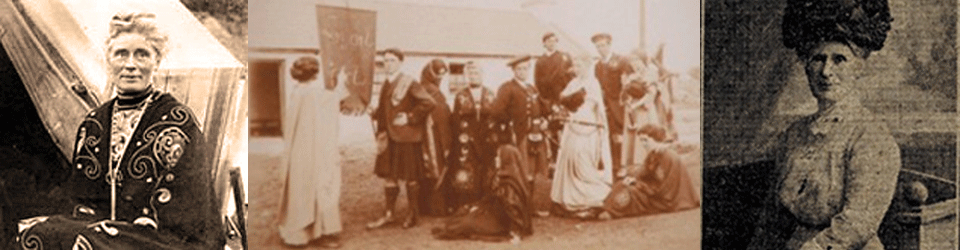
If Emily was in the crowd that day, it was only to have the pleasure of seeing a foreign power leave, and certainly not in support of the Irish Free State instead the Republic proclaimed on the steps of the GPO in 1916.
One Hundred years ago today the Anglo Irish Treaty was ratified by Dail Eireann. It was signed in London on December 6th 1921, by a negotiation team of Michael Collins, Arthur Griffiths, Arthur Robert Barton, Eamonn Duggan and George Gavan Duffy. When they made the return journey to Dublin they did so with heavy hearts knowing well that it would spit political and public opinion.
Eamon de Valera, who had refused to travel to London as part of the delegate rejected it completely, as did many other Dail members. Democratically the terms of the Treaty was opened to debate inside the Dail chambers. Tempers flared, members quit and the discussion continued throughout Christmas 1921 and into the first week of the New Year. On January 7th, the matter finally went to vote, resulting in the Treaty being ratified by a very slim margin of 64 to 57.
Emily along with the majority of Cumann na mBan rejected the terms of the Treaty completely. A convention to for early February to; “reaffirm their alliance to the Republic of Ireland”. At the convention every member cast their vote. A staggering eighty six per cent of members were against the Treaty.
(https://www.rte.ie/history/the-ban/2020/0401/1127789-cumann-na-mban-a-photo-essay/) Cumann na mBan. Copy Agenda of the Cumann Na MBan Special Convention.
On this day 1976 RTE aired a documentary about Three Candles Press on Radio na Raidio na Gaeltachta. Founder, Colm O’Lochlainn was one of the original members of Scoil Acla and a friend of Emily’s. In 1926 he founded Three Candles Press. Each candle represented one of the principles of truth, wisdom and knowledge. The business, was ahead of its time in the way it put the quality of its work and care of its employees ahead of profit.
His real love over printing and the politics of the Revolutionary period, which he was involved in for a time, was music and the collection of Irish Ballads, which he made his life’s work. Along with his friend Seamus Ennis, contributed greatly to the collection and retention of tunes that may have, without their intervention have got lost in the mists of time.
Sources
William Gerard O’Loughlin was born in Dublin on the 11th of October 1892. His father John O’Loughlin was a travelling sales representative for a printing company. His mother was a Delia (Bridget) Carr from Limerick City whose family were wealthy and in the printing business...Read more
After the Easter Rising more than 3,000 were arrested for their part or their supposed part. One was Emily, who was held on Remand at Tullamore Gaol for a week, for “…acting in such a manner as to give reasonable grounds for suspecting that she was about to act in a manner prejudicial to the Defense of the Realm”. The Act was passed when WWI broke out in 1914 to control communications at the ports around Britain and Ireland, and subject civilians to the rule of military courts. It was also under D.O.R.A the leaders of the Rising were tried and condemned to death under. Those who were not given the Death Penalty, were given various sentences, the more extreme rebels were sent to prisons across Britain, such as Emily’s friend Darrell Figgis. One such prison was Frongoch in Wales.
The abandoned distillery was repurposed as a prisoner of war camp during WWI
Frongoch, an abandoned distillery was initially used to house prisoners of war. It was sort of repurposed as a detention centre for prisoners of the Rising. The camp comprised of cold, dank, rat infested huts, equally if not more dismal than prison cells. The internees only real comfort was that they were free to mix and mingle with one another. Nevertheless they overheated in the summer and frozen in the colder months of late autumn and early winter, but were ‘saved by the bell’ when they were released just before Christmas 1916 otherwise some may have perished during coldest time of the year. As early as the summer Irish MP, Mr. Ginnell put it to the Home Secretary whether the food given to the Irish prisoners was sufficient for the healthy young countrymen. Mr. Samuel replied; “The diet is identical with that supplied to military and naval prisoners of war and is amply sufficient to keep the prisoners in good health”. It was not. But the Committee of the Irish National Aid and volunteer Dependents’ Fund, which Emily collected and gave generously to, intervened. They set out to make sure that the internees were not deprived of ‘celebrating’ “Hallow Eve”. They put the notice below in the newspapers:
The picture below appeared in the Illustrated London News in July 1921. If the photograph had background noise it would have been the low pitched chant of the Rosary, which was in fact recited when it was taken. The prayerful crowd of men, women and children had assembled outside the Mansion House, Dublin to petition the heavens for peace after a long drawn out war which had claimed the lives of nearly 2,000 over its two and a half year duration. Inside the delegates from both sides were deep in negotiation to determine Ireland’s future.
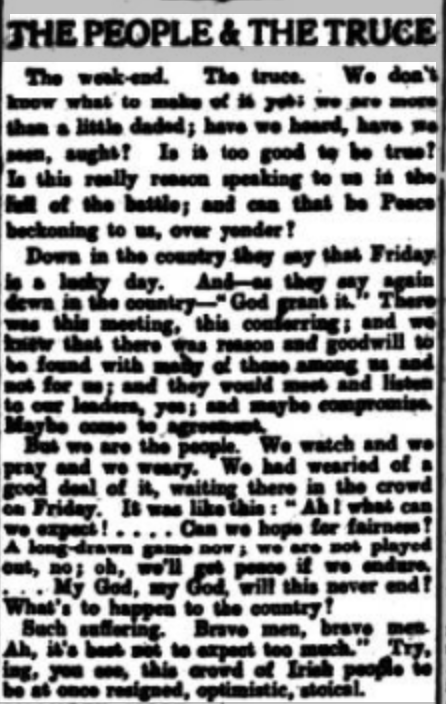
At midday on Monday July 11th 1921 the the Truce between the IRA and the British Crown Forces came into effect. The cease fire had been negotiated a week before on July 4th, between Eamon de Valera and Arthur Griffith on the Irish side and representing the British was the leader of the British Army in Ireland, Neville Mcready. The Truce was officially announced on July 8th, allowing a week for both sides to lay down arms. In its own way the Truce was a small victory for the Irish side as Britain had never acknowledged that they were at war with the country. They viewed the situation more as a series of violent ambushes and killing by the ‘murder gang’ not the official Irish Republican Army. The Truce validated the fact that a war had taken place, which in turn was a minor victory for the IRA, which would have boded very well with Republicans like Emily.
The general public breathed a sigh of relief. For the first time in a long time they could go about their daily business without the specter of violence looming on the streets. The sporadic turned frequent echoes of gunfire on the streets of Dublin and larger urban centres would fall silent replaced by the more natural sound of human traffic and children playing.
When the ceasefire was announced, it was met with great cheer, and just a little superstition. “Friday is a lucky day they say down the country”. More took a more prayerful view; “And they say again down the country God grant it”.
In Dublin there was a air of festivity with the sounding of sirens on the docks, workers given the day off and children were encouraged to celebrate.
“Back in Ireland, midday on 11 July 1921 was also being marked. At Dublin Port, for instance, American and British steamships signalled support for the truce by sounding their sirens, while many workers, including over 300 corporation labourers and 1,600 men at the Inchicore railway works, were let off from their workplaces, released to enjoy a Monday afternoon in the midst of a July heat wave. Some Dublin schoolchildren were similarly indulged.”
Retail and business took advantage of the festive mood in the hopes that the new lease on life would bring in customers. Some shops even offered special ‘Truce’ discounts on clothing. Their advertising campaign suggests that their clothes would be perfect attire to were to Truce celebrations!
Sources
A Truce? Ireland’s Own, Centenary Souvenir Edition 1921 2021; by Eoin Swithin Walsh.