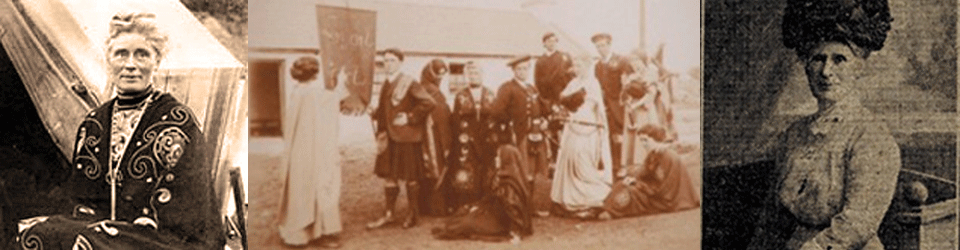
Category Archives: Friends

The Burning of the Custom House

On May 25th 1921 around lunch time the IRA launched their most grandiose attack of the War of Independence, the taking of the Custom House Dublin. The carefully planned attack was months in the making, carefully crafted to serve two main purposes, to attack the second most important centre of British administration in Ireland and to attract the attention of the international media. The attack was successful on both accounts, but it was also counterproductive on many accounts too.

Second to Dublin Castle the Custom House was the most important centre of British administration in Ireland. The strike at it was chosen over the taking of Beggar’s Bush Barracks, the Auxiliary Police Headquarters, because it was there were too many armed police, and a full scale battle would surely ensue. The Custom House was easier to take and there was a much lesser chance of instant bloodshed.

A few months earlier the at the home of the late The O’Rahilly, who died during the Easter Rising, in 40 Herbert Park a special meeting was called by senior IRA figures. In attendance were Michael Collins, Eamon de Valera, Cathal Brugha, Austin Stack, Richard Mulcahy, Liam Mellows, Piaras Béaslaí and the Commander of the IRA’s Dublin brigade, Oscar Traynor. Eamon de Valera, who had just returned from America, where he had made an impression on the Irish diaspora there, was determined to create a sensational attack to force the British side in further negotiations and attract international attention to the Irish campaign for freedom.

In the early afternoon of May 25th 1921, more than a hundred plain clothed IRA members gathered about the Custom House waiting for the signal to carry out orders. Many of the assembly were, passionate and enthusiastic but they were also young, inexperienced and unarmed and not fully equipped to carry out the task at hand. The limited ammunition was consigned to small group who were more experienced in guerrilla warfare.

Under the command of Tom Ennis, they entered the Custom House and overpowered the guards, while outside a lorry complete with all the necessary equipment to set the great building alight. In the chaos the caretaker was killed while he tried to raise the alarm. But word got out anyway, and within minutes the British forces arrived. A gun battle, that was hoped to have been avoided ensued. The IRA didn’t stand a chance with the better equipped British Military. Nine lives were lost including a boy of seventeen, who had joined the IRA. Mass arrests were made, depleting the Irish side of troops and valuable ammunition. The whole operation was not considered a Republican success, however it did achieve attracting the attention of the international media.

The Custom House burned for ten days in total, helped on by the fact that many of the Dublin Fire Brigade sided with that of the Republicans and many were members, who purposely delayed quenching the fire. There was also a sort of victory in the destruction of a sizable amount of the documents of the British administration in Ireland, almost all of the rest would go up in flames when the Four Courts were burned a year later.

Sources

MAY 25: Burning of the Custom House 192, Kilmainham Tales, Liz Gillis

https://www.rte.ie/news/2021/0522/1222440-custom-house-burning/

https://kilmainhamtales.ie/kts-01-may-25—burning-of-the-custom-house-1921.php

https://www.theirishstory.com/2012/05/23/today-in-irish-history-the-burning-of-the-customs-house-may-25-1921/#.YKwPhB17lsM

Freeman’s Journal 28 May 1921

Freeman’s Journal 26 May 1921

https://www.irishtimes.com/culture/books/arresting-and-rare-images-of-dublin-in-revolt-1918-23-1.3721029

Poets in Prison

In March 2021 a painting of an inmate escaping from Reading Gaol, appeared on the former prison . Entitled ‘Create Escape’, it depicts an inmate in the process breaking out by sliding down sheets of paper instead of traditional bed sheets tethered together and anchored at the end by a typewriter. The artist, who identity has never been identified, confirmed the work was his by a video on his website: https://www.banksy.co.uk/

The prison, closed since 2014, has been vacant since. Banksy’s involvement suggested he was backing the campaign to save the prison, according to Reading Borough Council. Who commented: “We are thrilled that Banksy appears to have thrown his support behind the council’s desire to transform the vacant Reading Gaol into a beacon of arts, heritage and culture with this piece of artwork he has aptly called Create Escape. Reading Gaol’s possible future incarnation as an arts or heritage centre, would make for a perfectly fitting continuum and nod to its past creative inmates, such Oscar Wilde.

Oscar Wilde at his trial in 1895

“In 1895, Oscar Wilde (1854–1900) was found guilty of ‘acts of gross indecency with other male persons’ and sentenced to two years’ hard labour. He was sent first to Pentonville, then to Wandsworth and finally to Reading Gaol.”

https://www.bl.uk/collection-items/the-ballad-of-reading-gaol-by-oscar-wilde#

After he was released in 1897 Oscar Wilde, made his way to France where he settled in Dieppe. It was there, that he penned his famous poem, The Ballad of Reading Gaol. It was there that he died in 1900 without ever returning to Ireland.

Poet and writer, Darrell Figgis was also an inmate at Reading Gaol. Incarcerated for his part in the Easter Rising, even though he was miles away at his writer’s refuge on Achill Island. As a person of interest to the authorities since his part in the Howth Gun Running of 1914, he was arrested under the Defense of the Realm Act 1914. He was taken to Castlebar Jail, from there transferred to Richmond Gaol in Dublin before been sent to Stafford Gaol and then on to Reading Gaol, where he remained until the end of 1916. During his incarceration in the many jails he produced poetry and his prison diary, The Chronicle of Jails. Like Oscar Wilde he too was struck by former inmate, Charles Thomas Wooldridge a trooper in the Royal Horse Guards, who hanged for the murder of his wife. Wilde wrote the Ballad of Reading Gaol which describes the hanging.

“It was an amazing sight. There were not merely flowers, a sight astonishing enough in itself; there was a prodigality of flowers. Then some of us remembered the cause. One of the graves unlocked the secret. It was marked with the letters C. T. W., and the date, 1896, to whom Oscar Wilde’s “Ballad of Reading Jail” had been inscribed, and in celebration of whose passing the poem had been penned.”

A CHRONICLE OF JAILS 1918

Sources

https://news.sky.com/story/banksy-artist-admits-escaping-inmate-artwork-on-former-on-reading-prison-wall-is-his-12235939

https://www.banksy.co.uk/

https://www.bbc.com/news/uk-england-berkshire-56243680

Cardiff Times 06 April 1895

https://poets.org/poem/ballad-reading-gaol

https://www.bl.uk/collection-items/the-ballad-of-reading-gaol-by-oscar-wilde#

https://www.theguardian.com/culture/2016/apr/21/easter-rising-jailer-singing-letter-reading-gaol

Figgis, Darrell, and William Murphy. A Chronicle of Jails. Dublin: University College Dublin Press, 2010.

Illustrated London News 17 February 1844

Darrell Figgis’ House is Raided

As the Anglo Irish War raged on and the violence escalated houses of known and suspected Republicans were searched by by the British Military. They literately, knocked on and in some cases knocked down doors hoping to throw a spanner in the Republican works. If nothing if interest was uncovered or any arrests were effected they turned their attentions on ordinary civilians. On the night of February 25th 1921 the military were particularly active in Dublin.

Dublin Evening Telegraph 26 February 1921

There was great military activity in the city last night. About 7 o’clock 4 armored cars passed through Westmoreland Street, flashing searchlights on pedestrians on each side of the roadway. Between 8 and 10 o’clock Crown forces were particulary active in Dawson street. Several houses were visited but as far as it known no arrests were effected. In on house searched near the Stephen’s Green end of the street, some books and papers were thrown from an upper window.

Dublin Evening Telegraph 26 February 1921

Darrell Figgis was not arrested, but his wife Millie, was hauled off to Dublin Castle and interrogated for about an hour. Finding and hearing nothing of interest the RIC released Millie without charge. Darrell Figgis was safe up the Dublin Mountains at the time, staying with their friend Mrs. Fox, as was Commissioner, Kevin R. O’Sheil, who like the Figgis’ was avoiding detection by the Crown Forces. Millie who was less of a suspect made the journey to the city every day to check on their property. Every night she returned with the same story. More leaders home were ransacked, but their remained untouched. Figgis was put out about the fact that his house was ignored when others were targeted. Until one day Millie came back flushed and excited as O’Sheil remembered in his witness statement many years later;

“The week of raids and arrests had nearly elapsed, the flat of Figgis in Kildare Street untouched and unharmed, when Milly arrived one evening, her face glowing with pride and excitement, “Darrell, we’ve been raided! They’ve pulled your books about and made an awful mess. something dreadful.”

BMH.WS1770 Section 5

Millie didn’t make too much of a fuss about her arrest, treating it as a matter of course, just like the raid. She was the latest of Emily’s friends, who found themselves at the mercy of the Crown forces.

Sources

Londonderry Sentinel 26 February 1921

Freeman’s Journal 26 February 1921

Dublin Evening Telegraph 26 February 1921

BMH.WS1770 Section 5

“Achill Lady” in Galway Goal

Anita Serves her Sentence

“So on this 19th day of January 1921 they took us back to Galway Fail which now admitted both of us. In the jail we fund another political prisoner, Miss Anita MacMahon, of a writer and a worker for Land Reform in Achill. She had been there for some time a and showed the signs and strain of imprisonment”. Alice M Cashel, recalled in her witness statement decades later. Anita was more than half way into her six month sentence for possession of seditious documents.

Anita who was used of having more freedom than most in her time must have found incarceration very difficult. Moreover, she had to endure being locked up while her friends were free and able to participate in the war against the British forces. Emily would have visited her if at all possible, although it may have been difficult for her to leave Dublin while she was working as a nurse or traveling when nearly every train was held up due to ambushes, searches and sometimes violent attacks. The latter would have been less of a problem for Emily than missing work.

Sources

WS Ref #: 366 , Witness: Alice M Cashel, Member Cumann na mBan, Galway; Vice-Chairman Galway County Council, 1920-1921

London Daily News 05 March 1921

Sheffield Independent 03 March 1921

Anita McMahon gets Sentenced in Galway

One hundred years ago, Emily’s friend Anita McMahon gets sentenced in Galway District Court, after being charged before a court-martial, the previous month. Anita stood silently before the jurisdiction, and was not represented by a lawyer, as she refused to recognise the court in which she was brought before, a British Court. Her address was given as Keel, Achill.

Keel, Achill where Anita McMahon was arrested in 1920

Anita was arrested on September 30th at her home, where a copy of the West Mayo Brigade Orders, the local Branch of IRA, dated 10th September. Among the documents were a pamphlet entitled “The Faith and Morals of Sinn Fein” and various other papers that were considered seditious. A week or so later the house, which was by then under surveillance by the local RIC (Royal Irish Constabulary), was searched again. More ‘seditious’ papers were found, this time a typewritten sheet, containing subversive phrases, enough to have Miss McMahon, hauled off to the local RIC station, possibly at Dugort or Achill Sound and then on to Galway.

Sources

Irish Times 15 November 1920

Irish Times 13 November 1952