Category Archives: History

Personal Effects

After the death of his daughter and subsequent arrest, Dr. Burke’s wife and young son left their marital home. Who could blame them for leaving the memories the house must have held. Dr. Burke’s wife went to live with her family, the ones she fled to so often when their marital problems became unbearable.

An advert was placed in the local papers announcing the sale of contents of the house. For the time the items for sale would be a good bargain for anyone who could afford them. They bore testimony to a lifestyle that was out of range for most, seeming desirable but the grim reality was something else. The auction offered 45 framed photographs, along with ones of his wife and children, perhaps there was one of his half-brothers and sisters, Emily included. It is hard to imagine who would want such items after they knew the circumstances of why they went up for sale, but it was Victorian times, personal effects were lesser and life harder with little room for sentiment.

It appeared from the notice below that many if not all items were sold due to the great turnout for the sale. “There were many spectators”, stated the article, not at all surprising as people had a morbid fascination with such thing particularly in that era.

Sources
17 March 1888 – Sheffield Daily Telegraph – Sheffield, South Yorkshire, England
Sheffield Daily Telegraph 20 March 1888

Evidence

Dr Burke cut a sorrowful figure when he appeared in the dock for his trial. As the newspaper article below states he had suffered terribly since the horrific death of his daughter. Emily’s brother stood accused of the murder of his daughter, Aileen aged only eight and his own attempted suicide, a crime at the time and remained so until 1961.

“From the middle of the 18th Century to the mid-20th Century there was growing tolerance and a softening of public attitudes towards suicide which was a reflection of, among other things, the secularisation of society and the emergence of the medical profession,” says Dr Wright, co-author of Histories of suicide: International perspectives on self-destruction in the modern world.

The Judge Mr. Williams who precised over the trial took the above more sympathetic attitude. It was bad enough that Dr. Burke delivered the shot that would leave his young daughter dead. From a modern point of view the man was not in his right mind, further evidence would prove so, but at that time it was not fully understood, although it was perceived to a degree.

Sources
Sheffield Evening Telegraph 26 March 1888
http://www.bbc.com/news/magazine-14374296

The Trial of Dr. Burke commences

A view of the town of Barnsley in the time of Dr. Burke

On March 27th 1888 the trial of Emily’s brother William, for the murder of his daughter  commences. Dr. Burke who was deemed medically fit for trial is taken to court in Barnsley. Far from fit he really was. Recovered from danger he may have been but mentally he was not really in any state to stand trial, but it was Victorian times and mental health was not considered then. Nonetheless he was brought to the the courthouse where outside a less than supportive crowd had gathered….

Sources
Sheffield Evening Telegraph 26 March 1888
Western Daily Press 27 March 1888
Illustrated London News 07 March 1857

Dr. Burke’s College Days in Galway

William Henry Emeris Burke attended Queen’s College, Galway as a medical student from 1863 to 65. At the time the College was less than 20 years in existence and medical studies had just been introduced.


William excelled  academically, was a talented musician and played cricket too. He had one disadvantage his father, Rev. Burke had not the means to finance his education. The Reverend had just married his second wife, Emily’s mother. She was financially independent after inheriting  from her late mother and brother, but that was tied up in land in Canada. She was also expecting her first child and in a poor position to help with her stepsons education. Luckily there were scholarships to help students that had a promising future, of which William Burke was one.

Sources
The Evening Freeman. 03 October 1863
The Evening Freeman. 22 September 1863
Tuam Herald 10 September 1864
D366/822 psi@nationalarchives.gsi.gov.uk

St. Patrick’s Day 100 Years Ago

St. Patrick’s day 1918 fell on a Sunday, it was still war time, so the celebrations were kept to a minimum. The official holiday was only fifteen years in existence, since it started in 1903. Drinking alcohol was allowed on St. Patrick’s Day in 1918, it was banned in 1927 till the 1970’s when the population was again free to indulge in “the drowning of the shamrock”.

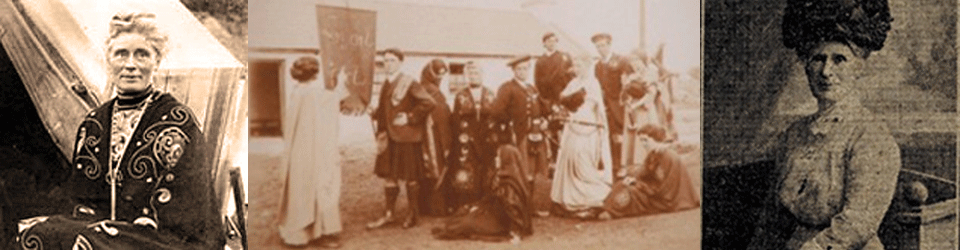
Some prominent people were against drinking on the holiday, including Countess Markievicz who was opposed to drinking, as she put it:

“I do not see why rich people should not be kept off their drink as well as poor”.

James O’Mara the Irish MP, in Westminster, who introduced the bill later opposed any drunken revelry, citing that it was “a direct insult to the Saint”. The Gaelic League were pro preserving the day as a dry holiday too.

The holiday went ahead on Achill, where it was celebrated since 1882:

“When the local clergy called for a special effort to be made on Saint Patrick’s Day 1882 to celebrate fourteen and a half centuries of the arrival in Ireland of Saint Patrick 432 A. D. the Dooagh musicians and their members from Keel decided to parade to Mass at Dookinella, the only church in Lower Achill. The people who normally walked to Dookinella anyway, paraded behind the Band. The first Parade was such a success that the custom has continued ever since.”

More fact about St. Patrick’s Day

Sources
Weekly Freeman’s Journal 16 March 1918
https://www.independent.ie/entertainment/festivals/st-patricks-day/17-things-you-didnt-know-about-st-patricks-day-26713114.html
As Time Marches On; A Brief History of Dooagh Pipe Band 1882-1982, J.J. McNamara & J. McNamara N. T.